How Astra 19.2°E Became Europe’s Main TV Orbit

Estimated reading time: 17 minutes.
Astra 19.2°E is not just another satellite position. It is the reference point of European television. Millions of households receive daily broadcasts through this single orbital slot. This article explains how Astra 19.2°E became Europe’s main TV orbit and why that position remains central to broadcasting today.
Quick Context
This article focuses on structure and distribution rather than channel lists. It explains how one orbital position gradually turned into the backbone of European satellite television.
- The Early Days of European Satellite TV
- Why Orbital Position Matters
- How Astra Created a Market Standard
- From Broadcasters to Households
- Building a Reliable Distribution Network
- The Economic Logic Behind 19.2°E
- Why Other Orbits Could Not Replace It
- Reality Check
- Final Verdict
- Frequently Asked Questions
The Early Days of European Satellite TV
Before satellite television, European broadcasting depended heavily on terrestrial networks. Coverage was limited. Cross border distribution was complex. Expansion was slow.
The introduction of Astra satellites changed this structure. A single orbital position could serve multiple countries simultaneously. This efficiency made satellite delivery economically attractive for broadcasters.
Why Orbital Position Matters
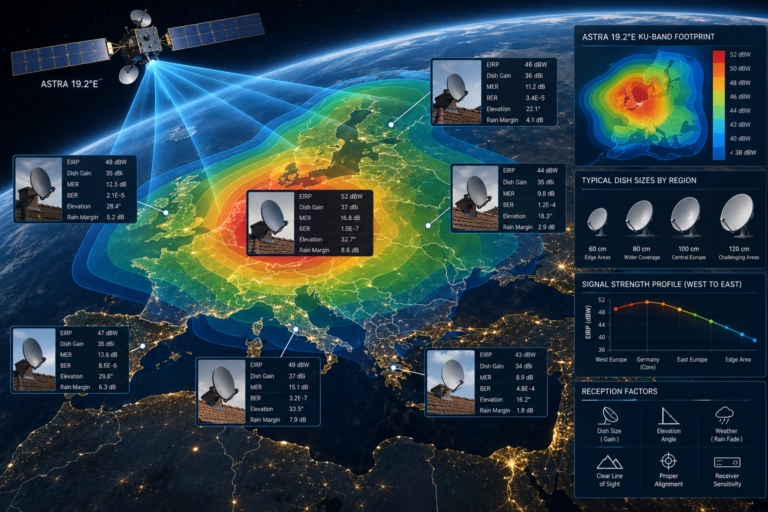
An orbital slot is not just a location in space. It defines signal stability, dish alignment, and long term reliability.
Astra 19.2°E offered a balance between coverage and technical simplicity. Installers could align dishes easily. Households could maintain reception with minimal adjustment.
Standardization is the silent driver of mass adoption.
How Astra Created a Market Standard
By concentrating major broadcasters on one position, Astra created familiarity. Viewers did not need to understand satellite mechanics. They only needed to know where to point the dish.
This concentration reduced fragmentation and increased confidence for both broadcasters and consumers.
From Broadcasters to Households
As more channels joined 19.2°E, installers began offering it as the default option. Retailers recommended it. Manufacturers optimized equipment for it.
Gradually, Astra 19.2°E became the normal television orbit in Europe.
Building a Reliable Distribution Network
Behind the scenes, Astra invested in uplink stations, redundancy systems, and orbital control. Reliability built trust. Trust built scale.
The Economic Logic Behind 19.2°E
Concentration lowers cost. Shared infrastructure reduces transmission expenses for broadcasters. This economic efficiency reinforced adoption.
Why Other Orbits Could Not Replace It
Alternative positions existed, but fragmentation increased complexity. 19.2°E benefited from early momentum and long term stability.
Reality Check
Astra 19.2°E did not become dominant by chance. It combined technical simplicity, economic efficiency, and market standardization.
Final Verdict
Final Verdict
Astra 19.2°E became Europe’s main TV orbit because it solved distribution at scale. It reduced complexity for viewers and broadcasters while offering stable long term performance. That combination remains difficult to replace.
Frequently Asked Questions
| Question | Answer |
|---|---|
| Why is Astra 19.2°E so important for Europe? | Because it concentrates a large number of broadcasters on one stable and widely supported orbital position. |
| Is Astra 19.2°E still relevant today? | Yes. It remains a primary distribution backbone for European satellite television. |
| Can other satellites replace it? | Replacement is difficult because market habits and infrastructure are deeply established around 19.2°E. |
| Does this orbit affect home installations? | Yes. It simplifies dish alignment and long term reception stability. |