Astra 19.2 No Signal German Channels Fix
Estimated reading time: 14 minutes.
“No signal” on German channels while using Astra 19.2 is one of the most common problems in satellite TV setups. It often appears suddenly and can affect either all channels or just a specific group. Many users assume the dish has stopped working completely, but in most cases, the issue is more specific and easier to diagnose.
The key to fixing this problem is understanding how the signal flows from the satellite to your receiver. Once you know where the signal can fail, you can identify the exact cause instead of guessing. In this guide, we will break down the real technical reasons behind “no signal” and how to fix them step by step.
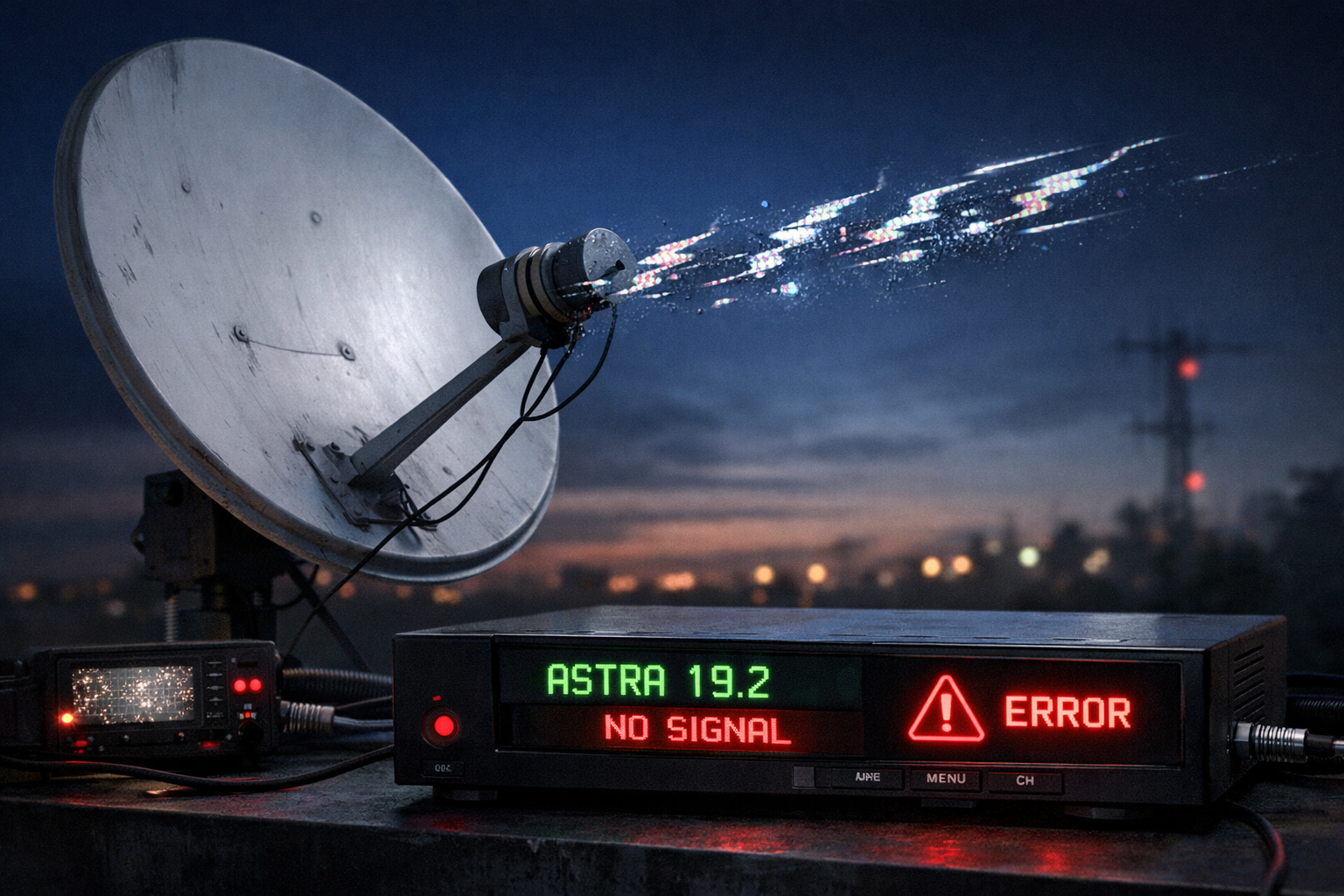
“No signal” does not always mean total signal loss. It usually means the receiver cannot lock onto a specific transponder. This can be caused by dish alignment, LNB switching issues, wrong frequency data, or weak signal quality.
- What “no signal” really means
- Full signal loss vs partial channel loss
- Dish alignment and pointing errors
- LNB switching and band selection issues
- Receiver tuning and configuration problems
- Signal quality vs signal strength
- Cable and connector failures
- Weather and environmental effects
- Analytical diagnosis table
- Step by step fix guide
- FAQ
What “no signal” really means
When a receiver shows “no signal,” it does not always mean the dish is completely disconnected. In technical terms, it means the tuner cannot lock onto the required signal parameters.
This could be due to missing frequency lock, low signal quality, or incorrect tuning data. The receiver needs a clean and stable signal to decode channels. If that condition is not met, it displays “no signal.”
Understanding this difference is critical. The system may still be receiving some signal, but not enough to decode it properly.
Full signal loss vs partial channel loss
Full signal loss affects all channels. This usually points to major issues such as dish misalignment, disconnected cable, or LNB failure.
Partial signal loss affects only specific German channels. This is more common and usually indicates a problem with a specific transponder, frequency band, or polarization path.
Recognizing this difference helps narrow down the cause quickly.
Dish alignment and pointing errors
Dish alignment is one of the most critical factors in satellite reception. Even a small misalignment can reduce signal quality enough to cause “no signal” errors.
A slightly misaligned dish may still receive strong transponders but fail to lock weaker ones. This creates selective channel loss.
Fine tuning the dish position can often restore missing channels without changing any hardware.
LNB switching and band selection issues
The LNB selects frequency bands and polarization using control signals from the receiver. If this switching fails, certain channels will not be received.
For example, if high band switching does not work, all channels in that band will show “no signal.” The same applies to polarization switching.
This type of issue often affects groups of German channels rather than individual ones.
Receiver tuning and configuration problems
Incorrect receiver settings can also cause “no signal.” If the frequency, symbol rate, or polarization is wrong, the receiver will not find the signal.
Outdated channel lists or incorrect transponder data are common causes. This is especially true after frequency updates.
Manual tuning using correct parameters is often required to fix this issue.
Signal quality vs signal strength
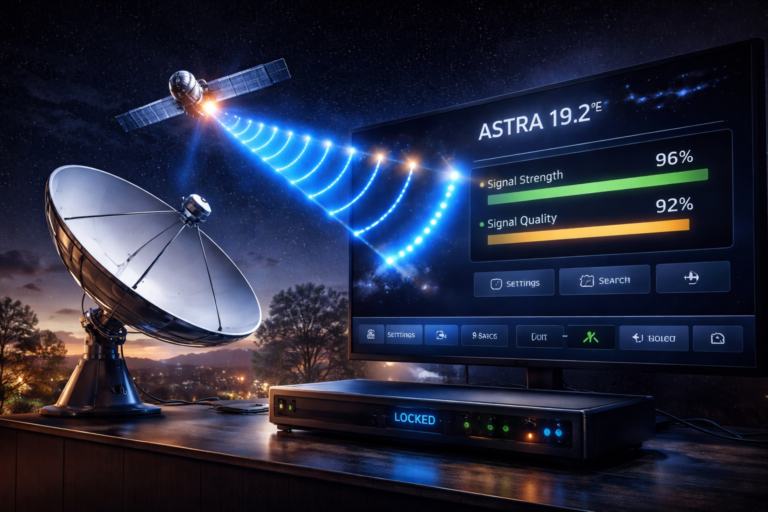
Signal strength shows that the dish is receiving RF energy. Signal quality shows whether the signal can be decoded.
A system may show good strength but still have no signal due to poor quality. This is common in weak alignment or noisy environments.
Always focus on quality when diagnosing problems.
Cable and connector failures
Damaged cables or loose connectors can reduce signal quality. Even small issues like oxidation or poor shielding can affect reception.
These problems may not affect all channels equally. Some transponders may fail while others still work.
Regular inspection of cables and connectors is essential for stable performance.
Weather and environmental effects
Rain and heavy clouds can reduce signal strength. This is known as rain fade.
Channels with lower signal margins are affected first. This creates situations where only some German channels show “no signal.”
Improving dish alignment and installation quality can reduce these effects.
Analytical diagnosis table
| Symptom | Cause | Meaning | Action |
|---|---|---|---|
| No signal on all channels | Dish misalignment or cable failure | Full signal loss | Check dish and cable |
| No signal on some channels | Transponder issue | Partial loss | Check frequency and alignment |
| High strength low quality | Noise or misalignment | Decoding failure | Adjust dish |
| Channels missing by group | LNB switching problem | Band or polarization issue | Check LNB |
| Signal drops in rain | Weak signal margin | Environmental effect | Improve setup |
Step by step fix guide
Start by checking if the issue affects all channels or only some. This determines whether the problem is general or specific.
Check signal quality on the receiver. If quality is low, adjust the dish alignment carefully.
Inspect the LNB and ensure proper switching between bands and polarization.
Verify receiver settings and update transponder data if needed.
Check cables and connectors for damage or loose connections.
Finally, test the system under stable weather conditions to confirm the fix.
Most “no signal” problems are not caused by complete system failure. They are usually the result of small issues in alignment, signal quality, or configuration.
Fixing “no signal” on Astra 19.2 German channels requires understanding how the system works. By focusing on signal quality, transponder behavior, and hardware condition, you can identify the real cause and restore stable reception.
FAQ
| Question | Answer |
|---|---|
| Why do I get no signal on some German channels only | Because those channels are on a specific transponder that your system cannot lock. |
| Does signal strength guarantee reception | No. Signal quality is more important for decoding channels. |
| Can weather cause no signal | Yes. Rain can reduce signal quality and cause channel loss. |
| Should I rescan channels immediately | No. First check signal quality and hardware. |
| What is the most common cause of no signal | Dish misalignment or weak signal quality. |