DirecTV Sports Package vs YouTube TV Technical Comparison
Estimated reading time: 18 minutes.
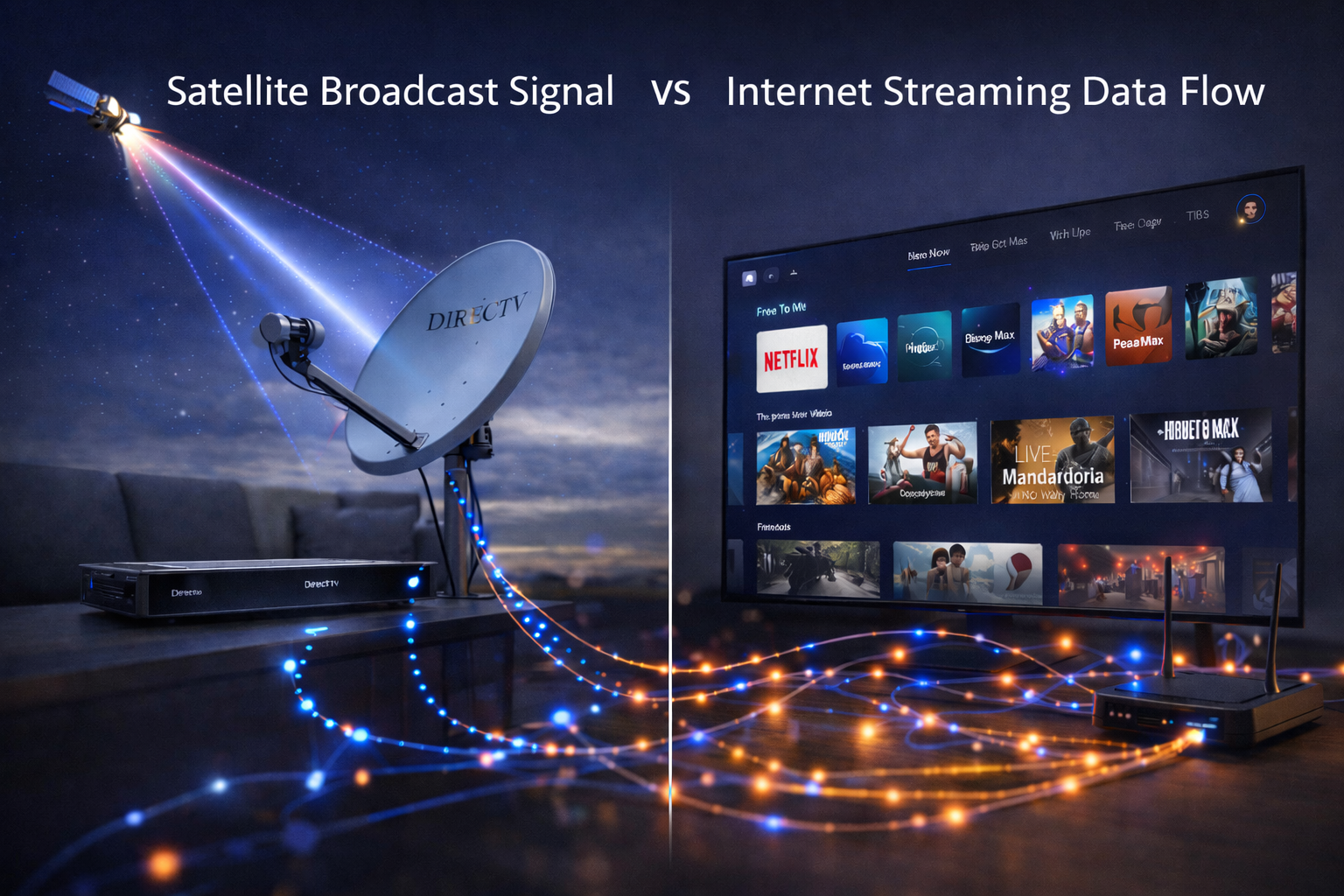
At a technical level, DirecTV and YouTube TV deliver the same content in completely different ways. One uses satellite broadcast signals transmitted over thousands of kilometers. The other relies on internet streaming through distributed data centers and content delivery networks. This difference in delivery method changes everything about performance.
When comparing a sports package specifically, the differences become even more noticeable. Live sports require low latency, stable signal, and consistent quality. Any delay, buffering, or signal drop affects the viewing experience immediately. Understanding how each system handles these challenges reveals which one performs better in real conditions.
DirecTV uses satellite broadcast with fixed signal delivery, while YouTube TV uses internet streaming dependent on network conditions. This creates differences in latency, stability, and consistency.
Signal delivery method difference
DirecTV uses satellite transmission. The signal is broadcast from a ground station to a satellite and then transmitted to all users simultaneously.
This is a one to many system. Every user receives the same signal at the same time.
YouTube TV uses internet streaming. The signal is delivered through servers and content delivery networks to each user individually.
This is a one to one system where each user depends on their internet connection.
Latency in live sports broadcasting
Latency refers to the delay between the live event and what the viewer sees.
Satellite systems like DirecTV typically have lower and more consistent latency because the signal is broadcast directly.
Streaming platforms like YouTube TV introduce additional delay due to encoding, buffering, and network transmission.
This delay can range from a few seconds to longer depending on network conditions.
Signal stability and reliability
Satellite signals are generally stable as long as the dish is properly aligned and weather conditions are acceptable.
Once the signal is locked, it does not depend on network congestion or bandwidth.
Streaming stability depends on internet speed, network congestion, and server performance.
Fluctuations in any of these can cause buffering or quality drops.
Video quality consistency
DirecTV delivers a fixed quality signal. The quality remains stable unless signal conditions degrade.
YouTube TV uses adaptive bitrate streaming. The quality changes depending on available bandwidth.
This means quality can drop during network congestion.
Network dependence vs broadcast independence
Satellite broadcasting does not depend on internet infrastructure. Once installed, it works independently.
Streaming services depend entirely on internet connectivity. Any network issue directly affects performance.
This makes streaming more flexible but also more variable.
Scalability and load behavior
Satellite systems handle large audiences efficiently because the signal is broadcast once.
Streaming platforms must handle each user individually. During high demand events, server load increases significantly.
This can lead to performance issues if infrastructure is not sufficient.
Real world performance scenarios
During major sports events, satellite users typically experience consistent performance.
Streaming users may encounter buffering or delays depending on network conditions.
In areas with strong internet infrastructure, streaming can perform well. In weaker networks, performance degrades.
Analytical comparison table
| Factor | DirecTV Satellite | YouTube TV Streaming |
|---|---|---|
| Delivery method | Broadcast | Internet streaming |
| Latency | Low and stable | Higher and variable |
| Signal stability | Consistent | Network dependent |
| Video quality | Fixed | Adaptive |
| Dependence | Independent of internet | Fully dependent on internet |
Technical verdict
From a technical perspective, satellite broadcasting offers more stable and predictable performance.
Streaming provides flexibility and accessibility but introduces variability due to network dependence.
The better option depends on whether stability or flexibility is more important for the user.
Streaming quality depends heavily on internet conditions. Satellite quality depends on signal alignment and environmental factors.
DirecTV provides stable broadcast performance with low latency, while YouTube TV offers flexible streaming with variable performance. For live sports, stability and latency often favor satellite systems, while streaming depends on network quality.
FAQ
| Question | Answer |
|---|---|
| Which has lower latency | Satellite systems like DirecTV generally have lower latency. |
| Why does streaming buffer | Because it depends on internet speed and network conditions. |
| Is satellite always better | Not always but it is more stable for live events. |
| Can streaming match satellite quality | Yes with strong internet but it may vary. |
| What affects streaming performance | Bandwidth, latency, and server load. |