German TV Packages Signal Structure Astra 19.2

Estimated reading time: 11 minutes.
Many viewers think German TV packages on Astra 19.2 are arranged in a simple list. In practice, the structure is far more technical. Channels are grouped into transport streams, placed on specific transponders, modulated with defined parameters, then processed by the receiver tuner step by step. When someone loses a group of channels, the real cause is often not random at all. It usually points to how that package is structured at signal level.
Understanding this structure matters because it changes how you troubleshoot. If several German channels disappear together, the issue may come from one transponder, one frequency band, one polarization path, one LNB position problem, or one receiver tuning error. Once you understand how the package is built inside Astra 19.2, the problem becomes easier to read and fix logically.
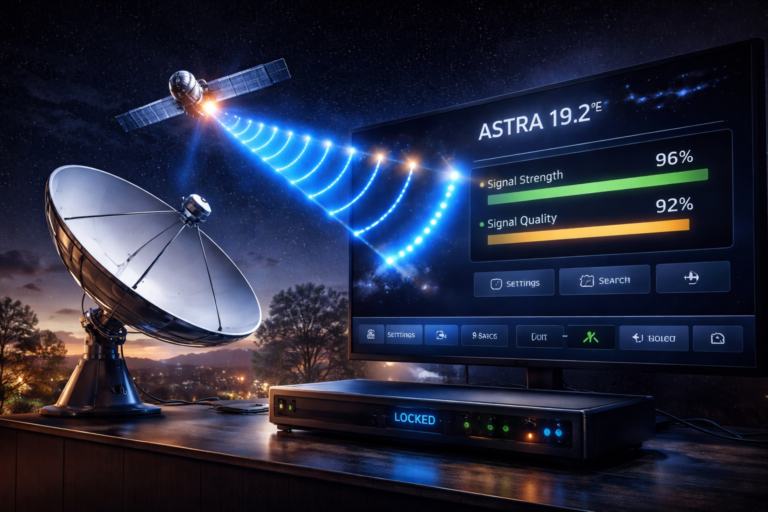
German TV packages on Astra 19.2 are not sent one channel at a time in isolation. Multiple services are grouped together inside shared signal structures called transponders or multiplexes. The dish collects RF energy, the LNB converts it, the receiver locks to the correct parameters, and then the tuner extracts the package contents. This is why package level problems often affect multiple channels at once.
- How German TV packages are built on Astra 19.2
- Why the transponder acts like the real package container
- How frequency and polarization shape package behavior
- How the receiver reads the package structure
- Signal strength vs quality in package reception
- Why one German package can fail while others still work
- Environmental and installation effects on grouped channels
- Analytical package diagnosis table
- Practical steps to diagnose package level reception problems
- FAQ
How German TV packages are built on Astra 19.2
Astra 19.2 East carries many German TV services, but these services do not travel independently from satellite to home. The broadcast system groups them into digital transport streams. Each stream contains several channels, audio tracks, metadata tables, service identifiers, timing information, and other signaling needed for the receiver to understand what is available.
This means a package is a technical structure first and a viewer experience second. From the viewer side, it may look like a family of related German channels. From the broadcast side, it is better understood as a set of services sharing the same transmission resource. That resource is usually a transponder with a defined frequency, polarization, symbol rate, modulation method, and forward error correction profile.
Once this idea becomes clear, many real world problems start to make sense. If three or five German channels disappear together, that often means they shared one transmission path. If channels from different groups continue to work normally, the dish may still be receiving the satellite overall, but one part of the signal structure may be failing.
Why the transponder acts like the real package container
A transponder is the main signal container in satellite broadcasting. It receives an uplinked signal, shifts or processes it according to the satellite system design, and retransmits it toward the coverage area. In home reception, the important point is that a transponder carries a group of digital services together. So when users say a package is missing, technicians usually ask which transponder those channels belong to.
For German TV on Astra 19.2, the channel package structure depends heavily on transponder allocation. One transponder may carry a group of public services. Another may carry commercial services. Another may carry HD or SD variants depending on the broadcaster strategy and capacity planning. The package logic is tied to bandwidth efficiency, audience needs, and platform organization.
This structure creates a useful diagnostic rule. If every missing channel belongs to one transponder, then random dish failure is less likely than a targeted issue in locking that specific signal. The problem could be related to polarization switching, marginal carrier to noise ratio, incorrect tuning data, transponder parameter changes, or borderline alignment that only affects narrower reception margins.
How frequency and polarization shape package behavior
German TV packages on Astra 19.2 are spread across different frequencies and polarization planes. This matters because your LNB and receiver must work together correctly to access the intended signal path. Satellite systems reuse frequency space by using both horizontal and vertical polarization. In addition, the LNB separates reception into low band and high band ranges using local oscillator switching logic.
In practice, that means one German package may sit on a high band horizontal transponder while another may use vertical polarization in another range. If the LNB is not switching correctly, or if cable voltage control from the receiver is unstable, some packages may vanish while others remain fully available. This is why partial channel loss is so common in real installations.
A viewer may wrongly assume the dish is aligned because some German channels still appear. But good reception on one band or polarization does not prove that all signal paths are healthy. A slight skew issue, weak connector contact, poor LNB behavior, or voltage drop can affect only selected groups. That is exactly why package level structure matters during diagnosis.
How the receiver reads the package structure
The receiver does more than display a channel list. Internally, it follows several processing steps. First, the tuner selects the requested frequency and polarization path through the LNB control system. Then it attempts carrier lock. After that, demodulation begins. If lock quality is sufficient, the receiver reads the transport stream tables that describe available services within that package.
These tables include identifiers that tell the receiver which video and audio streams belong to each channel. This is why a channel scan is not only a simple search. It is a process of discovering signal containers and then reading service definitions inside them. If the receiver cannot properly lock the transponder, none of the services inside that package can be listed or displayed correctly.
This explains another common user complaint. Sometimes the signal bar shows activity, yet the expected German package still does not scan in. In many cases, there is enough raw RF presence to show signal strength, but not enough clean demodulation quality to read the digital stream tables reliably. That is a package reading problem, not a total dish failure.
Signal strength vs quality in package reception
Signal strength and signal quality are often confused, especially in consumer receiver menus. Strength usually reflects that some level of RF input is reaching the tuner. Quality is more closely tied to whether the tuner can properly decode the digital carrier. For package level reception, quality matters much more than strength.
A German TV package can fail completely while the strength bar still looks acceptable. This happens because strength alone does not confirm clean symbol recovery, stable carrier lock, or strong enough error correction performance. Rain fade, minor dish misalignment, LNB noise issues, or interference can reduce the quality margin without making the strength reading collapse.
This is one of the most important ideas in Astra troubleshooting. If a user reports that one package disappeared but signal strength still looks normal, the correct technical question is not whether the dish has signal. The question is whether the tuner has enough quality to demodulate that exact transponder under current conditions.
Why one German package can fail while others still work
There are several technical reasons why one package can fail while others continue normally on Astra 19.2. The first is marginal alignment. A dish that is slightly off target may still lock strong transponders but struggle with weaker or more demanding ones. The second is skew error. If the LNB rotation is slightly wrong, one polarization may perform worse than the other.
A third reason is cable or connector weakness. Poor shielding, oxidation, or partial short conditions may affect high frequency behavior or control voltage stability. A fourth reason is inaccurate receiver data. If the stored frequency or symbol rate is outdated, the receiver may scan the wrong parameters and miss the package. A fifth reason is LNB instability, especially in older or overheated units where oscillator drift becomes more noticeable.
There is also the effect of modulation robustness. Some transponders are easier to receive than others depending on the transmission profile and local reception margin. Even when the published footprint looks strong, not every installation has the same dish size, cable quality, mounting precision, or LNB performance. That is why two homes in the same city may report different behavior on the same German package.
Environmental and installation effects on grouped channels
Environmental conditions do not affect every package equally. Rain fade is the best known example. When rain or heavy cloud moisture increases signal attenuation, installations already working near the edge of stable quality will show package loss first on their weakest transponders. This may look mysterious to the viewer because some channels remain stable while others vanish.
Physical installation quality also matters. Dish rigidity is often underestimated. A mount that moves slightly in wind may cause tiny pointing errors that only become visible on selected packages. LNB arm sag, poor focal positioning, or dish deformation can also reduce transponder consistency. These are not dramatic failures. They are subtle losses in efficiency that show up first where the signal margin is already thin.
Nearby obstacles matter too. Trees, walls, and seasonal foliage changes can create partial attenuation or reflection issues. Even if the dish still sees the satellite generally, the overall margin may be reduced enough that one German package drops below the receiver lock threshold before others do.
Analytical package diagnosis table
| Observed Symptom | Most Likely Technical Cause | What It Usually Means | Best First Check |
|---|---|---|---|
| Several German channels disappear together | Single transponder lock failure | Package structure is affected, not the whole satellite path | Check exact frequency, symbol rate, polarization |
| Strength high but quality low | Dish alignment, noise, or demodulation margin issue | RF is present but digital decoding is unstable | Fine tune dish and verify LNB skew |
| Only horizontal or vertical group missing | Polarization switching or skew problem | Receiver and LNB path may not be selecting correctly | Inspect voltage control and LNB rotation |
| Only high band package missing | 22 kHz switching issue or LNB fault | Band selection is incomplete | Test receiver settings and LNB response |
| Channels vanish during rain only | Low reception margin | Installation is working near its limit | Improve alignment and inspect dish size suitability |
| Package not found after scan | Outdated tuning data or weak lock | Receiver cannot properly read service tables | Update transponder parameters and rescan manually |
Practical steps to diagnose package level reception problems
When a German TV package fails on Astra 19.2, the best approach is systematic. First, identify whether the missing channels belong to one transponder or several. This immediately tells you whether the problem is grouped or general. If the channels share one frequency and polarization, your next step is to verify those exact parameters in the receiver menu.
Second, compare signal quality readings on a working transponder and the failing one. Do not focus only on the strength bar. If the failing package shows much lower quality, the issue is likely related to alignment margin, LNB behavior, or the package transmission path itself.
Third, inspect the installation physically. Make sure connectors are tight, dry, and clean. Check for center conductor problems, cable corrosion, or loose outdoor fittings. Then verify dish stability and LNB position. Even a small tilt or skew error can create selective package loss.
Fourth, perform careful dish adjustment if needed. Tiny movements matter. Move slowly and watch quality, not just strength. On Astra 19.2, the difference between acceptable and unstable reception can be very small, especially on installations that already worked for months before developing drift or weather related weakness.
Fifth, consider receiver behavior. Some receivers handle marginal signals better than others. Software quality, tuner sensitivity, and scan logic vary. If possible, cross check with another receiver on the same line. If one receiver finds the package easily and another struggles, the issue may be tuner sensitivity or configuration rather than the outdoor hardware alone.
Finally, remember that package structure is a clue. Missing groups are not random. They are usually telling you exactly where to look. If you know how the German channels are grouped on Astra 19.2, you can troubleshoot with much less guesswork and much better accuracy.
In real home installations, the biggest mistake is assuming that one working channel proves the whole Astra system is healthy. It does not. German packages are divided across different transponders, frequencies, bands, and polarization paths. A dish can appear mostly fine while still failing on one specific package because the reception margin is uneven. Most partial channel loss cases come from selective weaknesses, not total system failure.
The signal structure behind German TV packages on Astra 19.2 is the key to understanding why grouped channel problems happen. Channels are bundled inside transponders, shaped by frequency and polarization logic, then decoded by the receiver only if quality is high enough. Once you stop thinking of channels one by one and start thinking in package level signal paths, troubleshooting becomes more technical, more realistic, and much more effective.
FAQ
| Question | Answer |
|---|---|
| Why do several German channels disappear together on Astra 19.2 | Because they often share the same transponder. If the receiver cannot lock that transponder, every service inside that package can disappear at once. |
| Does a high signal strength reading mean the package should work | No. Strength only shows RF presence. Quality determines whether the receiver can actually decode the digital signal correctly. |
| Can LNB skew affect only some German packages | Yes. A skew problem can reduce performance on one polarization path more than the other, which can cause selective package loss. |
| Why does one package fail during rain while others stay on | Because not all transponders have the same reception margin at your location and installation condition. The weakest package drops first. |
| Should I rescan channels immediately when a package disappears | Only after verifying signal quality and current transponder data. A blind rescan will not fix poor lock conditions caused by alignment or hardware issues. |