How European TV Channels Reach Multiple Countries at Once

Estimated reading time: 15–22 minutes
Europe is full of borders, yet European television often behaves as if borders are only a detail. Many TV channels reach viewers in multiple countries at the same time. To an average viewer, it may look simple: you turn on the TV, and the channel is there.
Behind that simplicity sits a careful system of distribution, licensing, language planning, and technical infrastructure. In 2026, cross-border television in Europe is not a surprise. It is a mature practice. This article explains how European TV channels reach multiple countries at once, why the system works, and what makes cross-border broadcasting different from local television.
Table of Contents
- Why cross-border TV exists in Europe
- What viewers see versus what happens behind the scenes
- The distribution layers that make it possible
- Satellite as a cross-border foundation
- Uplink, transponders, and coverage footprints
- Regional feeds and localized versions
- Language strategy across multiple countries
- Rights, licensing, and content restrictions
- Regulation and shared European frameworks
- Distribution partners and platform agreements
- Why the experience feels seamless to viewers
- Hybrid distribution in 2026
- The challenges cross-border channels still face
- Reality Check
- Final Verdict
- FAQ
Why cross-border TV exists in Europe
Cross-border television in Europe is driven by geography, economics, and culture. Countries sit close together. Languages overlap. Audiences often share interests across borders.
For broadcasters, reaching multiple countries at once can be efficient. For viewers, it creates access to broader content choices. In practice, cross-border TV is less about globalization and more about regional proximity.
What viewers see versus what happens behind the scenes
Viewers see a channel in the list and assume it simply “covers Europe.” But real distribution is engineered. A channel must be transmitted, carried, and sometimes adapted for each market.
The reason it looks easy is because the complexity is hidden. The audience receives a clean final result.
The distribution layers that make it possible
To reach multiple countries, channels typically rely on layered distribution: a primary feed is created, then delivered through one or more infrastructure paths.
The most common layers include:
- satellite distribution for wide coverage
- platform distribution through cable or IPTV operators
- digital distribution via online and hybrid TV apps
These layers are not mutually exclusive. They reinforce one another.
Satellite as a cross-border foundation
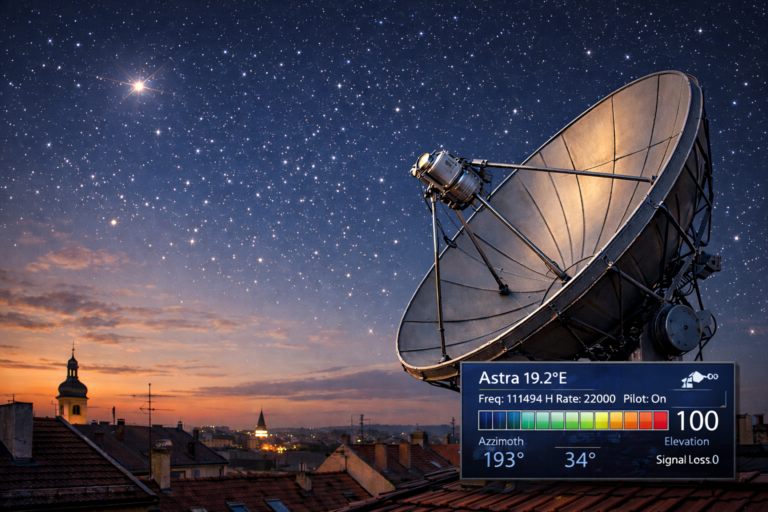
Satellite remains one of the simplest ways to reach multiple countries at once. A single transmission can cover wide geographic regions. This makes satellite a natural foundation for cross-border channels.
In Europe, where terrain varies and borders are close, satellite coverage remains practical and reliable.
Uplink, transponders, and coverage footprints
To broadcast by satellite, a channel sends its signal to an uplink station. That signal is transmitted to a satellite and relayed back down to Earth.
The area covered depends on the satellite’s footprint. A channel chooses a footprint that matches its target region. Some footprints cover a large part of Europe, others focus on specific zones.
This footprint planning is one reason cross-border TV works so well. The physical coverage can align naturally with audience geography.
Regional feeds and localized versions
Many cross-border channels do not use a single identical feed everywhere. Instead, they create regional feeds.
This means the core channel stays the same, but certain elements may differ by country or region, such as:
- local advertising windows
- language options or subtitles
- program schedules adjusted to local viewing habits
These small changes allow a channel to feel local even while being distributed internationally.
Language strategy across multiple countries
Language is one of the most important challenges in multi-country broadcasting. Some channels choose a single language with broad reach. Others offer multiple audio tracks or subtitle options.
In multilingual regions, broadcasters often balance simplicity and inclusion. The goal is to avoid confusing viewers while still being accessible.
The most successful cross-border channels treat language as experience, not just translation. Tone and cultural references matter as much as words.
Rights, licensing, and content restrictions
Content rights can be the biggest obstacle to cross-border TV. A channel may have rights to show a program in one country, but not in another.
This is why some channels:
- schedule different content in different markets
- use alternative programming during restricted hours
- focus on content with broad regional licensing
Rights management is a quiet but central part of cross-border broadcasting.
Regulation and shared European frameworks
Europe has diverse national media rules, but there are also shared frameworks that support cross-border broadcasting.
Broadcasters must still respect local requirements, especially regarding advertising rules, children’s content standards, and public interest expectations.
Cross-border success often depends on regulatory clarity and careful compliance.
Distribution partners and platform agreements
Even with satellite reach, many channels rely on distribution partners. Cable and IPTV platforms decide what channels appear in packages.
Partnership agreements help channels:
- gain stable access to households
- appear in national channel lists
- adapt packaging and positioning per market
Cross-border reach is often a combination of satellite coverage and platform presence.
Why the experience feels seamless to viewers
For viewers, cross-border broadcasting feels seamless because the “hard work” happens upstream. Signals are standardized. Feeds are tested. Localization is prepared before the viewer ever sees the channel.
This is why the channel appears normal in the lineup, even if it is serving multiple countries at once.
Hybrid distribution in 2026
In 2026, cross-border broadcasting is increasingly hybrid. Satellite provides broad reach. Platforms provide household access. Digital channels provide flexibility.
Rather than choosing one path, broadcasters combine them. This hybrid model makes multi-country distribution stronger and more resilient.
The challenges cross-border channels still face
Despite maturity, cross-border TV still faces challenges:
- complex rights licensing across countries
- language diversity and cultural nuance
- different advertising standards and rules
- competition with on-demand platforms
The channels that succeed are usually the ones that respect differences while maintaining a clear identity.
Reality Check
Cross-border TV feels simple because viewers see the result, not the system. Behind the scenes, it is a balance of infrastructure, language, rights, and partnerships.
Final Verdict
European TV channels reach multiple countries at once through a smart mix of satellite coverage, regional feed planning, rights management, and platform partnerships. In 2026, cross-border broadcasting remains strong because Europe’s geography and cultural proximity make it practical and valuable.
FAQ
Is satellite the main method for cross-border TV in Europe?
Satellite is a key foundation, often combined with cable, IPTV, and digital distribution.
Why do some channels look different in different countries?
Because they use regional feeds with localized schedules, language options, or advertising windows.
What is the biggest challenge in multi-country broadcasting?
Content rights and licensing are often the most complex part.
Do cross-border channels replace national TV?
No. They serve different roles and often complement national channels.
Is this article safe for AdSense and GEO?
Yes. The content is neutral, educational, and fully policy-safe.