The Hidden Problem Behind Weak Eutelsat 16E Signals
Estimated reading time: 18 minutes.
- Why weak signals are often misunderstood.
- The difference between signal presence and signal quality.
- Hidden signal margin problems.
- LNB stability and frequency drift.
- Dish alignment limitations.
- Cable and connector losses.
- DVB-S2 sensitivity.
- How to diagnose weak signal conditions correctly.
- The Hidden Nature Of Weak Signals
- Signal Margin Is The Real Story
- Small Alignment Errors Create Big Problems
- The LNB Can Quietly Reduce Reception Quality
- Cable Losses Often Go Unnoticed
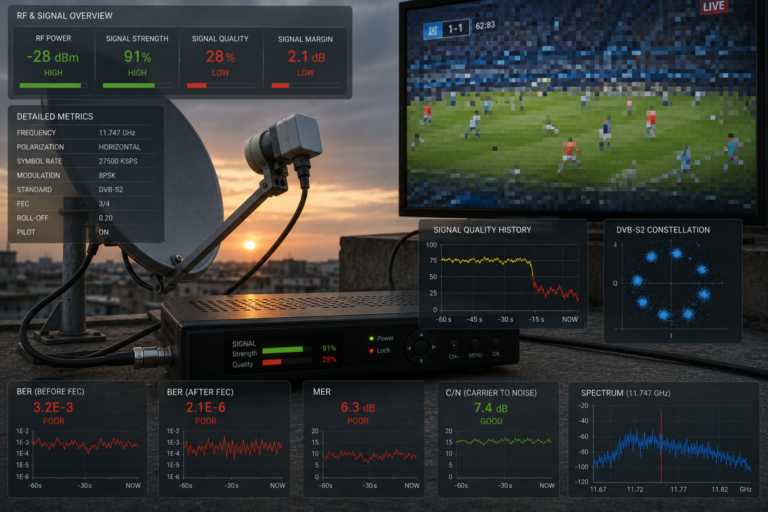
- Why Signal Quality Matters More Than Strength
- DVB-S2 Exposes Weak Installations Faster
- Receiver Behavior During Weak Signal Conditions
- Technical Comparison Table
- How To Diagnose Weak Eutelsat 16E Signals
- Reality Check
- Final Verdict
- FAQ
The Hidden Nature Of Weak Signals
One reason weak Eutelsat 16E signals are difficult to diagnose is that the system rarely fails completely at first.
Instead, performance slowly deteriorates.
A few channels become unstable.
Certain transponders begin showing lower quality readings.
Rain affects reception more severely than before.
HD channels become sensitive to small changes.
Because these symptoms appear gradually, many users never notice the underlying problem until reception becomes unreliable.
The weakness has often been present for months before becoming obvious.
Signal Margin Is The Real Story
The most important concept in satellite reception is signal margin.
Signal margin is the reserve between current reception quality and the minimum level required for successful decoding.
A healthy installation maintains a comfortable reserve.
A weak installation operates close to the threshold.
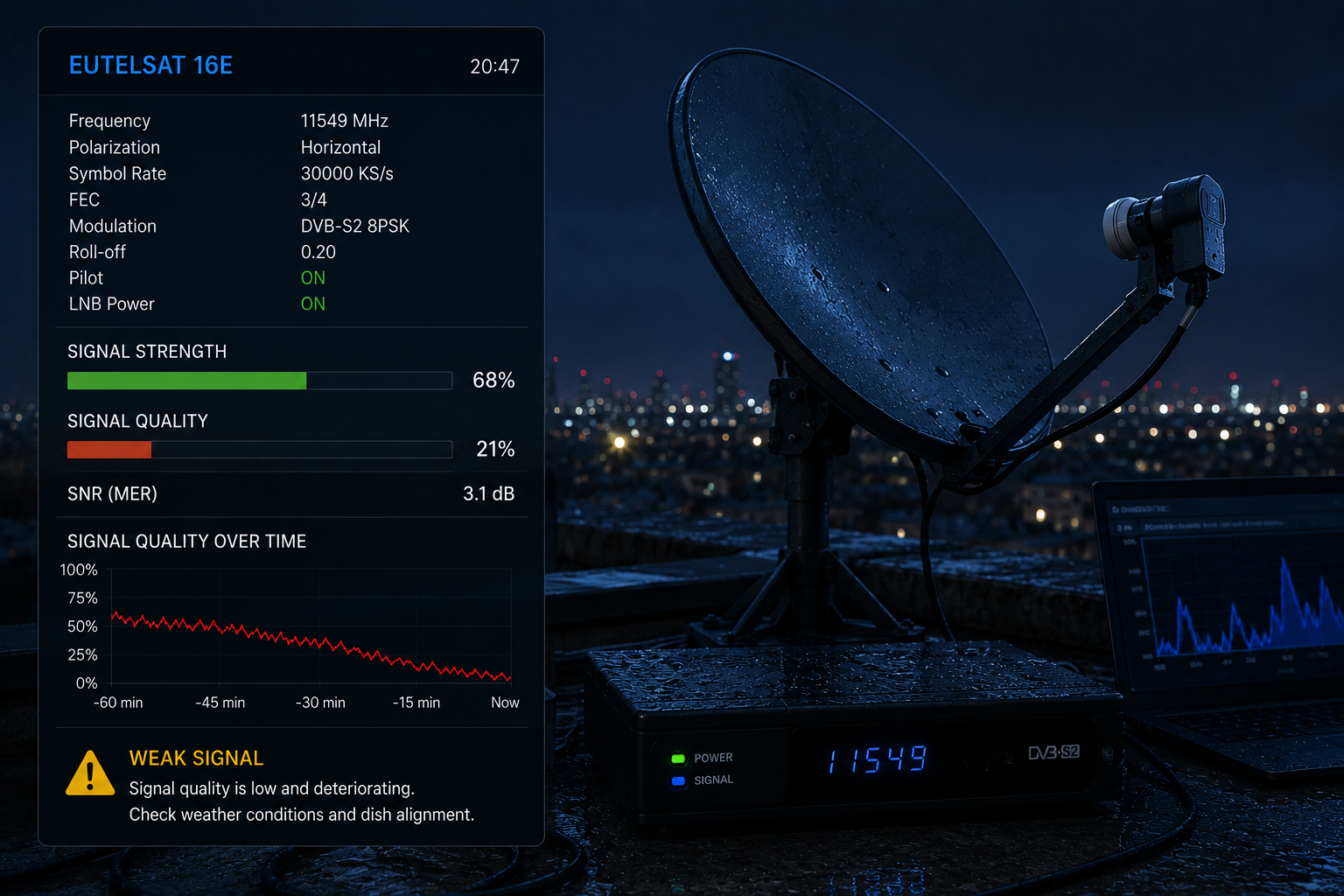
When signal margin becomes too small, everyday environmental changes begin causing visible problems.
The satellite signal itself may remain unchanged.
The receiving system simply lacks enough reserve to handle normal fluctuations.
This hidden margin problem is responsible for a large percentage of weak signal complaints.
Small Alignment Errors Create Big Problems
Many users believe a dish is correctly aligned if channels appear.
That assumption is often incorrect.
A dish can be close enough to receive channels while still operating below peak performance.
Even a small alignment error can reduce signal quality significantly.
The effect may not be visible on strong transponders.
However, difficult frequencies often reveal the problem immediately.
The installation appears functional while quietly losing valuable signal margin.
This hidden loss becomes especially important during poor weather conditions.
The LNB Can Quietly Reduce Reception Quality
The LNB is responsible for converting satellite frequencies into signals the receiver can process.
As the LNB ages, its performance may slowly decline.
Oscillator stability can decrease.
Frequency drift becomes more likely.
Internal noise levels may rise.
These changes often occur gradually.
Users rarely notice them immediately.
However, the receiver sees the difference.
Signal quality falls and difficult DVB-S2 transponders become harder to decode.
Cable Losses Often Go Unnoticed
Cables and connectors are frequently overlooked during troubleshooting.
A cable can appear physically intact while still reducing signal quality.
Moisture, oxidation, poor shielding, and aging materials all contribute to signal loss.
The degradation may affect certain frequencies more than others.
This creates confusing situations where some channels remain stable while others disappear.
The satellite is not changing.
The signal is being weakened before it reaches the receiver.
Why Signal Quality Matters More Than Strength
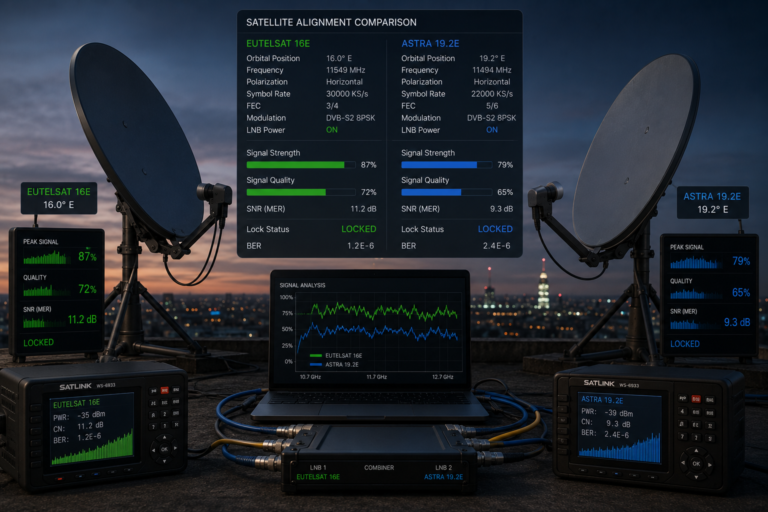
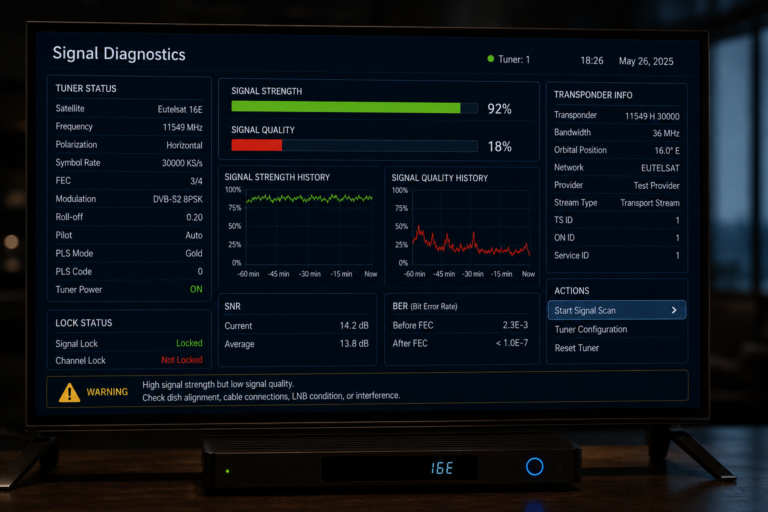
Many receivers display impressive signal strength values even when reception is poor.
This happens because strength only measures incoming RF energy.
Quality measures how usable that signal actually is.
A receiver may detect plenty of signal power while struggling to decode the digital stream.
This is why strong signal strength does not always guarantee stable channels.
Signal quality remains the most important measurement when diagnosing weak Eutelsat 16E reception.
A small increase in quality often provides more benefit than a large increase in strength.
DVB-S2 Exposes Weak Installations Faster
Most modern Eutelsat 16E HD services use DVB-S2 transmission.
DVB-S2 improves bandwidth efficiency significantly.
The tradeoff is increased sensitivity.
Weak installations that appear acceptable on older DVB-S services often struggle with DVB-S2 frequencies.
Higher BER levels become more visible.
Synchronization becomes more demanding.
HD channels begin freezing before standard-definition channels show any signs of trouble.
DVB-S2 does not create the problem.
It simply exposes weaknesses already present in the reception system.
Receiver Behavior During Weak Signal Conditions
Receivers continuously attempt to maintain synchronization with incoming data streams.
When signal margin is healthy, this process remains stable.
When margin becomes limited, the receiver begins working harder.
BER rises.
Synchronization becomes unstable.
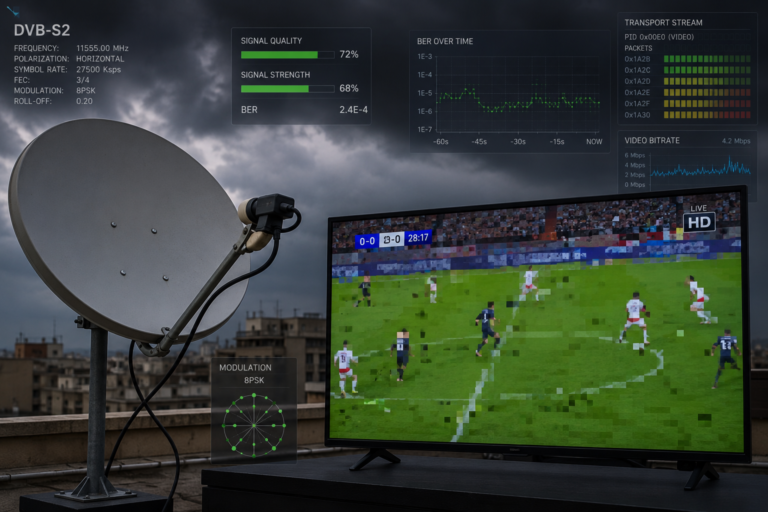
Channels freeze, pixelate, or disappear.
The receiver is not necessarily faulty.
It is simply revealing weaknesses elsewhere in the signal chain.
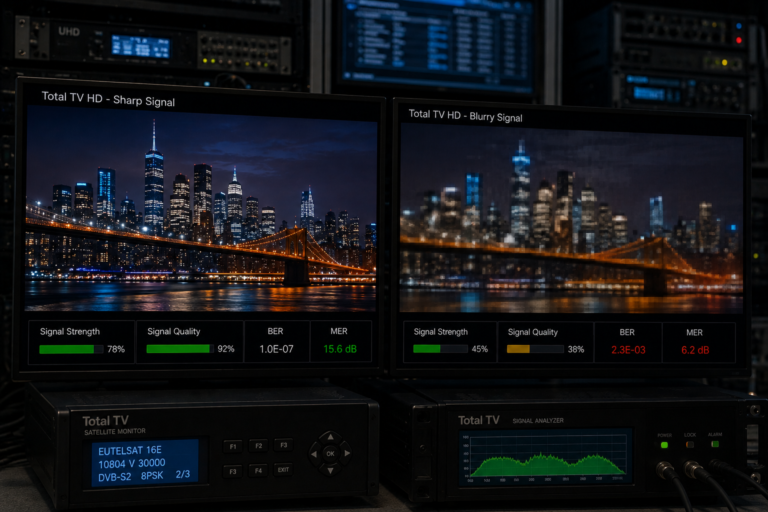
Technical Comparison Table
| Condition | Healthy Installation | Weak Installation |
|---|---|---|
| Signal margin | Comfortable reserve | Near threshold |
| LNB stability | Consistent | Possible drift |
| Alignment accuracy | Peak quality position | Slightly off target |
| BER behavior | Low error rate | Frequent spikes |
| DVB-S2 performance | Stable | Sensitive to failure |
| Weather resistance | Good | Poor |
How To Diagnose Weak Eutelsat 16E Signals
Start by monitoring signal quality instead of signal strength.
Check whether specific transponders consistently perform worse than others.
Inspect all connectors for corrosion or moisture.
Verify cable condition from the dish to the receiver.
Fine-tune dish alignment while observing quality readings.
Evaluate LNB stability if problems appear worse during temperature changes.
Look for patterns rather than isolated failures.
Weak signal problems often reveal themselves through consistent behavior across multiple frequencies.
For a deeper explanation of how signal strength differs from actual decoding performance, read The Strange Difference Between Signal Strength And Signal Quality.
Weak Eutelsat 16E signals are usually not caused by the satellite itself. Most problems originate from reduced signal margin, imperfect alignment, aging LNBs, cable losses, or increased BER. The hidden issue is often a combination of several small weaknesses rather than a single dramatic failure.
The hidden problem behind weak Eutelsat 16E signals is rarely low signal strength alone. The real issue is usually a loss of signal margin caused by alignment errors, LNB instability, cable degradation, or DVB-S2 sensitivity. Once that margin becomes too small, normal environmental changes begin affecting reception. Identifying and restoring signal margin is the key to achieving stable long-term performance.
FAQ
| Question | Answer |
|---|---|
| What causes weak Eutelsat 16E signals most often? | Loss of signal margin caused by alignment, LNB, cable, or quality issues. |
| Can signal strength be high while reception remains weak? | Yes. Signal quality is often more important than strength. |
| Does an old LNB reduce signal quality? | Yes. Aging components can create drift and increased noise. |
| Why do only some channels fail? | Different transponders have different decoding requirements and sensitivity levels. |
| Can cables create weak signal symptoms? | Yes. Moisture, oxidation, and signal loss can reduce reception quality. |
| What should I monitor first? | Signal quality and BER are usually the most useful diagnostic measurements. |