Why Tring TV HD Channels Suddenly Break Into Squares
Estimated Reading Time: 9 minutes
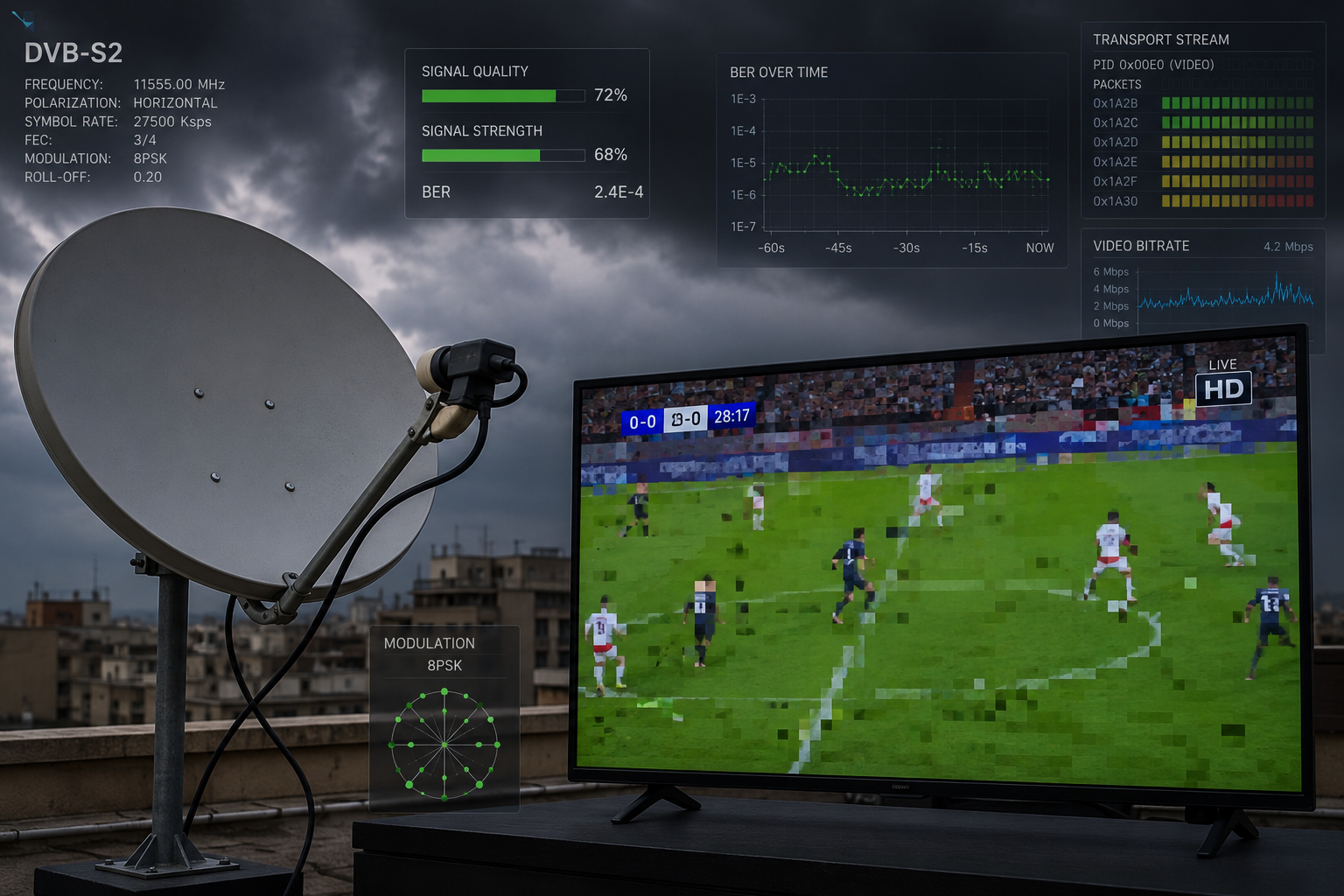
One moment the picture looks perfectly sharp. A few seconds later, the entire screen breaks into large digital squares before freezing or recovering on its own. Many Tring TV viewers assume the television is failing, but in most cases the display is simply revealing that the satellite receiver is struggling to reconstruct the incoming transport stream.
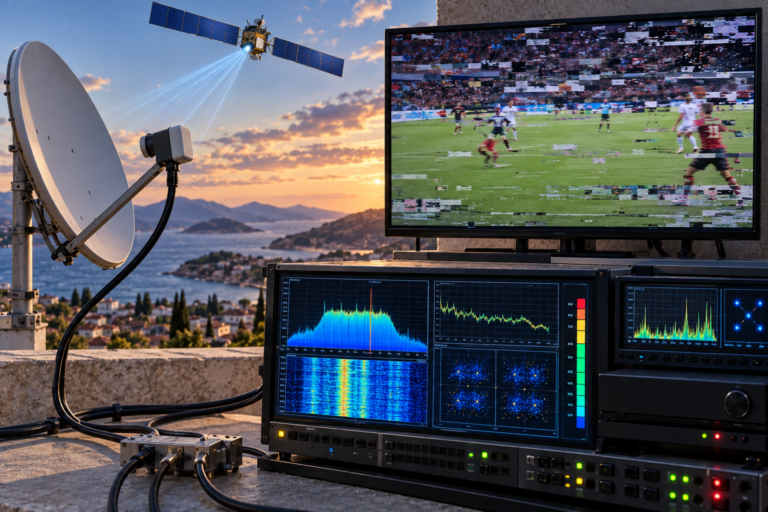
Unlike the analog television era, modern DVB-S2 broadcasts rarely become gradually snowy. Instead, the decoder works normally until the incoming error rate exceeds its correction capability. At that point, the receiver begins losing complete blocks of video data, producing the familiar square-shaped artifacts known as macroblocking or pixelation.
Square-shaped image artifacts usually indicate that the receiver is receiving enough RF power to remain locked on the satellite signal, but not enough clean information for the Forward Error Correction system to rebuild every transport packet correctly. The result is visible macroblocking rather than a completely black screen.
- What Are The Squares On The Screen?
- How DVB-S2 Normally Delivers HD Video
- Why Pixelation Appears Before Complete Signal Loss
- The Role Of BER And Signal Margin
- How Dish Alignment Influences HD Stability
- Environmental Conditions That Trigger Macroblocking
- LNB Performance And Frequency Stability
- Logical Troubleshooting Steps
- Reality Check
- Final Verdict
- FAQ
What Are The Squares On The Screen?
The squares are not individual television pixels. They are compressed blocks of video data that could not be reconstructed correctly after transmission. Modern video codecs compress images into blocks to reduce bandwidth. When portions of the incoming data become corrupted, entire image regions may be displayed incorrectly, creating the familiar mosaic appearance called macroblocking. Broadcast engineers commonly use this visual symptom as an indicator that transmission errors are affecting the received transport stream. :contentReference[oaicite:0]{index=0}
Because HD channels carry more visual information than SD channels, they generally require a cleaner signal for consistent decoding. Small increases in transmission errors that an SD channel might tolerate can become immediately visible on an HD service.
How DVB-S2 Normally Delivers HD Video
A Tring TV transponder broadcasts a continuous DVB-S2 carrier from a geostationary satellite. The dish concentrates the microwave signal onto the LNB, which amplifies the extremely weak signal and converts it to an intermediate frequency that travels through the coaxial cable into the receiver.
Inside the receiver, several processing stages occur before any image reaches the television. Carrier synchronization locks onto the incoming waveform. Symbol timing determines where each transmitted symbol begins and ends. Demodulation converts those symbols into digital information before powerful LDPC and BCH Forward Error Correction algorithms repair transmission errors. Finally, the MPEG transport stream is reconstructed and passed to the video decoder for display. DVB-S2 achieves high efficiency through advanced modulation and powerful FEC, allowing reliable HD broadcasting when adequate signal quality is available. :contentReference[oaicite:1]{index=1}
Why Pixelation Appears Before Complete Signal Loss
Many viewers wonder why the image breaks into squares instead of disappearing immediately.
The answer lies inside the decoder. As long as enough packets can still be corrected, video playback continues normally. When the number of corrupted bits rises beyond the correction capability of the Forward Error Correction system, missing information begins appearing inside the decoded picture.
Instead of displaying static like analog television, digital receivers attempt to display the most complete picture they can reconstruct. Missing blocks become visible as squares, frozen image regions, or short bursts of distortion while audio may continue briefly before interruption.
The Role Of BER And Signal Margin
Bit Error Rate, commonly abbreviated as BER, measures how many received bits contain errors before and after Forward Error Correction.
A very low BER indicates that the receiver is successfully decoding nearly every transmitted bit. As RF noise increases, BER begins rising. Initially, LDPC and BCH correction algorithms repair the damaged information without affecting the displayed image. Eventually the correction capability becomes exhausted, causing visible pixelation and eventually complete transport stream failure. DVB-S2 relies heavily on these powerful coding techniques to maintain reliable reception close to theoretical channel limits. :contentReference[oaicite:2]{index=2}
Signal margin is equally important. Think of it as the safety distance between normal operating conditions and complete decoding failure. Installations with a generous signal margin can tolerate rain, slight dish movement, or additional atmospheric attenuation. Installations operating close to the decoding threshold may experience macroblocking whenever conditions deteriorate even slightly.
How Dish Alignment Influences HD Stability
Satellite dishes are highly directional microwave antennas.
Even a movement of only a few millimeters at the dish rim changes the pointing angle enough to reduce received signal quality. Signal strength readings may still appear relatively high while signal quality drops noticeably because the antenna is no longer centered on the strongest portion of the satellite beam.
Small alignment errors also reduce signal margin, making HD channels much more sensitive to weather and other impairments.
| Condition | Receiver Behavior | Visible Result |
|---|---|---|
| High signal margin | Stable DVB-S2 decoding | Smooth HD picture |
| Moderate BER increase | FEC corrects most errors | Normal viewing |
| Signal margin becomes low | Error correction approaches its limit | Occasional macroblocking |
| Very high BER | Transport packets cannot be recovered | Frozen picture or signal loss |
Environmental Conditions That Trigger Macroblocking
Heavy rainfall absorbs microwave energy travelling between the satellite and the receiving dish. This phenomenon, known as rain fade, reduces the carrier-to-noise ratio reaching the receiver.
Strong winds may slightly rotate the dish mounting or vibrate the reflector. Moisture inside outdoor connectors increases attenuation, while nearby trees that have grown into the signal path can partially block the satellite beam.
Each of these conditions reduces signal margin. If enough margin remains, viewers notice nothing. If the installation already operates close to its decoding threshold, HD pixelation becomes much more likely.
LNB Performance And Frequency Stability
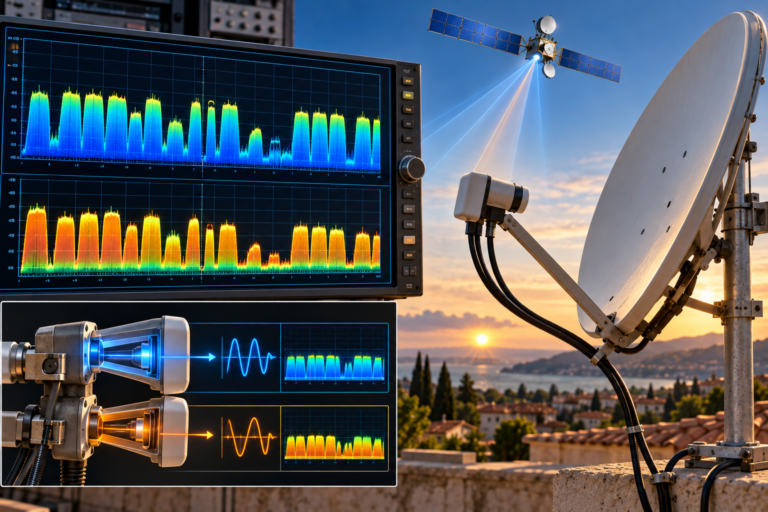
The Low Noise Block converter performs two essential tasks. It amplifies the weak satellite signal while adding as little noise as possible, then converts the microwave frequency into an intermediate frequency suitable for transmission through coaxial cable.
If the LNB develops excessive oscillator drift or increased internal noise, the receiver must work harder to maintain synchronization with the incoming carrier. Modern DVB-S2 receivers are designed to compensate for normal frequency errors, but excessive instability can reduce decoding performance under marginal reception conditions. Simulation studies of DVB-S2 links show that carrier frequency error, timing error, and RF impairments directly influence BER and synchronization performance. :contentReference[oaicite:3]{index=3}
Logical Troubleshooting Steps
Rather than replacing equipment immediately, begin by observing when the problem occurs.
If pixelation appears only during rain, the installation probably lacks adequate signal margin. If the problem affects only one transponder, verify dish alignment and inspect all outdoor connections. If every HD channel experiences identical symptoms throughout the day, examining the LNB, coaxial cable, and receiver signal quality readings becomes the next logical step.
If you have already noticed that channels become softer before they start breaking into squares, our guide explaining why Total TV channels suddenly become blurry explains how declining signal quality gradually affects the decoder before complete pixelation appears.
A higher signal strength reading does not always guarantee reliable reception. Engineers place greater importance on signal quality, BER, and available signal margin because these measurements determine whether the receiver can continuously reconstruct the DVB-S2 transport stream without visible decoding errors.
When Tring TV HD channels suddenly break into squares, the receiver is usually reporting a transmission problem rather than a television fault. Macroblocking occurs because corrupted transport packets exceed the correction capability of the DVB-S2 decoder. Maintaining accurate dish alignment, stable LNB performance, healthy signal margin, and low BER gives the receiver enough clean information to deliver uninterrupted HD television even when reception conditions become less than ideal.
| Question | Answer |
|---|---|
| Why do only HD channels become pixelated? | HD services generally require cleaner reception and are less tolerant of transmission errors. |
| Does signal strength matter more than signal quality? | No. Signal quality and BER are usually better indicators of reliable DVB-S2 decoding. |
| Can rain create square-shaped artifacts? | Yes. Rain fade reduces signal margin and may increase BER until macroblocking appears. |
| Can a faulty LNB cause pixelation? | Yes. Increased internal noise or oscillator instability can reduce decoding reliability. |
| Should I replace my receiver first? | Not usually. Dish alignment, outdoor connectors, coaxial cable, and the LNB should be checked before replacing the receiver. |