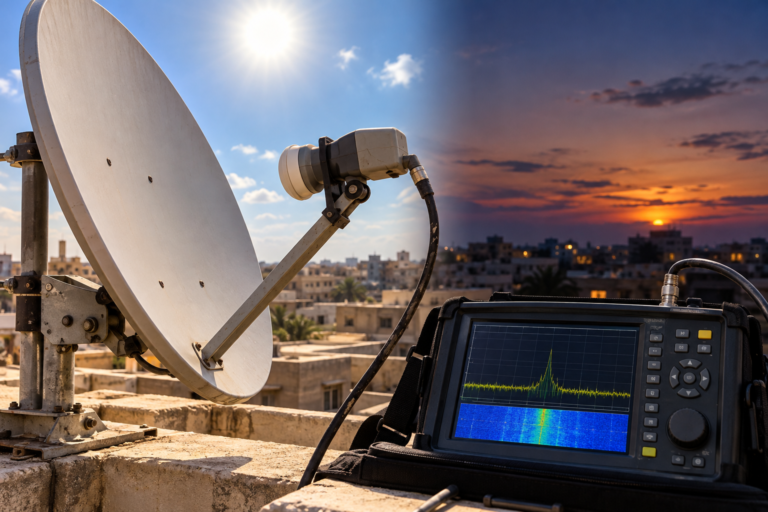
Why One Tiny Dish Adjustment Changes Everything On 16E
Estimated reading time: 19 minutes.
This article explains:
- Why tiny dish movements matter on Eutelsat 16E.
- Signal quality vs signal strength.
- How satellite beam focus actually works.
- Dish alignment margin and decoding reserve.
- LNB skew optimization.
- BER stability improvements.
- Why HD transponders react more strongly.
- Real technical methods for fine-tuning reception.
- How Satellite Beam Geometry Really Works
- Signal Quality vs Signal Strength
- Why Tiny Adjustments Create Big Results
- Signal Margin and Decoding Reserve
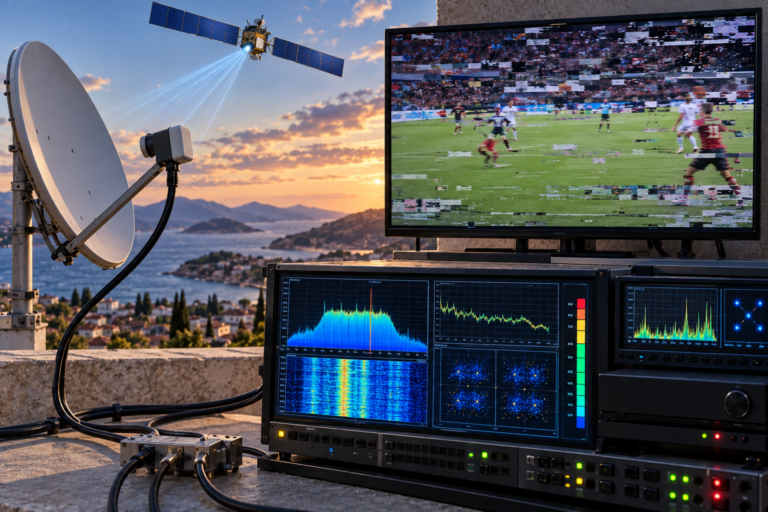
- BER Stability and Error Correction
- Why HD Channels Improve the Most
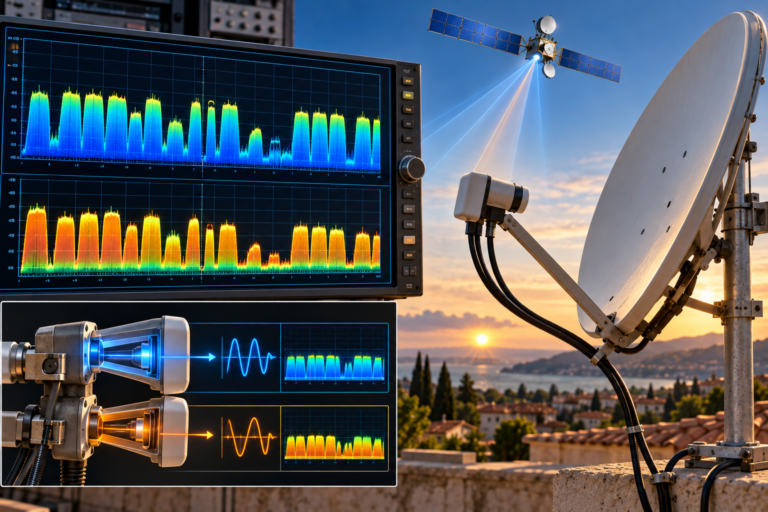
- LNB Skew and Polarization Accuracy
- Weather Resistance After Fine-Tuning
- Technical Comparison Table
- How To Fine-Tune Eutelsat 16E Correctly
- Reality Check
- Final Verdict
- FAQ
How Satellite Beam Geometry Really Works
Many people imagine satellite reception as a simple process where the dish either points at the satellite or does not.
The reality is far more precise.
The satellite beam reaching Earth covers a large area, but the receiving dish still needs to focus incoming energy into a very specific point where the LNB collects the reflected signal.
Even small changes in dish position alter how efficiently that reflected energy reaches the LNB feedhorn.
A movement that looks insignificant to the eye can change the concentration of signal energy enough to improve decoding performance noticeably.
On Eutelsat 16E, this becomes especially important because some transponders operate closer to reception limits than others.
The dish may appear correctly aligned while still missing the true quality peak by a small amount.
That small error often becomes the difference between stable viewing and constant instability.
Signal Quality vs Signal Strength
One of the biggest mistakes during alignment is focusing only on signal strength.
Signal strength measures RF energy reaching the tuner.
Signal quality measures how clean and decodable the digital transport stream actually remains.
Many users stop adjusting once strength reaches a high percentage.
The real goal should be maximizing quality.
A tiny dish movement may increase quality dramatically while barely changing strength readings.
This confuses many users because the receiver screen appears almost unchanged.
Behind the scenes, however, BER stability may improve significantly.
That improvement creates stronger decoding reserve and fewer synchronization problems.
Why Tiny Adjustments Create Big Results
Satellite dishes operate within surprisingly narrow alignment windows.
The strongest quality point often exists inside a very small adjustment range.
Moving slightly above or below that peak may reduce signal reserve without making the loss immediately obvious.
Channels may still open normally during good weather.
Problems appear later when environmental conditions become difficult.
A tiny adjustment often places the dish directly on the quality peak.
The increase may only be a few percentage points on the receiver display.
Yet those few points often represent a large improvement in decoding margin.
That extra reserve helps the system survive humidity changes, rain fade, thermal drift, and interference much more effectively.
Signal Margin and Decoding Reserve
Signal margin is one of the most important concepts in satellite reception.
Every receiver requires a minimum signal quality level to decode channels correctly.
The difference between current quality and that minimum threshold is called the signal margin.
Weak installations may operate dangerously close to the decoding edge.
Under clear weather they seem normal.
Then small environmental changes suddenly create freezing and channel loss.
A tiny dish adjustment often increases signal margin enough to move the system away from the danger zone.
The user may not notice a huge visual change immediately.
The real improvement appears during difficult conditions when the signal remains stable instead of collapsing.
BER Stability and Error Correction
BER stands for Bit Error Rate.
It measures how many digital bits arrive corrupted during transmission.
Modern receivers constantly repair small transmission errors using forward error correction systems.
When BER remains low, decoding stays stable.
When BER rises, the receiver must work harder to reconstruct the transport stream.
A tiny alignment improvement often reduces BER dramatically.
The reduction may seem invisible because channels already work.
However, lower BER creates stronger long-term stability.
The receiver spends less time correcting errors and more time maintaining clean synchronization.
This becomes extremely important on demanding DVB-S2 HD transponders.
Why HD Channels Improve the Most
HD channels usually react more strongly to alignment improvements.
Modern HD broadcasting often uses DVB-S2 combined with 8PSK modulation.
These systems provide excellent bandwidth efficiency but require cleaner signal quality.
Small BER increases affect HD streams much faster than older SD channels.
This is why users often notice that a tiny dish adjustment suddenly stabilizes HD channels while SD channels appeared normal all along.
The HD transponder was operating near its correction limit.
The alignment improvement increased quality reserve enough to restore stable decoding.
The satellite did not become stronger.
The receiving system simply became more efficient.
LNB Skew and Polarization Accuracy
Many users focus only on dish direction while ignoring LNB skew.
Skew controls the rotational angle of the LNB relative to satellite polarization.
Eutelsat 16E uses both horizontal and vertical transponders.
Incorrect skew reduces isolation between these polarizations.
This creates contamination between signals and increases decoding difficulty.
A tiny skew adjustment sometimes improves quality more than moving the dish itself.
Sensitive frequencies often respond immediately.
BER drops. Quality rises. Stability improves.
This is one reason professional installers spend significant time optimizing skew after basic alignment is complete.
Weather Resistance After Fine-Tuning
One of the biggest benefits of proper alignment is weather resistance.
Rain fade removes signal margin from the system.
Weak installations lose lock quickly because little reserve exists.
Well-optimized systems survive much longer.
A tiny alignment improvement often creates enough reserve to prevent weather-related failures entirely during moderate rain.
Users sometimes believe the weather became weaker after dish adjustment.
The real reason is that the installation now operates with stronger signal margin.
Environmental stress no longer pushes the receiver below the decoding threshold.
Technical Comparison Table
| Condition | Before Fine Adjustment | After Fine Adjustment |
|---|---|---|
| Signal quality | Near threshold | Higher reserve margin |
| BER stability | Frequent spikes | Lower error rate |
| HD channel performance | Sensitive to instability | More stable decoding |
| Rain resistance | Fails earlier | Better weather tolerance |
| Receiver synchronization | Occasional lock problems | More stable operation |
| Transponder reliability | Uneven performance | Improved consistency |
How To Fine-Tune Eutelsat 16E Correctly
Always use signal quality measurements instead of relying only on strength readings.
Move the dish slowly in extremely small increments.
Allow the receiver a few seconds to react after each adjustment.
Watch quality stability instead of chasing the highest strength number.
Check multiple transponders during optimization.
Some frequencies reveal alignment weaknesses more clearly than others.
Optimize LNB skew carefully after dish positioning is complete.
Inspect cable condition and connectors because alignment improvements cannot compensate for damaged hardware.
Stable low-noise LNB units also improve results significantly on difficult Eutelsat 16E frequencies.
If you want deeper analysis of signal behavior and Eutelsat troubleshooting, read Why Some Eutelsat 16E Channels Work Only After Midnight.
Most unstable Eutelsat 16E systems are not suffering from major hardware failures. Very often, they are operating slightly away from the true quality peak. A tiny adjustment may only improve quality by a few percentage points, but those points can dramatically increase decoding reserve and long-term stability.
One tiny dish adjustment can change everything on Eutelsat 16E because modern satellite reception depends heavily on signal quality margin rather than raw signal strength. Small improvements in alignment, BER stability, and polarization accuracy often create large gains in decoding performance. The difference between constant instability and reliable reception is sometimes measured in only a few millimeters of movement.
FAQ
| Question | Answer |
|---|---|
| Can a very small dish movement really improve reception? | Yes. Tiny adjustments can increase signal quality margin significantly. |
| Why does signal quality matter more than strength? | Because decoding stability depends mainly on clean signal quality and low BER. |
| Do HD channels react more strongly to alignment changes? | Yes. HD DVB-S2 transponders require cleaner signal conditions. |
| Can skew adjustment improve unstable frequencies? | Yes. Proper polarization alignment often improves difficult transponders dramatically. |
| Will better alignment improve rain performance? | Usually yes, because stronger signal margin increases weather resistance. |
| What should I monitor during alignment? | Signal quality, BER stability, and transponder consistency rather than strength alone. |