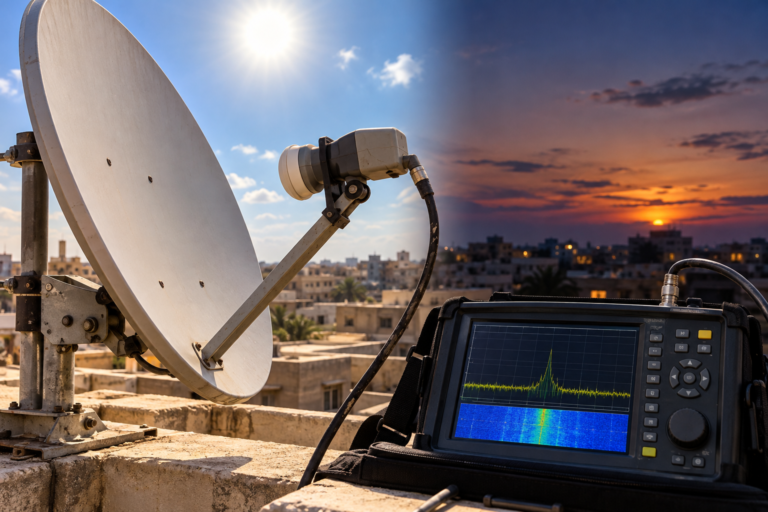
Why Eutelsat 16E Signal Gets Worse At Exactly The Same Time Daily
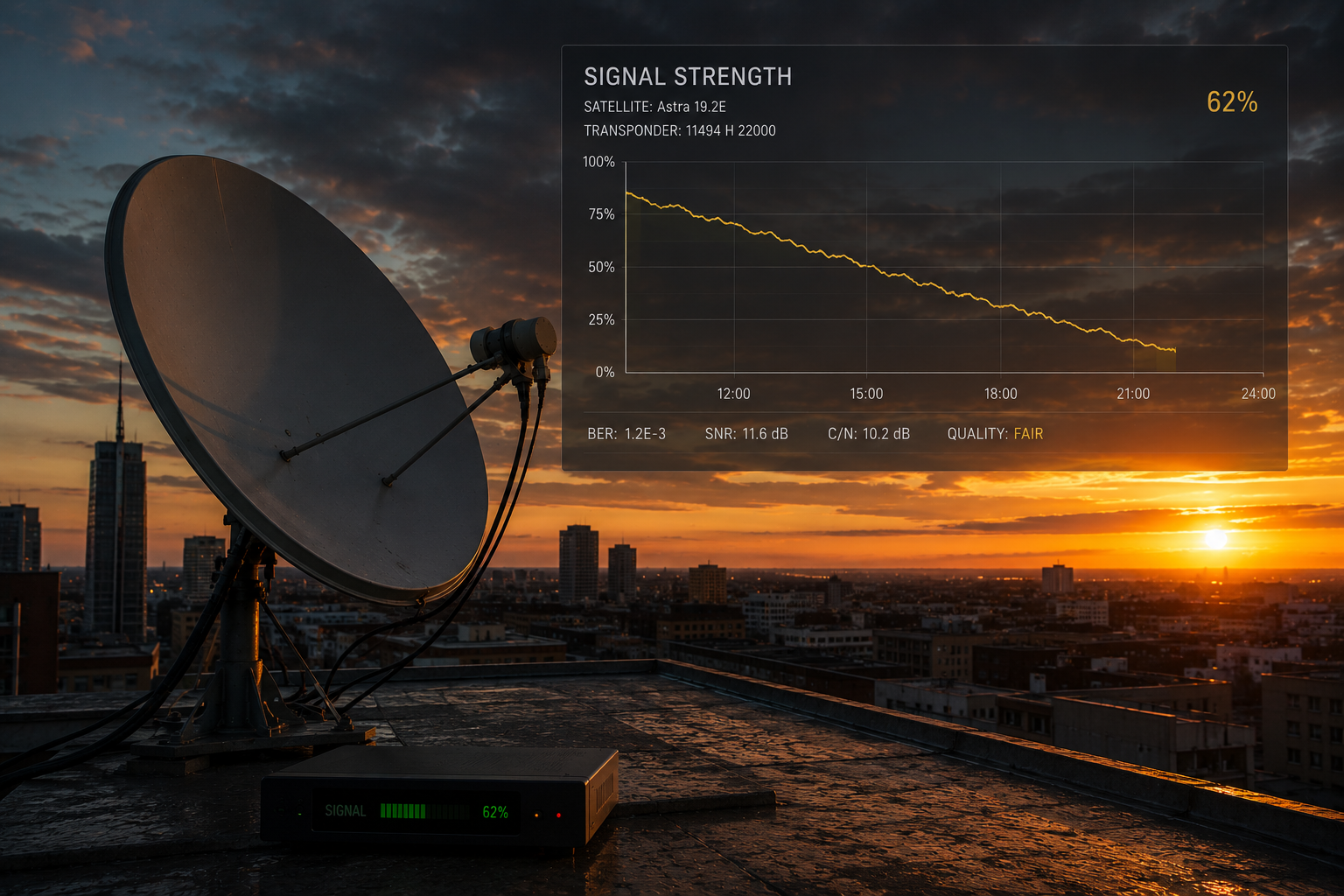
Estimated reading time: 18 minutes.
- Why signal drops happen at the same hour daily.
- LNB temperature drift and oscillator instability.
- Signal margin behavior throughout the day.
- Atmospheric changes after sunset.
- Dish expansion and thermal movement.
- Receiver synchronization pressure.
- Why weak transponders fail first.
- Real fixes for recurring daily instability.
- Why Daily Signal Patterns Are Common
- Temperature Changes Affect Reception More Than Most People Realize
- LNB Thermal Drift And Frequency Accuracy
- Signal Margin Shrinks During Critical Hours
- Atmospheric Conditions Change Every Evening
- Dish Expansion And Mechanical Movement
- Why HD Channels Usually Show Problems First
- Receiver Synchronization Under Stress
- Technical Comparison Table
- How To Fix Daily Signal Drops
- Reality Check
- Final Verdict
- FAQ
Why Daily Signal Patterns Are Common
When a signal problem appears at nearly the same time every day, the cause is rarely random.
Satellite systems constantly interact with environmental conditions.
Temperature changes follow predictable daily cycles.
Atmospheric behavior changes as daylight disappears.
Outdoor equipment heats and cools at specific rates.
Because these physical conditions repeat every day, reception problems often repeat on a similar schedule.
The satellite itself remains in normal operation.
What changes is the condition of the receiving system.
A marginal installation may remain stable for most of the day before losing enough signal margin to reveal hidden weaknesses.
Temperature Changes Affect Reception More Than Most People Realize
Satellite equipment spends its entire life outdoors.
During daylight hours, dishes, LNB units, brackets, and cables absorb heat continuously.
As sunset approaches, temperatures begin changing rapidly.
Different materials cool at different speeds.
Metal structures contract slightly.
Plastic components respond differently.
These changes may sound insignificant.
However, satellite reception often depends on extremely precise geometry and frequency stability.
A small physical change may slightly alter signal quality on already sensitive Eutelsat 16E transponders.
LNB Thermal Drift And Frequency Accuracy
One of the most common causes of daily signal variation is LNB thermal drift.
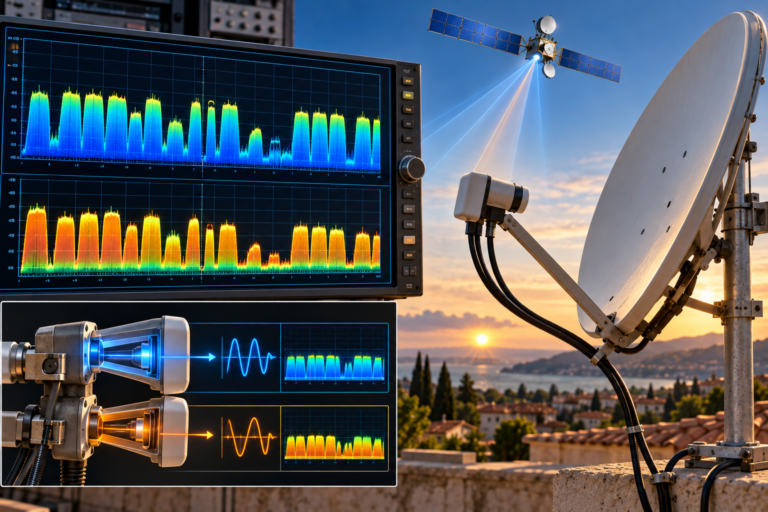
Inside every LNB exists an oscillator that converts high satellite frequencies into lower frequencies the receiver can process.
Modern DVB-S2 transponders require highly accurate synchronization.
As temperature changes, oscillator behavior may shift slightly.
High-quality LNB units control this behavior very well.
Cheaper or aging LNBs often become less stable.
The result is frequency drift.
Receivers may still detect the signal, but synchronization becomes more difficult.
BER begins increasing.
Signal quality slowly drops even though signal strength appears almost unchanged.
This is one reason daily signal degradation often affects the same frequencies repeatedly.
Signal Margin Shrinks During Critical Hours
Signal margin is the hidden safety reserve above the minimum decoding threshold.
Strong installations contain comfortable reserve capacity.
Weak installations operate much closer to the edge.
When temperature changes, slight atmospheric attenuation appears, or hardware stability shifts, that reserve becomes smaller.
A system that worked comfortably during the afternoon may suddenly approach the decoding limit in the evening.
The receiver begins working harder to maintain synchronization.
Small BER spikes appear.
Weak transponders become unstable.
Users often interpret this as a mysterious daily signal loss when the real issue is shrinking signal margin.
Atmospheric Conditions Change Every Evening
The atmosphere is not a static environment.
Humidity levels change.
Air density changes.
Temperature layers move continuously.
These changes slightly affect microwave signal propagation.
Strong satellite systems absorb these variations easily.
Marginal systems react much more aggressively.
A transponder operating near the correction threshold may begin showing instability at exactly the same time every evening because the atmosphere changes in a predictable daily pattern.
The signal itself is not disappearing.
The receiving system simply lacks enough reserve to ignore those environmental changes.
Dish Expansion And Mechanical Movement
Many users focus entirely on electronic components while ignoring mechanical behavior.
Satellite dishes expand slightly during hot daylight conditions.
As temperatures drop, structures contract again.
The movement is extremely small.
Yet Eutelsat 16E often reacts strongly to alignment precision.
A dish that was already slightly off the quality peak may lose additional margin during thermal movement.
This explains why some users experience recurring evening instability despite apparently correct installation.
The alignment was never fully optimized.
The daily thermal cycle simply exposes the weakness repeatedly.
Why HD Channels Usually Show Problems First
HD channels often use DVB-S2 combined with higher-density modulation systems such as 8PSK.
These technologies improve efficiency but require cleaner signal quality.
Small BER increases affect HD transponders much faster than older SD services.
This is why users often notice evening problems first on HD channels.
The HD transponder is usually not weaker.
It simply operates with stricter decoding requirements.
A small loss of quality margin becomes visible immediately.
The same installation may continue displaying SD channels normally while HD channels begin freezing or disappearing.
Receiver Synchronization Under Stress
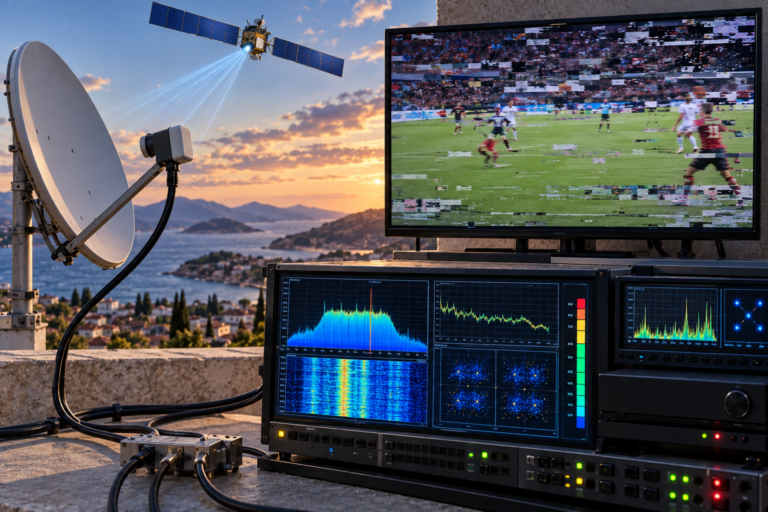
Receivers continuously rebuild transport streams while correcting transmission errors.
As signal quality drops, synchronization becomes harder to maintain.
The receiver begins working under greater correction pressure.
Some tuners handle these situations well.
Others lose lock quickly.
This explains why two receivers connected to similar systems may behave differently during the same evening conditions.
The receiver often reveals hidden signal margin weaknesses rather than creating the problem itself.
Technical Comparison Table
| Condition | Stable Installation | Installation With Daily Signal Drops |
|---|---|---|
| Signal margin | Large reserve available | Operating near threshold |
| LNB stability | Stable oscillator performance | Thermal drift possible |
| Dish alignment | Optimized quality peak | Slight alignment weakness |
| Evening behavior | Minimal change | Noticeable quality loss |
| HD transponder stability | Stable decoding | Frequent freezing |
| BER performance | Low error rate | Evening error spikes |
How To Fix Daily Signal Drops
Begin by maximizing signal quality rather than focusing only on strength percentages.
Fine-tune dish alignment carefully.
Small adjustments often create large improvements in quality reserve.
Inspect the LNB.
If the unit is old or low quality, replacement may dramatically improve stability.
Check cable condition and connector quality.
Moisture damage often increases instability during environmental transitions.
Monitor several transponders throughout the day.
Patterns often reveal whether the issue comes from thermal drift, signal margin weakness, or alignment problems.
For a deeper explanation of how tiny alignment changes transform reception stability, read Why One Tiny Dish Adjustment Changes Everything On 16E.
When Eutelsat 16E becomes weaker at the same time every day, the satellite is usually not the real problem. Repeating environmental conditions, thermal changes, LNB drift, and weak signal margin create recurring instability patterns that appear almost like a scheduled event.
Daily signal degradation on Eutelsat 16E is usually the result of predictable physical behavior rather than mysterious satellite issues. Temperature cycles, atmospheric changes, shrinking signal margin, and hardware stability all combine to create recurring reception patterns. Systems with strong alignment and healthy hardware usually remain stable, while marginal installations reveal the same weaknesses at nearly the same hour every day.
FAQ
| Question | Answer |
|---|---|
| Why does my Eutelsat 16E signal drop every evening? | Usually because environmental changes expose weak signal margin or hardware instability. |
| Can temperature affect satellite reception? | Yes. Temperature changes influence LNB stability and mechanical alignment behavior. |
| What is LNB thermal drift? | It is frequency instability caused by temperature-related oscillator changes inside the LNB. |
| Why are HD channels affected first? | Because HD DVB-S2 transponders require cleaner signal quality and stronger synchronization. |
| Can better alignment solve daily signal drops? | Very often yes, because stronger signal margin improves long-term stability. |
| Does the satellite change power every evening? | No. Daily reception changes usually come from the receiving system rather than satellite transmission changes. |