The Strange Difference Between Signal Strength And Signal Quality
Estimated reading time: 18 minutes.
- What signal strength actually measures.
- What signal quality actually measures.
- Why high strength can still produce no channels.
- BER and digital decoding stability.
- DVB-S2 sensitivity to quality loss.
- Receiver lock behavior.
- How alignment affects quality more than strength.
- Practical troubleshooting methods.
- Why Strength And Quality Are Not The Same
- What Signal Strength Really Means
- What Signal Quality Actually Measures
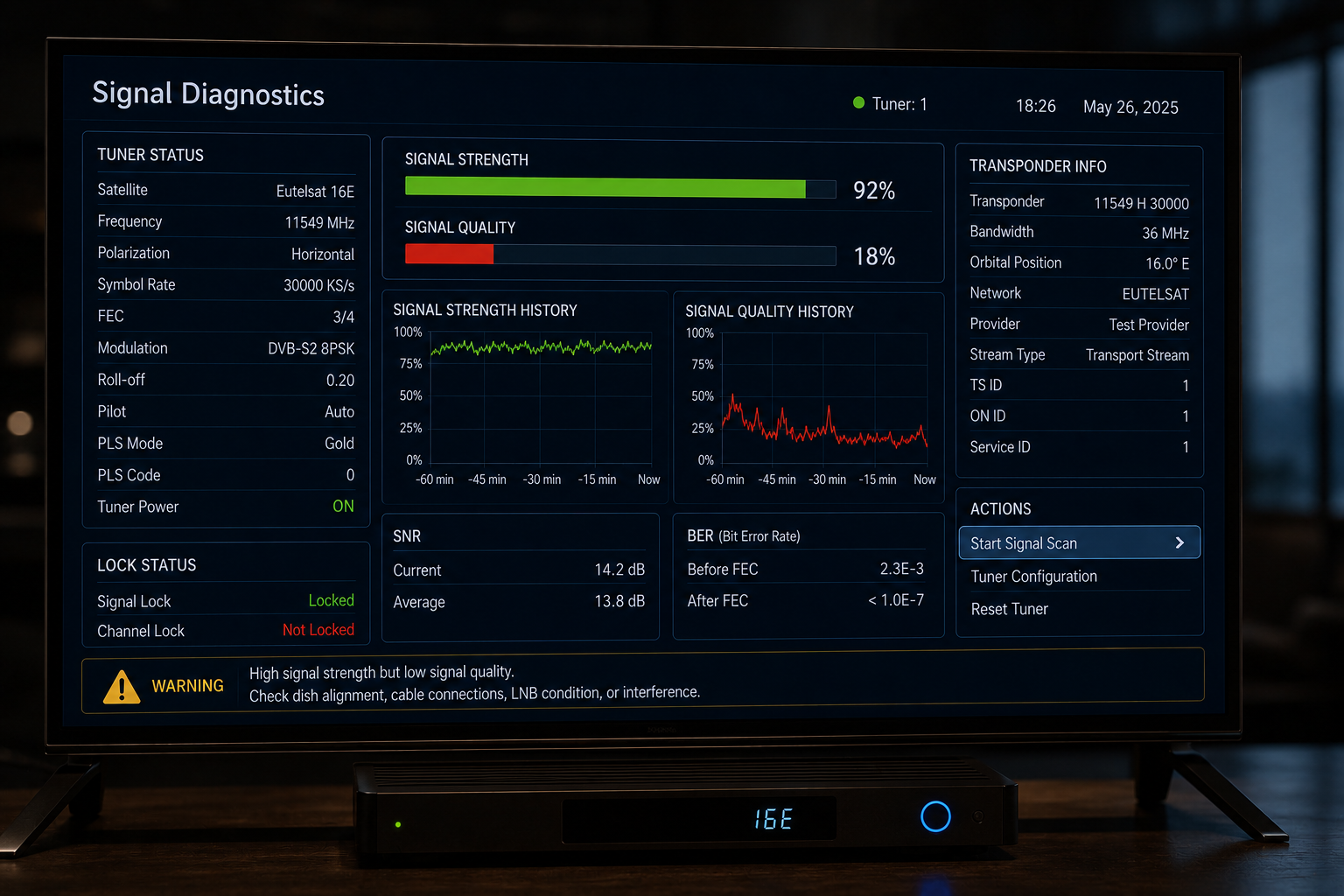
- Why High Strength Can Still Cause Failure
- BER And Digital Signal Integrity
- Why DVB-S2 Depends More On Quality
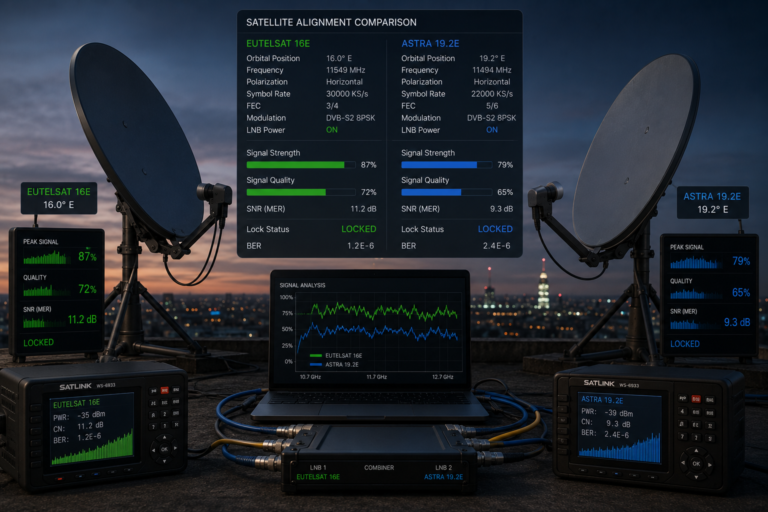
- Dish Alignment And Quality Peaks
- How Receivers Interpret Both Measurements
- Technical Comparison Table
- How To Improve Signal Quality
- Reality Check
- Final Verdict
- FAQ
Why Strength And Quality Are Not The Same
Many receivers display both signal strength and signal quality using percentage values.
Because the numbers look similar, users often assume they measure the same thing.
They do not.
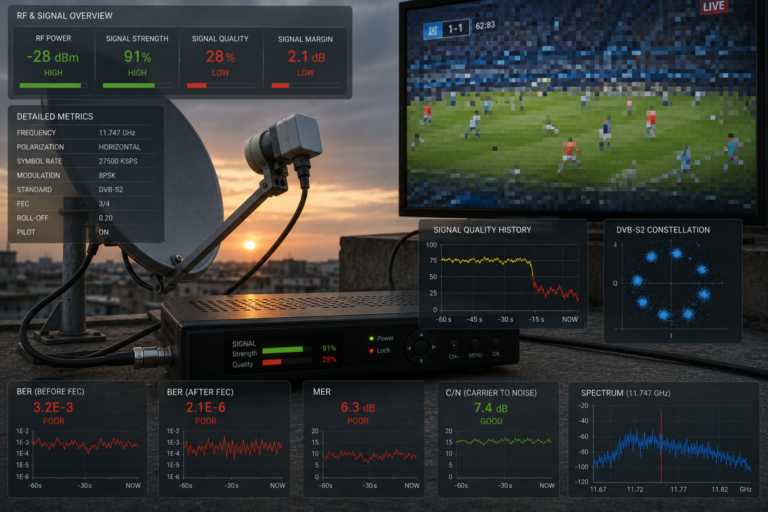
Signal strength measures how much RF energy reaches the tuner.
Signal quality measures how accurately the receiver can decode digital information from that signal.
A strong signal can still contain noise, distortion, synchronization errors, or frequency instability.
When that happens, strength remains high while quality falls dramatically.
The receiver sees plenty of signal energy but struggles to interpret the actual data stream.
What Signal Strength Really Means
Signal strength is essentially a measurement of incoming RF power.
The tuner detects electromagnetic energy arriving from the LNB.
The receiver then converts that energy into a percentage value.
A high strength reading simply confirms that the receiver sees a signal source.
It does not guarantee that the signal is usable.
For example, a poorly aligned dish may still deliver strong RF energy.
An unstable LNB may still produce high strength readings.
Even interference can sometimes raise strength while damaging reception quality.
What Signal Quality Actually Measures
Signal quality reflects how clean the digital stream appears to the receiver.
This includes synchronization accuracy, error correction performance, and overall decoding reliability.
Quality directly affects whether channels open successfully.
When quality remains stable, the receiver can reconstruct the transport stream correctly.
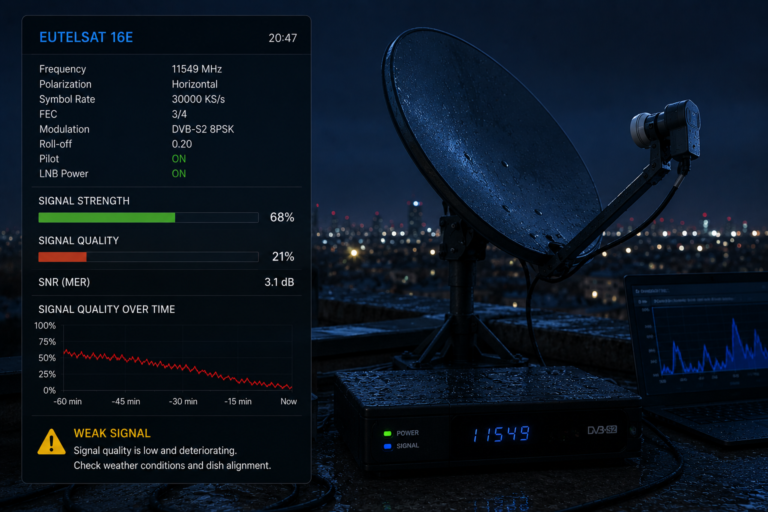
When quality drops, decoding begins failing.
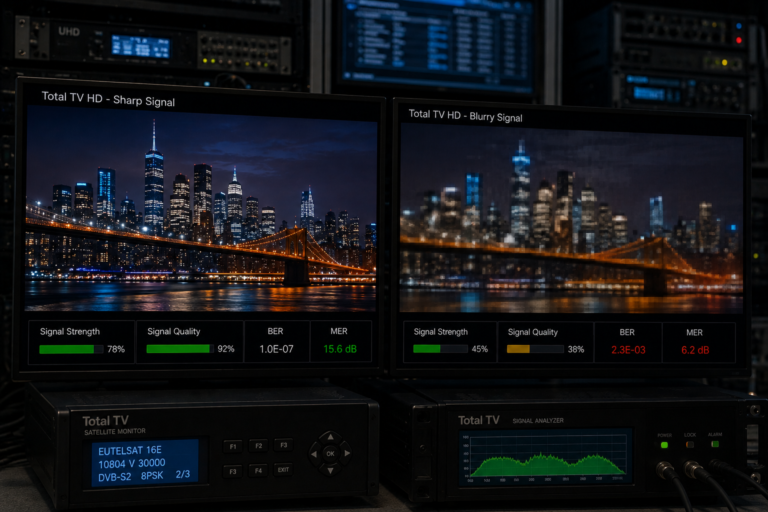
This is why quality readings often predict channel stability much better than strength readings.
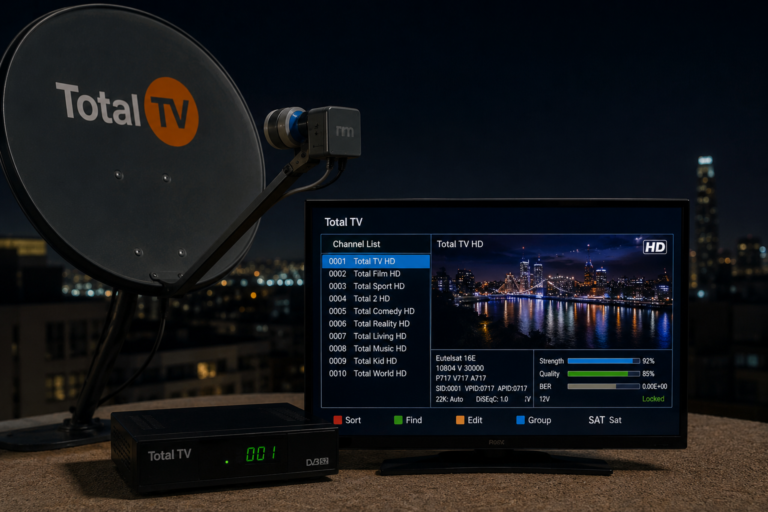
On Eutelsat 16E, quality usually determines whether difficult HD transponders remain stable.
Why High Strength Can Still Cause Failure
Many users encounter a situation where signal strength looks excellent but channels refuse to lock.
This happens because strength only measures signal presence.
The receiver may detect large amounts of RF energy while receiving poor digital information.
Frequency drift, weak alignment, poor LNB performance, noise, and BER instability can all damage quality without significantly affecting strength.
The result is one of the most confusing troubleshooting situations in satellite reception.
The signal appears strong.
The channels still fail.
The missing piece is signal quality.
BER And Digital Signal Integrity
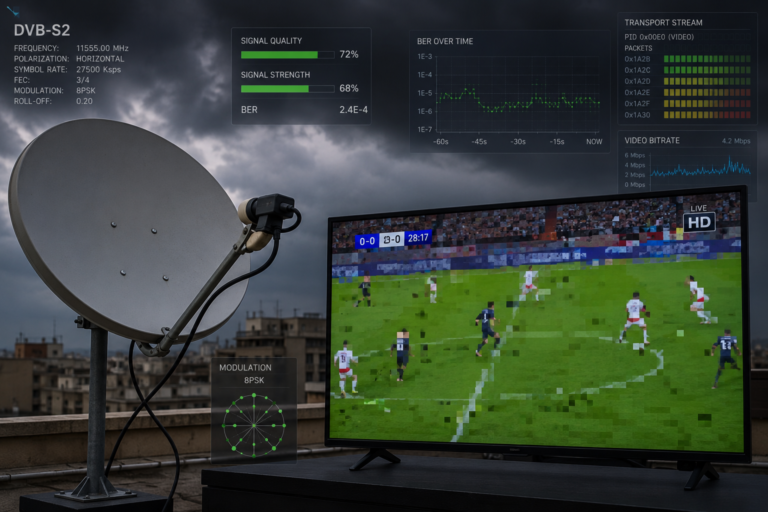
BER stands for Bit Error Rate.
It represents the number of transmission errors reaching the receiver.
Every digital satellite signal contains some errors.
Forward correction systems repair them automatically.
As BER rises, correction becomes harder.
Quality readings begin falling.
Eventually the receiver reaches a point where the transport stream can no longer be reconstructed accurately.
At that stage channels freeze, pixelate, or disappear completely.
This often happens even while strength readings remain high.
Why DVB-S2 Depends More On Quality
Modern Eutelsat 16E services rely heavily on DVB-S2 technology.
DVB-S2 provides excellent bandwidth efficiency.
However, it also demands cleaner reception conditions.
Small quality losses affect DVB-S2 frequencies much more aggressively than older DVB-S services.
This is why HD channels often reveal problems before SD channels.
The HD transponder usually requires better synchronization and lower BER.
If quality drops slightly, HD reception often becomes unstable first.
Dish Alignment And Quality Peaks
Many users align dishes by maximizing signal strength.
This often produces acceptable results but not optimal ones.
The real goal should be maximizing signal quality.
A tiny dish movement may produce almost no change in strength while dramatically improving quality.
This happens because quality peaks are usually narrower than strength peaks.
A dish positioned near the edge of the quality peak may still show strong signal strength.
However, difficult transponders may remain unstable until alignment is refined further.
How Receivers Interpret Both Measurements
Receivers constantly analyze incoming signals.
Strength readings come primarily from tuner power measurements.
Quality readings depend on successful synchronization and error correction performance.
This is why quality often changes faster than strength.
A small degradation may have little effect on signal power but a major effect on decoding stability.
Experienced installers usually focus on quality because it reflects real-world channel performance more accurately.
Technical Comparison Table
| Characteristic | Signal Strength | Signal Quality |
|---|---|---|
| Main purpose | Measures RF energy | Measures decoding reliability |
| Indicates satellite presence | Yes | Partially |
| Predicts channel stability | Limited | Very accurately |
| Affected by BER | Usually no | Strongly affected |
| Critical for DVB-S2 | Less important | Extremely important |
| Best troubleshooting metric | Basic reference | Primary diagnostic tool |
How To Improve Signal Quality
Start by optimizing dish alignment using quality readings rather than strength percentages.
Check LNB stability and skew adjustment.
Inspect connectors for moisture or corrosion.
Verify cable quality and shielding.
Monitor BER if your receiver provides that information.
Small quality improvements often create major gains in channel stability.
Many users spend time chasing higher strength when the real solution is cleaner signal quality.
For a deeper explanation of recurring daily signal fluctuations, read Why Eutelsat 16E Signal Gets Worse At Exactly The Same Time Daily.
High signal strength does not automatically mean good reception. A receiver can detect strong RF energy while struggling to decode the digital stream. Signal quality is usually the measurement that determines whether channels remain stable, especially on modern DVB-S2 HD transponders.
The strange difference between signal strength and signal quality explains many satellite reception mysteries. Strength only confirms that a signal exists. Quality determines whether the receiver can actually use that signal successfully. For Eutelsat 16E troubleshooting, quality should almost always receive more attention than strength because it directly controls synchronization, BER stability, and channel reliability.
FAQ
| Question | Answer |
|---|---|
| Can I have high signal strength and no channels? | Yes. High strength does not guarantee good signal quality. |
| Which measurement is more important? | Signal quality is usually more important for stable reception. |
| Why do HD channels fail first? | Because DVB-S2 HD channels require cleaner synchronization and lower BER. |
| Can dish alignment improve quality? | Yes. Small alignment changes often improve quality significantly. |
| Does BER affect signal strength? | Usually no. BER mainly affects signal quality and decoding stability. |
| What should I watch during troubleshooting? | Monitor signal quality and BER rather than focusing only on strength. |