How Sky Italia Handles Millions Of Viewers At The Same Time
Estimated reading time: 11 to 13 minutes.
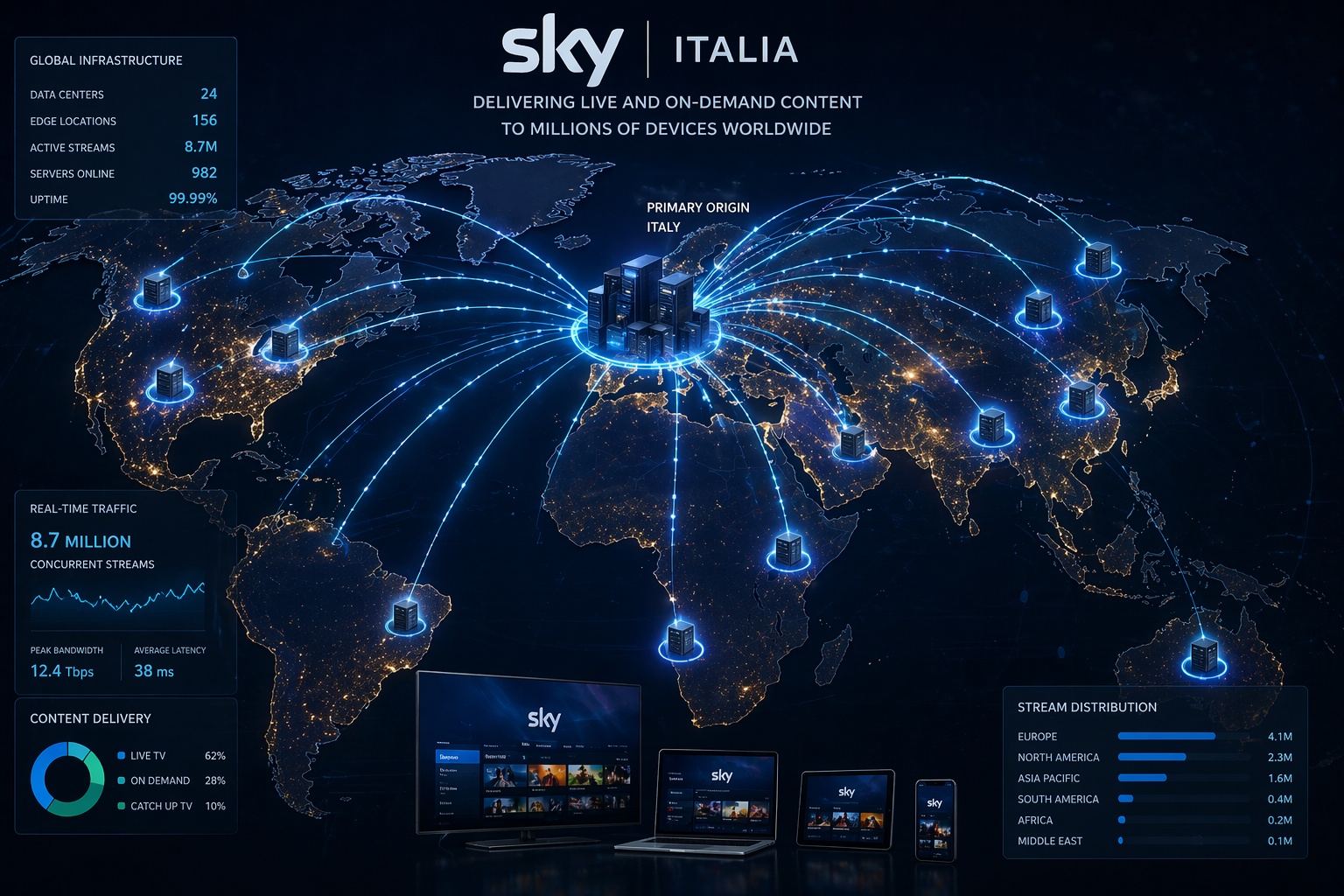
When millions of people watch Sky Italia at the same time, the system does not send one single stream to everyone. Instead, it distributes the load across a large and complex infrastructure. This is what allows the platform to remain stable even during major live events.
Streaming at scale is not about raw power alone. It depends on smart distribution, efficient routing, and adaptive systems that respond in real time. Without these mechanisms, even a powerful system would collapse under high demand.
Quick Context. Sky Italia handles millions of viewers using Content Delivery Networks, load balancing, caching systems, and distributed server architecture.
Table of Contents
The challenge of millions of viewers
Content Delivery Networks explained
Load balancing and traffic distribution
Edge servers and geographic delivery
Caching and repeated content efficiency
The challenge of millions of viewers
Streaming to a single user is simple. Streaming to millions at the same time is a completely different problem.
If all users connected to one server, it would immediately overload. The system must spread requests across multiple resources.
This requires a distributed architecture where traffic is divided and handled efficiently.
Scalability is the key requirement for modern streaming systems.
Content Delivery Networks explained
Content Delivery Networks are one of the main tools used to scale streaming. A CDN consists of many servers located in different regions.
Instead of sending data from a single central server, content is stored and delivered from multiple locations closer to users. :contentReference[oaicite:0]{index=0}
This reduces latency and distributes the load across thousands of nodes.
CDNs are essential for handling large audiences efficiently.
Load balancing and traffic distribution
Load balancing distributes incoming user requests across multiple servers. This prevents any single server from becoming overloaded.
Advanced systems use dynamic load balancing, which adjusts distribution based on current conditions. :contentReference[oaicite:1]{index=1}
If one server becomes busy, traffic is redirected to others.
This ensures that performance remains stable even during heavy demand.
Edge servers and geographic delivery
Edge servers are part of the CDN. They are located close to users to reduce distance and delay.
When you start a stream, the system connects you to the nearest available server.
This improves speed and reduces network load on central systems.
Geographic distribution is critical for global streaming platforms.
Caching and repeated content efficiency
When many users watch the same content, the system does not generate it repeatedly. Instead, it uses caching.
Caching stores frequently requested video segments in memory close to users.
This reduces server workload and speeds up delivery. :contentReference[oaicite:2]{index=2}
Without caching, systems would not scale efficiently.
Adaptive streaming at scale
Adaptive streaming allows each user to receive a stream that matches their connection.
This reduces pressure on the system because not all users request the same quality level.
Lower bandwidth users receive lighter streams, while stronger connections receive higher quality.
This flexibility helps balance overall system load.
Redundancy and failover systems
Modern streaming platforms use redundancy to avoid failure. Multiple CDNs and servers are used simultaneously.
If one system fails, traffic is automatically redirected to another.
This approach eliminates single points of failure and improves reliability. :contentReference[oaicite:3]{index=3}
Failover systems are essential during peak events.
Real world scenario
During a major football match, millions of viewers connect at the same time.
The system distributes them across thousands of servers. Each viewer connects to the nearest node.
Load balancers ensure that no server becomes overloaded. Caching reduces repeated data requests.
For understanding how video quality adapts under load, see this guide Why Sky Italia Looks Blurry Sometimes.
| Component | Function | Impact | Result |
|---|---|---|---|
| CDN | Distributed delivery | Reduced latency | Faster streaming |
| Load balancing | Traffic distribution | Prevent overload | Stable system |
| Edge servers | Local delivery | Shorter distance | Better performance |
| Caching | Store content | Less server load | Efficient scaling |
| Failover | Backup systems | High availability | No downtime |
Reality Check
Handling millions of viewers is not about one powerful server. It requires a distributed system where load is shared across many layers. Even small inefficiencies can affect performance at scale.
Final Verdict
Sky Italia handles millions of viewers by distributing traffic across a global infrastructure of servers, CDNs, and load balancing systems. This approach ensures that no single point becomes overloaded. Scalability is achieved through smart distribution, caching, and adaptive streaming. Without these systems, large scale streaming would not be possible.
FAQ
| Question | Answer |
|---|---|
| How does Sky Italia handle many users | By using distributed servers and CDNs |
| What is a CDN | A network of servers that deliver content closer to users |
| Why is load balancing important | It prevents servers from being overloaded |
| What happens during peak events | The system distributes traffic across many servers |
| Can the system fail under heavy load | Modern systems use redundancy to avoid failure |