Why Tring HD Channels Freeze Randomly on Satellite
Estimated Reading Time: 8 minutes
A Tring HD channel can play perfectly for several minutes, freeze for a second, recover, and then repeat the problem later. Because the picture works between interruptions, the fault often appears completely random. In many satellite installations, however, there is a measurable RF reason behind this behaviour.
The receiver may be operating close to the digital decoding threshold. Small changes in signal quality caused by dish alignment, LNB performance, cabling, weather or mechanical movement can then push the DVB-S2 carrier from reliable reception into a region where error correction can no longer recover all of the transmitted data.
Random freezing does not automatically mean that Tring’s broadcast is faulty, and it does not happen simply because a channel is HD. The first task is to determine whether the interruption originates in the satellite RF path, receiver, decoding chain or programme distribution itself.
- Why Digital Satellite TV Can Fail Suddenly
- The Hidden Role of Signal Margin
- Why MER Matters More Than a Signal Percentage
- What BER Reveals About Freezing
- Small Dish Alignment Errors Can Be Enough
- How the LNB Can Create Intermittent Problems
- Cables and Connectors Can Cause Random Errors
- Weather, Wind and Changing Reception Conditions
- Why Only Some Tring Channels May Freeze
- Why Changing the Receiver Can Appear to Fix It
- How to Diagnose Tring Freezing Correctly
- Reality Check
- Final Verdict
- FAQ
Why Digital Satellite TV Can Fail Suddenly
Digital satellite television behaves very differently from old analogue television.
An analogue picture normally became progressively noisier as reception weakened. Digital television can remain visually perfect while the receiver still has enough signal quality to reconstruct the transmitted data.
Forward error correction can repair a certain amount of corrupted information. As reception deteriorates, the viewer may therefore notice almost nothing initially.
Eventually, however, the error rate becomes too high.
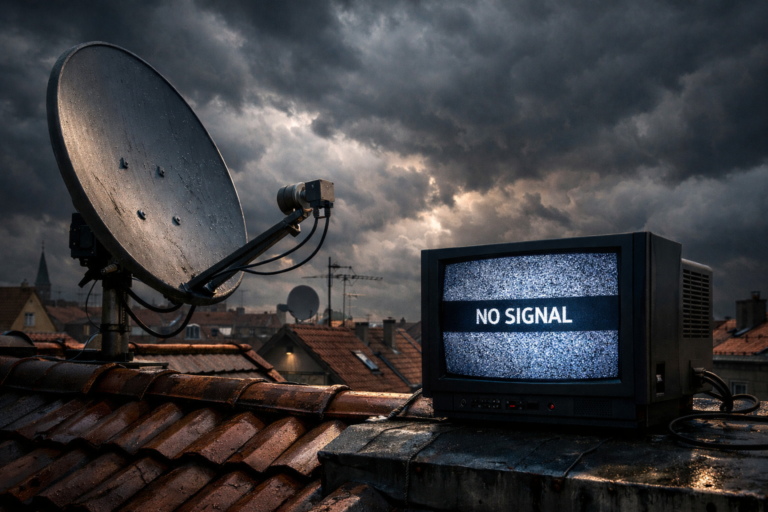
Once the receiver can no longer recover enough valid transport-stream data, the result can be frozen frames, block corruption, audio interruptions or complete loss of picture.
This transition is commonly described as the digital cliff.
A system operating comfortably above the cliff can be highly stable. A system operating just above it may appear normal most of the time but fail whenever conditions change slightly.
The Hidden Role of Signal Margin
The important difference between a reliable installation and a marginal one is often not whether both currently show a picture. It is how much usable margin remains before reception fails.
Imagine two receivers displaying the same Tring HD programme under clear weather.
Both pictures look identical because digital video does not become sharper merely because the RF signal has more margin.
But one installation may have substantial reserve above the required demodulation threshold, while the other sits dangerously close to it.
A small additional loss caused by rain, wind, LNB drift or cable variation may have almost no visible effect on the first installation. The second may immediately begin freezing.
A perfect picture does not prove that the satellite link has healthy margin. Digital reception can look perfect until the available margin is almost exhausted.
This is why intermittent freezing often requires measurements rather than simply looking at the television picture.
Why MER Matters More Than a Signal Percentage
Consumer satellite receivers often display values such as “Signal Strength 90%” and “Quality 70%.” These numbers can be useful for basic adjustment, but they should not be treated as standardized RF measurements.
Manufacturers can calculate and scale these percentages differently. A 75% reading on one receiver is not necessarily equivalent to 75% on another.
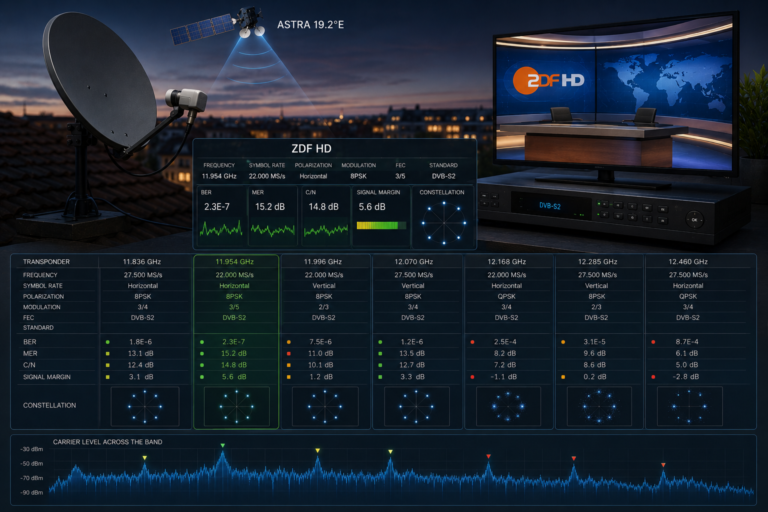
MER, or Modulation Error Ratio, provides a much more meaningful view of digital modulation quality when measured correctly.
In simplified terms, MER indicates how cleanly the received constellation points correspond to their ideal positions.
Noise, interference, distortion and other impairments can reduce MER.
The important quantity is not simply the absolute MER number but the margin between the measured value and the level required for reliable demodulation of the specific modulation and coding configuration.
A carrier with comfortable margin can tolerate additional degradation. A carrier already close to threshold cannot.
This is why two installations can both show “good signal” while one freezes regularly and the other remains stable.
For a broader explanation, see Why Signal Quality Matters More Than Signal Strength.
What BER Reveals About Freezing
BER, or Bit Error Rate, measures errors in the recovered digital data.
It is particularly useful because DVB satellite systems use forward error correction. The receiver can encounter transmission errors and still deliver a perfect programme as long as the correction system successfully repairs them.
Depending on the measuring instrument, BER may be reported at different points in the decoding chain.
Errors observed before final correction do not necessarily mean visible picture corruption. What matters is whether the error-correction system retains enough margin to recover the stream reliably.
DVB-S2 uses powerful LDPC and BCH error correction. This allows impressive operation under difficult RF conditions, but FEC is not unlimited.
When the incoming carrier deteriorates sufficiently, uncorrectable errors begin reaching the transport stream.
That is when the television picture can suddenly freeze or break apart.
| Reception Condition | What the Receiver May Do | Visible Result |
|---|---|---|
| Healthy margin | Demodulates and corrects errors comfortably | Stable picture |
| Reduced margin | FEC works harder but still recovers data | Picture may still appear perfect |
| Near threshold | Short bursts of errors become difficult to correct | Occasional freezing or pixelation |
| Below threshold | Carrier or transport-stream recovery fails | Severe breakup or complete loss |
Small Dish Alignment Errors Can Be Enough
A satellite dish does not need to be dramatically misaligned to create an intermittent problem.
If an installation already has limited margin, a small azimuth or elevation error can reduce the antenna gain available in the required direction.
The same applies to LNB skew.
Satellite systems can use opposite polarizations to reuse frequency resources. Incorrect LNB rotation can reduce polarization isolation and make the wanted carrier more vulnerable to energy from the opposite polarization.
The result may still be enough for reception under ideal conditions but insufficient when the RF environment deteriorates slightly.
Mechanical stability also matters. A loose mount or flexible pole can allow the antenna to move in wind. The movement may be too small to notice visually but large enough to reduce margin temporarily.
When freezing happens mainly during windy conditions, the physical installation deserves careful inspection.
How the LNB Can Create Intermittent Problems
The LNB is another important part of the RF chain.
It receives the microwave energy focused by the dish, amplifies the signal and converts the Ku-band carrier to a lower intermediate frequency that can travel through coaxial cable to the receiver.
An ageing, damaged or thermally unstable LNB can create intermittent behaviour.
Local oscillator instability can shift the converted frequency. Noise performance can deteriorate. Internal components can become temperature-sensitive, and water ingress can cause unpredictable faults.
None of this means that every freezing problem requires a new LNB.
Replacing components without measurement can hide the real fault.
But if reception quality changes strongly with temperature, or multiple carriers show unusual instability despite correct dish alignment, the LNB should be included in the diagnosis.
Cables and Connectors Can Cause Random Errors
The coaxial cable does more than carry the received satellite IF signal.
It also carries DC power and control signals between the receiver and LNB.
A poorly fitted F-connector, oxidized connection, crushed cable or water ingress can therefore create several different symptoms.
Signal loss may increase. Impedance discontinuities can degrade RF performance. Intermittent electrical contact can affect LNB power or polarization selection.
These problems are particularly deceptive because touching or moving the cable may temporarily restore normal operation.
Long cable runs introduce additional attenuation, especially toward the higher end of the satellite IF range. This means some carriers may be affected more than others.
Before blaming a broadcaster or receiver, inspect the complete path from the LNB to the tuner.
Weather, Wind and Changing Reception Conditions
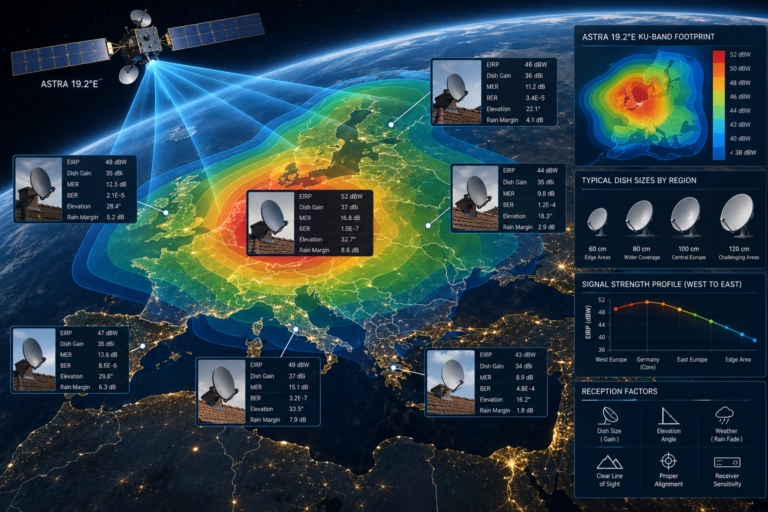
Ku-band satellite signals are affected by atmospheric attenuation, especially during heavy rain.
Rain fade introduces additional propagation loss between the satellite and receiving antenna.
A healthy installation normally includes enough fade margin to tolerate ordinary variations, although sufficiently severe weather can still interrupt reception.
A marginal installation behaves differently.
Even modest additional attenuation may push it over the decoding threshold.
Wind can create a separate mechanical effect by moving the dish. Temperature can influence the LNB, cable and mechanical structure. These mechanisms should not all be grouped together as “bad weather.”
The pattern of the failure can provide useful evidence.
| When Freezing Appears | Possible Area to Investigate |
|---|---|
| Mainly during heavy rain | Fade margin, dish size and alignment |
| Mainly during wind | Dish mounting and mechanical stability |
| Changes between hot and cool periods | LNB, receiver, cabling or thermally sensitive installation components |
| Appears constantly on one carrier | Carrier-specific margin or RF-chain issue |
| Appears on every service simultaneously | Common RF, receiver or system-level problem |
Why Only Some Tring Channels May Freeze
One of the most useful diagnostic clues is which channels are affected.
Do not think of the complete Tring service as one RF signal.
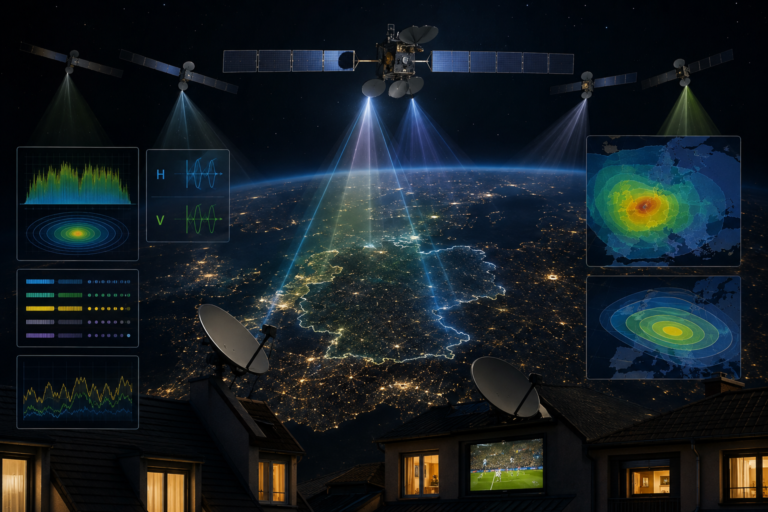
Satellite platforms distribute programmes through multiple carriers and multiplexes. Different carriers can use different frequencies, polarizations and transmission configurations.
Consequently, one group of services can operate reliably while another group freezes.
If several affected channels disappear or freeze together, check whether they belong to the same multiplex or carrier. That pattern can point toward an RF problem rather than several independent video faults.
Frequency-dependent cable losses, polarization problems and differences in available carrier margin can all produce selective failures.
It is therefore more useful to record the affected frequencies and services than simply report that “Tring freezes.”
The exact current satellite parameters should always be verified for the particular Tring service and distribution path being received because channel assignments and transponder configurations can change.
Why Changing the Receiver Can Appear to Fix It
Two DVB-S2 receivers do not necessarily behave identically near the decoding threshold.
Tuner design, demodulator implementation, carrier acquisition, frequency-error tolerance and firmware can influence performance.
One receiver may maintain lock slightly longer than another when the incoming signal becomes marginal.
This can create the impression that Receiver A has “better signal” even though both are connected to exactly the same dish.
However, this needs to be interpreted carefully.
If changing receivers turns an unstable service into a stable one, the original receiver may indeed have a fault or poorer marginal-signal performance.
But it can also reveal that the antenna system itself has insufficient margin.
A receiver that performs slightly better near threshold should not be used as a substitute for correcting a badly aligned dish, damaged cable or defective LNB.
How to Diagnose Tring Freezing Correctly
The most efficient approach is to isolate each part of the reception chain instead of changing several components at once.
1. Identify exactly which channels freeze.
2. Determine whether affected services share the same carrier or polarization.
3. Measure carrier quality rather than relying only on receiver signal percentages.
4. Check MER and BER where suitable test equipment is available.
5. Peak dish azimuth and elevation accurately.
6. Verify LNB skew and feed position.
7. Inspect connectors, cable and outdoor weather sealing.
8. Observe whether failures correlate with rain, wind or temperature.
9. Test another compatible receiver if available.
10. Only after the RF path is proven stable should programme decoding or service-side problems become the main suspect.
This sequence also prevents a common mistake: repeatedly rescanning channels when the underlying problem is RF quality.
A scan can update service information and find changed frequencies. It cannot repair a marginal link budget.
Reality Check
There is no single technical cause behind every Tring HD freeze. The same visible symptom can originate from a marginal satellite carrier, poor dish alignment, LNB instability, cable problems, receiver behaviour, decoding faults or an upstream programme problem.
It is also incorrect to conclude that an HD channel freezes because “HD needs stronger satellite signal.” HD describes the video service. RF robustness depends on the physical carrier, including its DVB mode, modulation, FEC, available link margin and receiving conditions.
If reception is already error-free with healthy margin, increasing signal strength does not make the digital picture sharper. The value of additional RF margin is reliability.
Final Verdict
Random Tring HD freezing is often the visible result of a reception system operating too close to its digital threshold.
The picture can remain perfect while DVB-S2 error correction is still successfully recovering damaged data. A small additional impairment can then produce uncorrectable errors, causing the decoder to hold the previous frame, display block corruption or temporarily lose the service.
The correct diagnosis therefore starts with signal quality and margin, not simply the receiver’s strength percentage. Dish alignment, MER, BER, LNB stability, polarization, cabling, weather behaviour and receiver performance should be examined systematically.
If only one group of channels freezes, investigate the carrier they share. If the whole system is unstable, inspect the common RF path. And if measurements prove the satellite reception is healthy while one programme continues to freeze, the investigation can then move beyond the RF layer.
Frequently Asked Questions
| Question | Answer |
|---|---|
| Why does a Tring HD channel freeze and then recover by itself? | A marginal carrier can temporarily cross the reliable decoding threshold. When signal quality improves again, the receiver can recover lock or resume error-free transport-stream decoding. |
| Does HD require a stronger satellite signal than SD? | Not inherently. HD and SD describe video formats. Their reception behaviour depends on the RF carriers transporting them, including modulation, FEC and available signal margin. |
| Can I have 90% signal strength and still experience freezing? | Yes. Consumer strength percentages are not standardized and may primarily represent RF level. They do not necessarily show whether the wanted digital carrier has sufficient MER or low enough BER. |
| Can poor dish alignment cause only occasional freezing? | Yes. A slightly misaligned dish may still provide enough margin under good conditions but become unstable when weather, wind or other small losses reduce the available signal quality. |
| Can a faulty LNB cause random freezing? | Yes. LNB instability, frequency drift, water damage or other faults can affect carrier quality. However, the LNB should be tested rather than replaced automatically. |
| Why do only some Tring channels freeze? | Different services can be carried on different satellite carriers. A frequency, polarization or carrier-specific reception problem can therefore affect one group while others remain stable. |
| Can changing the receiver solve the problem? | Sometimes. Receivers can differ in tuner and demodulator performance, and a faulty receiver can cause instability. But a better receiver should not be used to hide inadequate dish alignment or another RF problem. |
| Does rescanning the channels fix random freezing? | Only if the underlying problem was outdated service information or changed tuning parameters. A rescan cannot correct low MER, high BER, poor alignment, cable loss or a defective LNB. |
| Is freezing during rain normal? | Very heavy rain can interrupt Ku-band satellite reception, but frequent freezing during modest weather may indicate insufficient fade margin or another weakness in the installation. |