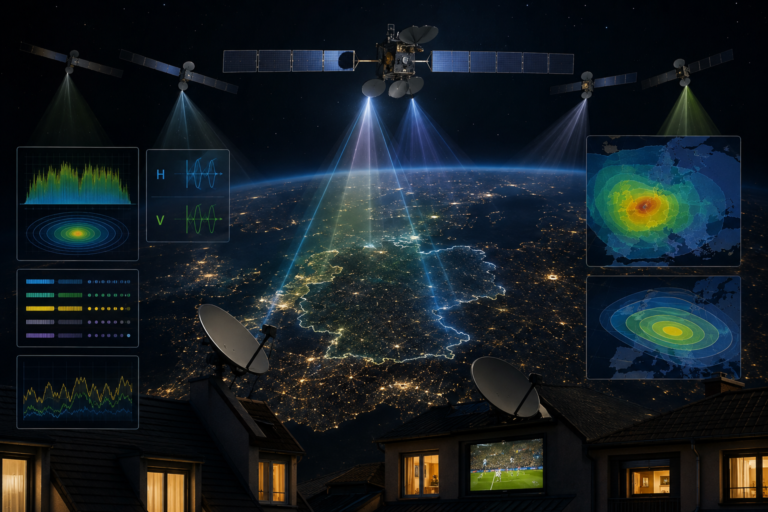
Why Astra Works at Night but Weakens by Day
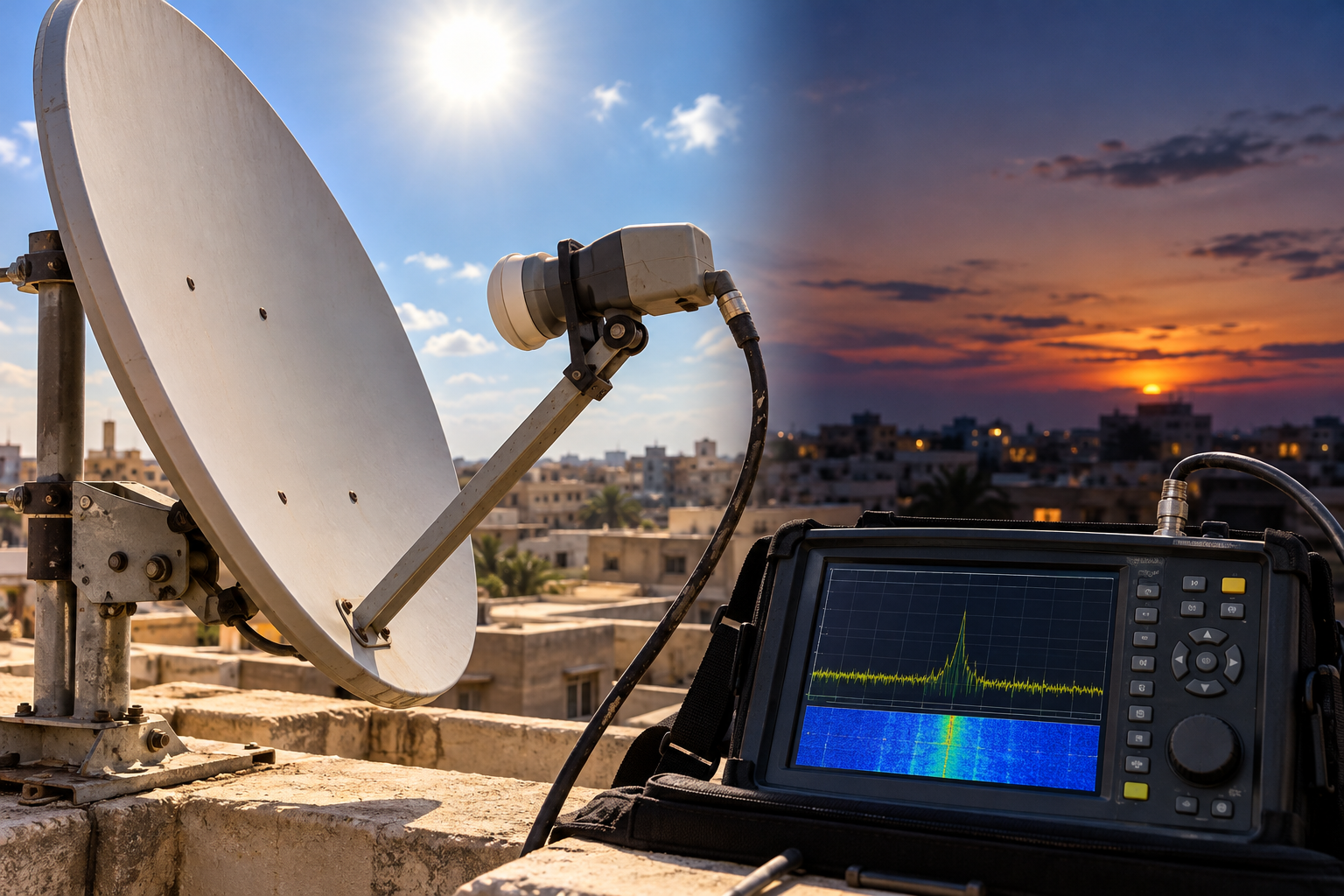
Your Astra channels work perfectly after sunset. The picture is stable, weaker transponders lock without difficulty, and the receiver reports acceptable signal quality. Then, during the afternoon, some channels begin freezing or disappear entirely. A few hours later, they return without anyone adjusting the satellite dish.
This pattern often leads viewers to assume that Astra 19.2E transmits a weaker signal during daylight. In normal operation, that is not how geostationary satellite reception works. A consistent day-and-night difference usually points toward something in the receiving installation that changes with temperature, environmental conditions or available signal margin. Finding the cause requires looking beyond the receiver’s signal-strength percentage.
Astra 19.2E is an orbital position served by geostationary satellites. Its normal transmission power does not follow a simple daily cycle in which signals become weak during daylight and strong at night. Repeated daytime reception problems are more likely to involve temperature-sensitive equipment, marginal alignment, damaged connections or a specific interference event.
- Does Astra Really Become Weaker During the Day?
- How Daytime Heat Affects an LNB
- Why LNB Oscillator Drift Matters
- Can Temperature Change Dish Alignment?
- Why Cables and Connectors Can Cause Daytime Faults
- When the Receiver Is the Real Problem
- Why Only Certain Astra Transponders Fail
- Solar Outages: A Different Daytime Problem
- Other Environmental Causes
- What Measurements Actually Matter?
- How to Diagnose the Problem Step by Step
- Which Repairs Make Sense?
- Reality Check
- Final Verdict
- Frequently Asked Questions
Does Astra Really Become Weaker During the Day?
Under normal conditions, Astra 19.2E does not deliberately reduce its transmission power every afternoon.
The satellites operating at this orbital position remain approximately fixed in the sky from the perspective of a stationary ground antenna. Your dish should not need daily repositioning simply because the sun rises or sets.
That does not mean satellite reception is completely unaffected by the environment. Weather, interference, obstructions and equipment condition can change the quality of the signal reaching the receiver.
However, the distinction matters: a reduction in received signal quality is not necessarily a reduction in satellite transmission power.
If the same channels consistently fail during warmer hours and recover at night, investigate the receiving equipment first.
The strongest clue is whether the problem follows temperature, clock time or a particular weather condition.
How Daytime Heat Affects an LNB
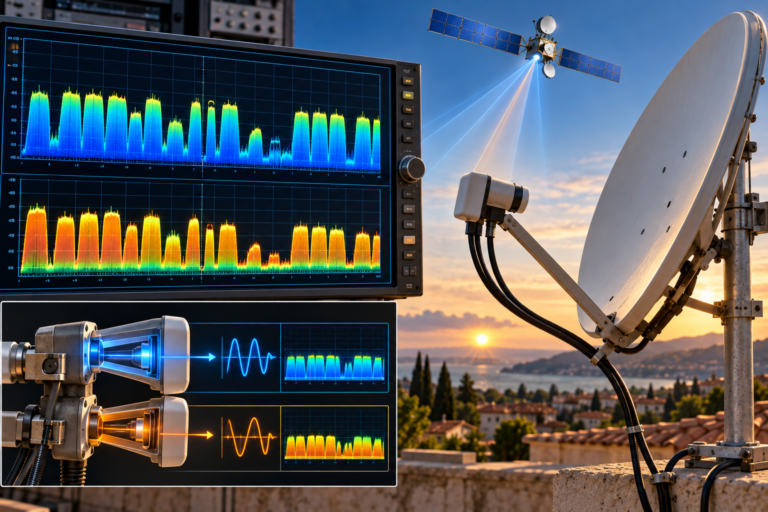
The low-noise block downconverter, or LNB, is mounted at the focus of the satellite dish. It is responsible for amplifying the received Ku-band signal and converting it to a lower intermediate frequency that can travel through coaxial cable.
Because the LNB is installed outdoors, its internal temperature can change substantially throughout the day.
A correctly designed LNB should operate within its specified temperature range. Nevertheless, aging or defective components can become increasingly unstable when heated.
Several performance characteristics may change with temperature:
- Local oscillator frequency stability
- Noise performance
- Amplifier gain
- Power-supply regulation
- Internal switching behavior
These changes do not automatically cause reception failure. A healthy installation normally has enough operating margin to tolerate ordinary component variations.
Problems become visible when an LNB is already deteriorating or the satellite link has very little reserve.
For example, an installation that provides only a small amount of additional MER above the decoding threshold may work at night but fail after the LNB warms and its performance changes.
The temperature pattern is useful evidence, but it is not enough on its own to prove that the LNB is defective.
Why LNB Oscillator Drift Matters
A universal Ku-band LNB typically uses two nominal local oscillator frequencies: 9750 MHz for the lower band and 10600 MHz for the upper band.
The receiver relies on these frequencies to locate the correct intermediate-frequency signal.
Consider a transponder operating at 11,500 MHz.
Satellite frequency: 11,500 MHz
Nominal LNB oscillator: 9,750 MHz
Intermediate frequency: 1,750 MHz
If the actual local oscillator shifts with temperature, the resulting intermediate frequency also shifts.
Satellite receivers can compensate for a certain amount of frequency error through carrier acquisition and tracking. But that capability is not unlimited.
An aging LNB with excessive oscillator drift may become difficult to lock, especially on transponders already operating with marginal signal quality.
This is one reason some viewers report that channels disappear during hot afternoons but return later in the evening.
However, a small frequency change within the LNB’s normal specification should not be treated as a fault. Excessive drift needs to be confirmed through measurements or a controlled replacement test.
Can Temperature Change Dish Alignment?
Temperature affects physical materials as well as electronics.
Metal expands when heated and contracts when cooled. Satellite reflectors, support arms and mounting brackets can therefore experience small dimensional changes.
In a properly installed antenna, ordinary thermal expansion should not normally cause major reception problems.
But an installation with loose mounting hardware, a distorted reflector or insufficient alignment margin can become sensitive to relatively small changes.
For example, a dish that is already slightly misaligned may provide adequate reception under favorable conditions. A small additional loss can then push weaker transponders below their decoding thresholds.
Before adjusting the dish, inspect its mounting stability.
A rigid installation with properly tightened hardware is less likely to suffer from mechanical movement than a dish mounted on a flexible pole or deteriorating bracket.
Wind-related movement can produce similar symptoms, so temperature should not be blamed without checking the actual conditions.
Why Cables and Connectors Can Cause Daytime Faults
The coaxial cable is often overlooked because it appears to be a passive component.
In reality, the cable carries both the intermediate-frequency signal and the electrical power and control signals required by the LNB.
Outdoor connections are exposed to heating, cooling, moisture and mechanical stress.
A poorly fitted F-connector may become intermittent. Moisture can enter damaged coaxial cable. Corrosion can increase electrical resistance or degrade RF performance.
These problems may be more noticeable as the installation heats up, although the relationship depends on the particular fault.
Typical warning signs include:
- Channels disappearing from one polarization
- Loss of high-band or low-band transponders
- Intermittent signal lock
- Reception changing when a cable is disturbed
- Visible corrosion or moisture near outdoor connectors
Universal LNBs commonly use approximately 13V and 18V control states to select polarization, along with a 22 kHz tone for high-band selection.
A damaged connection can therefore affect channel groups differently, rather than causing every Astra channel to disappear simultaneously.
When the Receiver Is the Real Problem
Sometimes the LNB and dish are working correctly, but the receiver itself becomes unstable.
Satellite receivers contain tuner electronics, demodulators, processors and power-supply components that generate heat during operation.
If the receiver is installed in a poorly ventilated cabinet or near another heat-producing device, its internal temperature can rise significantly.
An aging power supply or defective tuner may behave differently when warm.
That can create symptoms resembling weak satellite reception.
It is important to distinguish two situations.
Situation one: the receiver loses carrier lock and reports that the transponder is unavailable.
This suggests a problem somewhere in the RF reception chain, although the receiver tuner itself may still be responsible.
Situation two: the receiver maintains stable lock and acceptable signal-quality measurements, but the picture freezes.
That can indicate a problem farther along the decoding path, including transport-stream handling, video decoding or receiver hardware.
Simply replacing the LNB would not necessarily solve the second situation.
Why Only Certain Astra Transponders Fail
One of the most revealing symptoms is when only a few Astra channels disappear during the day.
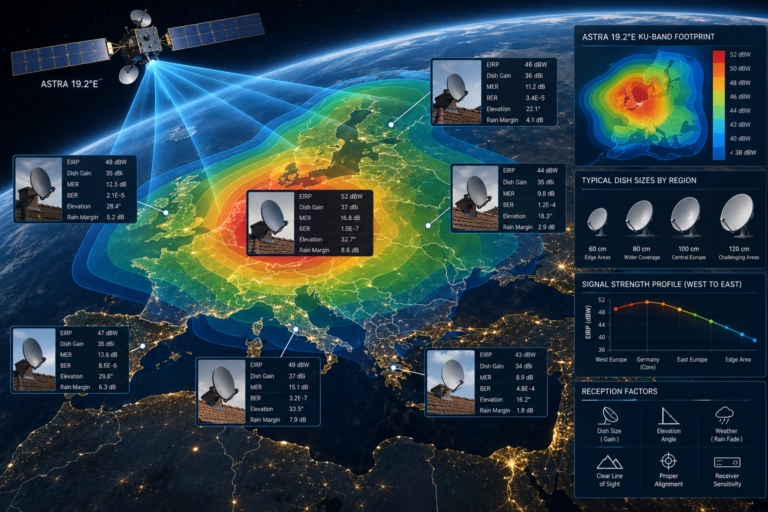
Not every transponder arrives at the receiver with identical signal quality.
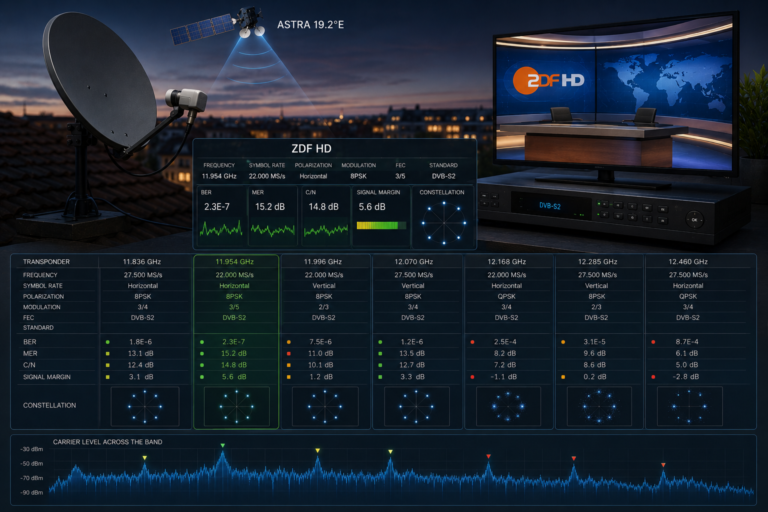
Individual carriers can differ in frequency, polarization, satellite beam, modulation, forward error correction and available link margin.
These differences affect how much additional impairment the receiver can tolerate before decoding fails.
For example, a carrier using a more demanding modulation and coding configuration may require better signal quality than another carrier using a more robust configuration.
The exact threshold depends on the waveform and receiver implementation, not simply whether a channel is HD or SD.
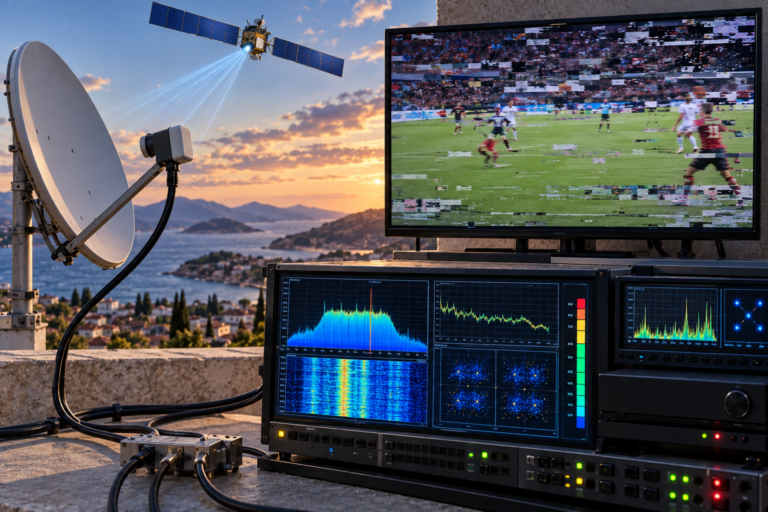
Digital satellite reception also has a characteristic failure behavior known as the digital cliff.
The picture can remain almost perfect while forward error correction successfully recovers the transmitted information. Once the signal quality falls below the required threshold, errors can increase rapidly and the picture may freeze or disappear.
This explains why a small deterioration in the receiving system can produce a dramatic change in picture quality.
| Reception Condition | Likely Result |
|---|---|
| Carrier has comfortable decoding margin | Channels remain stable despite minor performance changes |
| Carrier has limited decoding margin | Pixelation may begin after a small deterioration |
| Carrier falls below acquisition threshold | Receiver may lose lock or fail to tune the transponder |
| Receiver retains RF lock but decoder fails | Picture may freeze even though the carrier remains present |
For a detailed explanation of this distinction, see Why Signal Quality Matters More Than Signal Strength.
Solar Outages: A Different Daytime Problem
There is one genuine solar-related phenomenon that can temporarily disrupt reception from geostationary satellites.
It is called a solar outage, or sun transit interference.
Around the equinox periods, the sun can pass close to the line of sight between a ground antenna and a geostationary satellite.
The sun emits broadband radio noise. When it appears within the antenna beam near the satellite’s direction, the received noise level can increase enough to reduce carrier-to-noise ratio.
The receiver may temporarily lose lock or display picture errors.
This is different from an LNB overheating throughout the afternoon.
| Heat-Related Equipment Problem | Solar Outage |
|---|---|
| May recur on many hot days | Occurs during limited seasonal periods |
| Often develops as equipment warms | Occurs around predictable alignment times |
| Can last for extended periods | Usually causes a relatively brief interruption |
| May improve after cooling | Recovers as the sun moves away from the antenna beam |
| May require equipment repair | Usually resolves without equipment changes |
The exact dates and duration depend on the receiving location, satellite longitude and antenna beamwidth.
If the problem happens for a short period around the same time on several consecutive days near an equinox, solar interference deserves investigation.
It should not be used to explain reception that fails throughout every hot afternoon.
Other Environmental Causes
Temperature-sensitive electronics are not the only possible explanation for a daily reception pattern.
Local environmental conditions can also change.
Branches may move into the satellite path under recurring daytime wind conditions. A poorly supported antenna may shift slightly as its mounting structure warms or moves.
Nearby equipment may also introduce interference during particular operating hours.
For example, an electrical device that runs only during the day could generate interference affecting a vulnerable cable or receiver installation.
That possibility should be investigated through observation and measurement rather than assumed from the timing alone.
The important point is that the satellite’s apparent direction remains nearly constant. If the reception path changes, the cause is generally local to the receiving environment.
What Measurements Actually Matter?
A receiver displaying 90% signal strength does not necessarily have 90% usable reception quality.
Consumer receiver percentages are not standardized across manufacturers. Some strength indicators are influenced by automatic gain control and may not accurately represent the signal’s decoding margin.
Professional satellite meters provide more meaningful information.
| Measurement | Why It Matters |
|---|---|
| RF power | Indicates the received signal level |
| MER | Measures modulation quality and helps reveal signal impairment |
| Carrier-to-noise ratio | Shows the wanted carrier relative to noise |
| Pre-FEC BER | Helps identify errors before correction |
| Post-FEC errors | Indicate whether errors remain after decoding |
| Carrier lock | Shows whether the receiver can acquire and maintain the selected signal |
The most useful test is a controlled comparison of the same transponder during the day and at night.
Do not compare one frequency at midday with a different frequency after sunset and assume the readings describe the same problem.
Use the same receiver or meter, the same transponder and the same measurement method.
How to Diagnose the Problem Step by Step
A structured diagnostic process is more effective than replacing components at random.
Step 1: Record the failure pattern.
Write down the approximate time when reception deteriorates and when it recovers. Note whether the pattern follows hot weather, direct sunlight or a specific time of day.
Step 2: Identify the affected transponders.
Check whether failures involve one frequency, one polarization, one frequency band or many unrelated carriers.
Step 3: Compare signal quality.
Record MER, BER or receiver quality readings during both stable and unstable periods. Include at least one unaffected transponder as a reference.
Step 4: Check receiver ventilation.
Ensure the receiver has adequate airflow and is not exposed to unnecessary heat. Avoid opening the receiver or modifying internal electrical components.
Step 5: Inspect the coaxial installation.
With the receiver switched off, check accessible F-connectors and cable sections for visible damage, moisture and corrosion.
Step 6: Check dish stability.
Inspect the mounting structure for looseness or visible movement. Do not change azimuth or elevation until measurements suggest an alignment problem.
Step 7: Test the LNB.
If the problem consistently follows temperature and other causes have been excluded, compare performance with a compatible known-good LNB. A professional installer can perform this test without introducing unnecessary changes to the dish alignment.
Step 8: Consider solar interference.
If the interruption is brief and occurs during a seasonal sun-transit window, compare the timing with predictions for your location and Astra’s orbital position.
Step 9: Verify the repair.
After correcting the suspected fault, repeat the same measurements during warm and cool conditions.
Which Repairs Make Sense?
The correct repair depends on what the measurements reveal.
If the LNB is unstable with temperature, replacing it with a compatible, properly specified unit may solve the problem.
If connectors show corrosion or moisture damage, the affected connections and cable sections should be repaired or replaced using suitable outdoor materials and weather protection.
If the dish mounting is loose, restoring mechanical stability and then verifying alignment is more useful than repeatedly making small adjustments.
If the receiver overheats, improve ventilation and investigate hardware stability.
If all equipment is functioning correctly but a particular transponder has insufficient margin, a professional alignment check may be appropriate. In some installations, increasing dish size can provide additional gain, but it should not be the first response to an unidentified fault.
One repair to avoid is changing several components simultaneously without recording the original conditions.
That approach makes it difficult to determine what actually caused the reception problem.
Reality Check
Astra reception that weakens during the day is not proof that Astra’s transmission power changes with daylight.
Normal geostationary reception does not depend on the sun being above or below the horizon.
Daytime failures can expose temperature-sensitive LNB electronics, excessive oscillator drift, marginal cabling, receiver instability or insufficient alignment margin.
Solar interference is a genuine exception, but it follows a limited seasonal pattern rather than causing ordinary daily afternoon weakness throughout the year.
The decisive evidence is how the same transponders behave under controlled measurements, not simply whether the problem occurs before or after sunset.
Final Verdict
If Astra works reliably at night but weakens during the day, investigate the receiving system before blaming the satellite.
The most useful starting points are the LNB, coaxial connections, receiver temperature and available signal margin.
An aging LNB can become unstable when heated. A damaged connector can behave intermittently. A marginally aligned dish may leave certain transponders with too little reserve. An overheating receiver can produce symptoms that resemble poor RF reception.
These problems become particularly visible on carriers operating close to their decoding thresholds.
Solar outages should also be considered when the failure is brief, seasonal and occurs at predictable times.
Measure the same transponders during stable nighttime reception and problematic daytime reception. Identify what actually changes, then repair that specific weakness.
The goal is not simply to restore the picture temporarily. It is to establish enough reliable reception margin for the installation to remain stable across normal daily temperature changes.
Frequently Asked Questions
| Question | Answer |
|---|---|
| Why does Astra work at night but not during the day? | A recurring daytime problem may involve temperature-sensitive LNB electronics, damaged connections, receiver overheating, dish instability or insufficient signal margin. |
| Does Astra 19.2E transmit less power during daylight? | No normal daily reduction in satellite transmission power should be assumed. Reception differences usually require investigation of local equipment or environmental conditions. |
| Can an LNB overheat in the sun? | An LNB can become hot in direct sunlight. Healthy equipment should tolerate its specified operating range, but aging or defective components may become unstable when heated. |
| Can LNB oscillator drift cause missing channels? | Yes. Excessive local oscillator drift can shift the downconverted carrier beyond the receiver’s practical acquisition or tracking tolerance. |
| Why do only some Astra channels disappear in hot weather? | Different transponders can have different reception margins and decoding requirements. Marginal carriers may fail before stronger or more robust ones. |
| Can heat change satellite dish alignment? | Thermal expansion can produce small mechanical changes, but significant reception problems are more likely when the mounting is already unstable or alignment margin is limited. |
| What is a solar outage? | A temporary interference event caused when the sun appears close to the satellite direction and its radio noise enters the receiving antenna beam. |
| Does a solar outage happen every day? | No. It occurs during limited seasonal periods around the equinoxes, with timing and duration depending on the receiving location and satellite position. |
| Should I replace the LNB immediately? | Not necessarily. First compare signal measurements, inspect accessible connections, check receiver ventilation and rule out alignment or solar-interference problems. |
| What is the best measurement for diagnosing the problem? | MER, carrier-to-noise ratio, BER and lock status are more informative than signal-strength percentages. Compare the same transponders during both stable and unstable periods. |