Why Sky Italia Works Better At Certain Times Of The Day
Estimated reading time: 10 to 12 minutes.
Many users notice a pattern when watching Sky Italia. The stream works smoothly at certain times of the day, but during other periods it becomes slower, less stable, or starts buffering. This behavior is not random. It reflects how internet based delivery systems react to changing network conditions over time.
Unlike satellite broadcasting, which delivers a constant signal, streaming depends on shared network infrastructure. This means performance changes based on how many users are active, how data is routed, and how stable the connection remains throughout the day. Understanding these patterns helps explain why performance improves at some times and declines at others.
Quick Context. Sky Italia performs better during low network traffic periods and worse during peak hours due to congestion, latency changes, and shared bandwidth across networks.
Table of Contents
Why performance changes throughout the day
What happens during peak hours
Why off peak hours feel faster
Network congestion and shared bandwidth
ISP routing and traffic management
Local network and WiFi load changes
Why performance changes throughout the day
Streaming performance is closely tied to network usage patterns. Internet traffic is not constant. It increases and decreases based on user activity.
During the day, especially in the evening, many users are online at the same time. Streaming services, downloads, and online applications all compete for bandwidth. This affects how data is delivered.
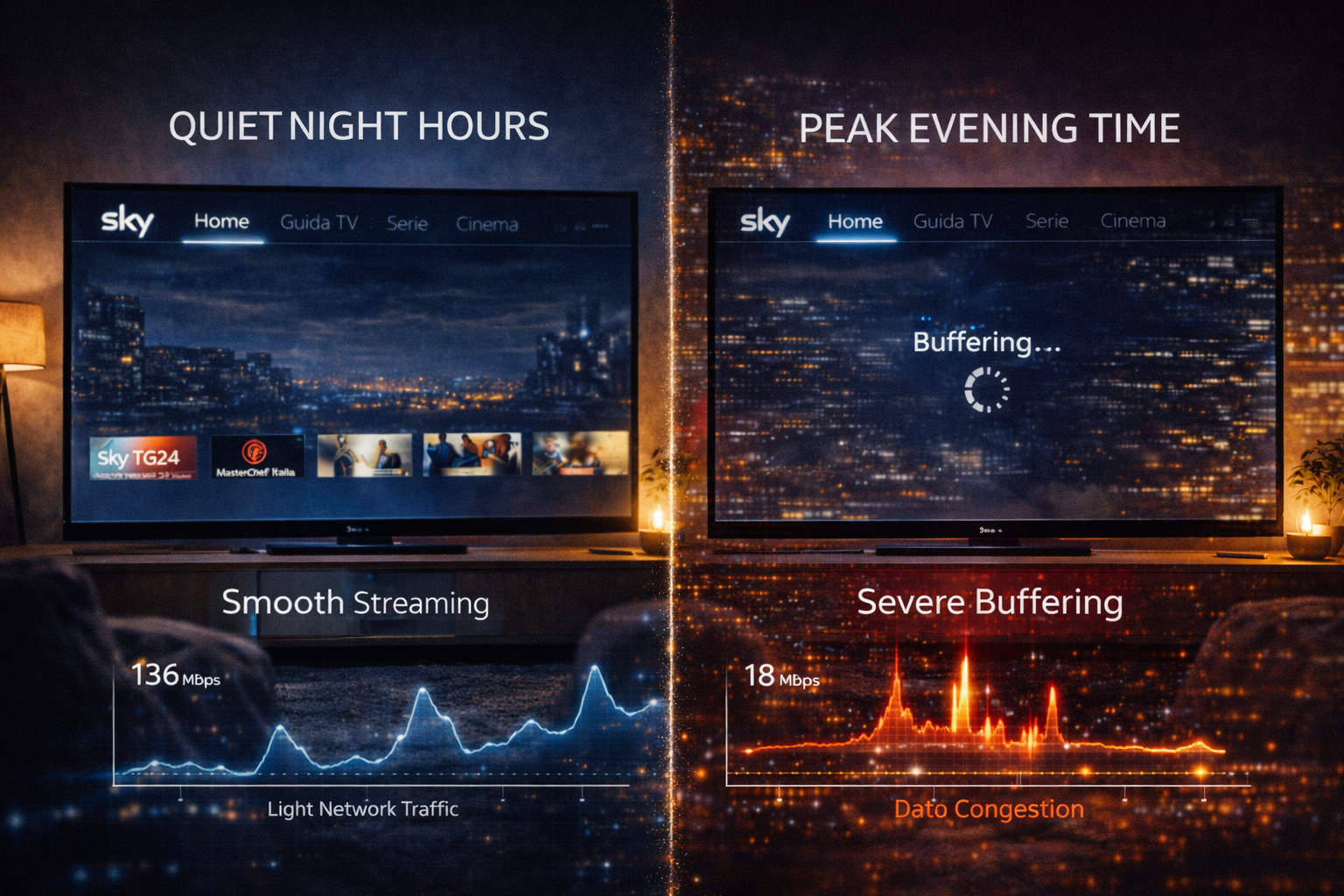
At quieter times, fewer users share the network. Data flows more easily, resulting in smoother streaming.
This variation explains why the same connection can behave differently depending on the time of day.
What happens during peak hours
Peak hours usually occur in the evening when most people are at home using the internet. During this time, network demand increases significantly.
Streaming services experience higher load. More users request data simultaneously, which increases pressure on network infrastructure.
This leads to slower delivery times, higher latency, and reduced consistency. Even if your connection is normally stable, these conditions can affect performance.
As a result, buffering, lag, and quality drops become more common during these periods.
Why off peak hours feel faster
Off peak hours, such as late night or early morning, have lower network usage. Fewer users are active, and less data is being transmitted.
This allows network resources to be used more efficiently. Data travels faster and with fewer interruptions.
Latency is usually lower, and bandwidth is more consistently available. This creates smoother playback and higher quality streaming.
The system is not faster in absolute terms, but it is less congested, which improves performance.
Network congestion and shared bandwidth
Internet connections are shared across many users. When multiple users access the network simultaneously, bandwidth is divided.
This shared nature creates congestion during busy periods. Data packets may be delayed or queued, affecting delivery timing.
Streaming requires continuous data flow. Even small delays can disrupt playback.
Congestion is one of the main reasons why performance varies throughout the day.
How latency changes over time
Latency is not constant. It can increase during peak hours due to network congestion and routing delays.
Higher latency means data takes longer to reach your device. This affects how quickly the buffer can refill.
In off peak hours, latency is often lower, which improves responsiveness and reduces buffering risk.
Latency variation is less visible than speed changes but has a significant impact on streaming performance.
ISP routing and traffic management
Internet service providers manage traffic across their networks. During high demand, they may adjust routing paths or prioritize certain types of traffic.
These changes can affect how data travels from servers to your device. Some paths may be longer or more congested than others.
This can create differences in performance even within the same network. Routing decisions influence latency and stability.
Users do not see these changes directly, but they experience the effects through streaming performance.
Local network and WiFi load changes
Performance is also affected by local conditions. In many homes, multiple devices use the network at the same time.
During peak hours, more devices may be active. This increases local traffic and reduces available bandwidth for streaming.
WiFi networks are especially sensitive to congestion and interference. This can further reduce stability.
Even if the external network is stable, local conditions can still affect performance.
How to confirm time based performance issues
Observe when performance problems occur. If issues happen mainly in the evening, network congestion is likely the cause.
Test streaming at different times of the day. Compare quality and stability during peak and off peak hours.
Check latency during these periods. Higher latency during peak hours confirms network related delays.
Monitor local usage. Identify whether multiple devices are active during problem periods.
This approach helps distinguish time based issues from other technical problems.
| Time Period | Network Condition | Technical Effect | Result |
|---|---|---|---|
| Peak hours | High congestion | Increased latency | Buffering and lag |
| Off peak hours | Low congestion | Stable delivery | Smooth playback |
| Evening | Heavy usage | Bandwidth sharing | Quality drops |
| Late night | Minimal traffic | Low latency | High quality streaming |
| Local network load | Multiple devices | Reduced availability | Variable performance |
Reality Check
Streaming performance is not fixed throughout the day. It changes based on network usage patterns. Even a well configured system will experience variations due to external factors beyond user control.
Final Verdict
Sky Italia works better at certain times of the day because streaming depends on shared network conditions. Peak hours introduce congestion, higher latency, and reduced consistency, while off peak hours provide smoother delivery. Understanding these patterns helps users adjust expectations and optimize their viewing experience. In streaming systems, time of day is a real performance factor.
FAQ
| Question | Answer |
|---|---|
| Why does Sky Italia work better at night | Because network traffic is lower, resulting in more stable data delivery. |
| What are peak hours for streaming | Usually evening hours when many users are online at the same time. |
| Does internet speed change during the day | The available performance can change due to network congestion. |
| Can WiFi affect time based performance | Yes. More devices active at certain times can reduce stability. |
| How can I improve performance during peak hours | Use Ethernet, reduce local usage, and ensure a stable connection. |