Why Eutelsat 16E Needs More Accurate Alignment Than Astra
Estimated reading time: 18 minutes.
- Why Eutelsat 16E feels more demanding.
- Signal margin differences.
- Coverage and transponder behavior.
- DVB-S2 sensitivity.
- LNB skew importance.
- Alignment tolerance differences.
- Dish size considerations.
- How to optimize reception.
- Why Users Compare Astra And Eutelsat 16E
- Signal Margin Makes The Biggest Difference
- Alignment Tolerance Is Not Equal
- Modern DVB-S2 Transponders Require Precision
- LNB Skew Matters More Than Most People Think
- Dish Size Changes The Equation
- Why Quality Drops Before Strength
- Weather Exposes Alignment Errors Faster
- Technical Comparison Table
- How To Optimize Eutelsat 16E Alignment
- Reality Check
- Final Verdict
- FAQ
Why Users Compare Astra And Eutelsat 16E
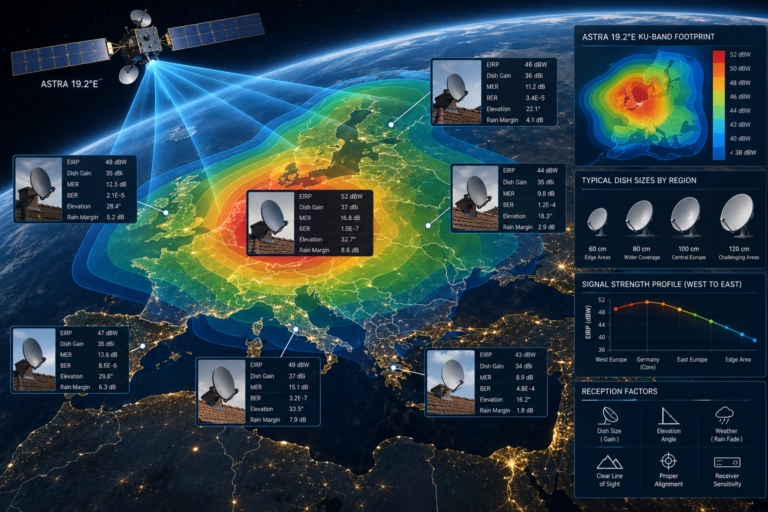
Astra satellites are among the most commonly received television satellites in Europe.
Many viewers begin their satellite experience using Astra before expanding to other orbital positions.
Because Astra often provides strong and consistent reception across large coverage areas, users become accustomed to forgiving alignment conditions.
When they later install Eutelsat 16E, the same alignment habits may no longer produce ideal results.
Reception works, but optimization becomes more important.
Signal Margin Makes The Biggest Difference
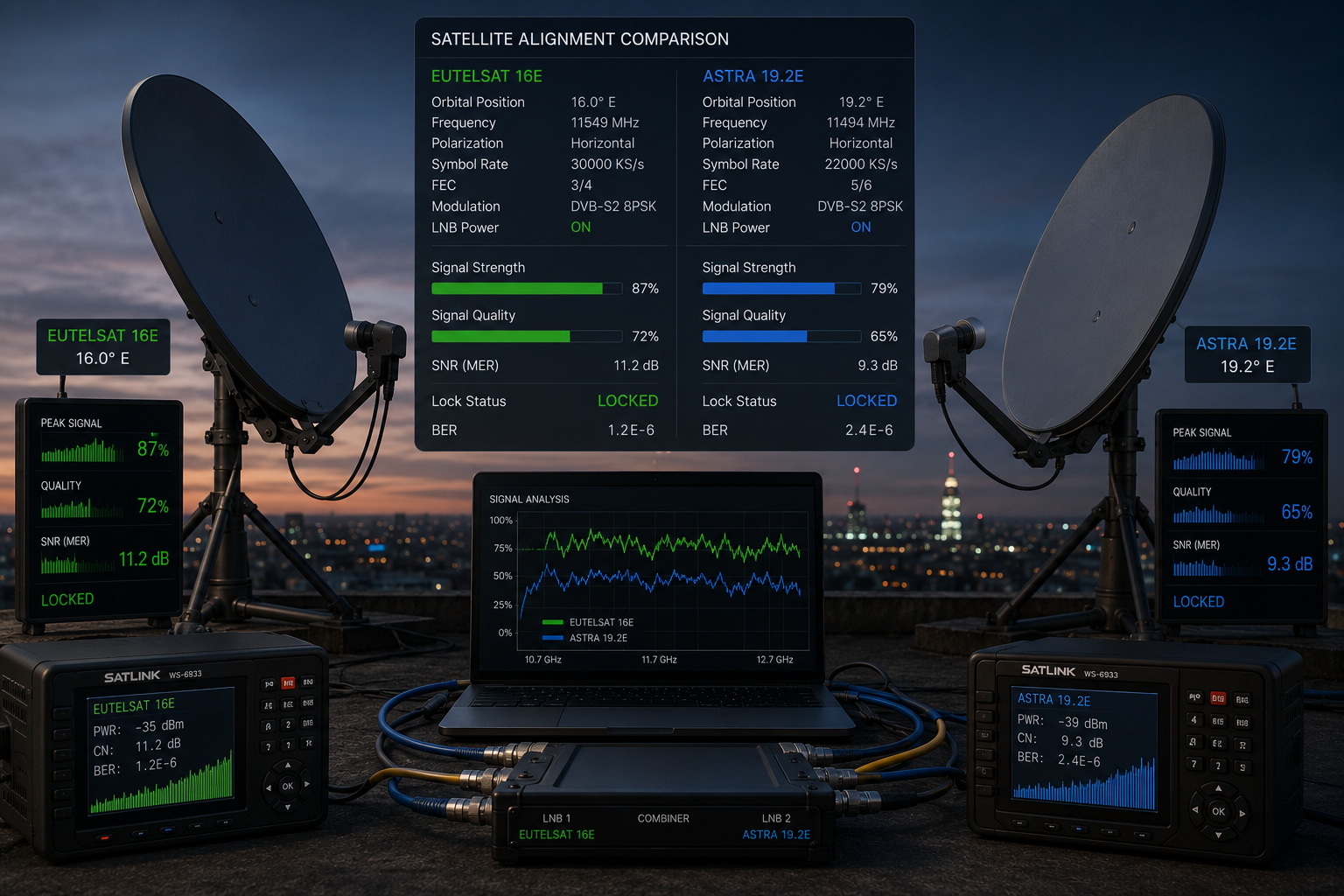
The most important factor is signal margin.
Signal margin is the reserve above the minimum decoding threshold.
A system with generous margin can tolerate small pointing errors.
A system with limited margin cannot.
Several Eutelsat 16E transponders are known among installers for requiring more careful optimization than stronger mainstream Astra services.
This means a dish position that appears acceptable may still leave valuable signal margin unused.
Alignment Tolerance Is Not Equal
Every satellite position has a practical alignment tolerance.
Theoretically, a dish either points correctly or it does not.
In practice, there is always a small range where reception remains possible.
Astra installations often continue performing well even when alignment is slightly below optimum.
Eutelsat 16E tends to reveal those imperfections sooner.
The result is a stronger need for precise azimuth, elevation, and focal optimization.
Modern DVB-S2 Transponders Require Precision
Many Eutelsat 16E services use DVB-S2 technology.
DVB-S2 offers excellent spectrum efficiency but requires cleaner reception conditions.
Small BER increases that go unnoticed on older transmissions may become visible immediately on modern HD services.
This creates the impression that Eutelsat 16E is difficult to receive.
The real issue is often that DVB-S2 exposes weaknesses more quickly.
LNB Skew Matters More Than Most People Think
Many users focus only on moving the dish left, right, up, and down.
They completely ignore LNB skew.
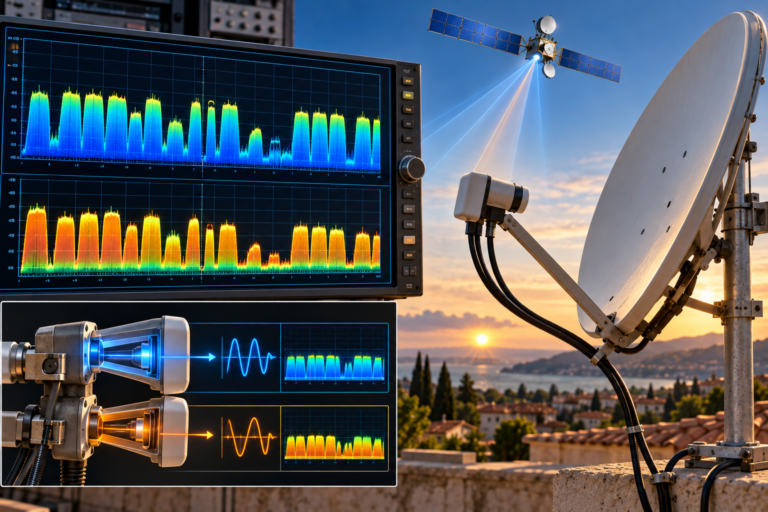
Skew controls polarization alignment.
An incorrect skew angle reduces separation between horizontal and vertical signals.
Signal quality suffers even though strength may remain high.
Eutelsat 16E often rewards careful skew optimization with noticeably better quality readings.
Dish Size Changes The Equation
Larger dishes provide more gain and more signal margin.
When margin increases, alignment becomes slightly more forgiving.
Smaller dishes leave less reserve available.
This is one reason different users report different experiences with the same satellite.
A large dish may hide alignment weaknesses that become obvious on smaller installations.
Why Quality Drops Before Strength
Signal strength and signal quality are not the same measurement.
Strength reflects received RF energy.
Quality reflects how accurately the receiver can decode the signal.
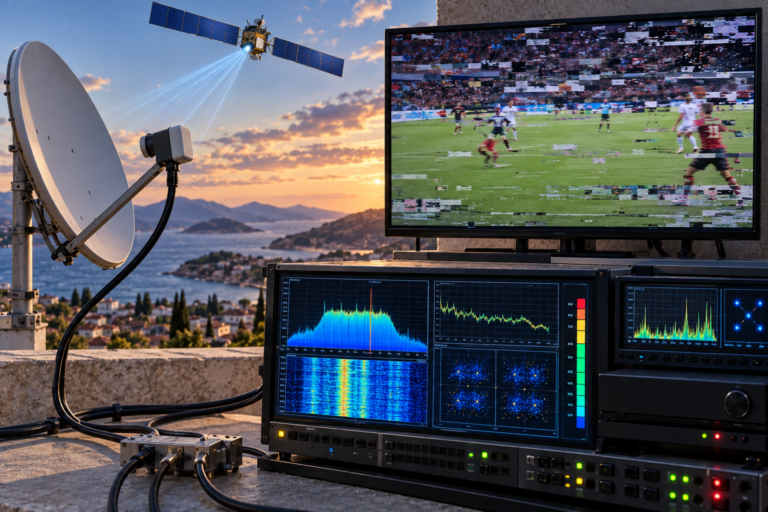
When alignment is slightly off, quality usually falls before strength.
This explains why a receiver may show excellent strength while certain Eutelsat 16E channels remain unstable.
The installation is receiving signal.
The decoding conditions are simply not ideal.
Weather Exposes Alignment Errors Faster
Weather always reduces available signal margin.
Rain, humidity, and atmospheric attenuation consume part of the reserve.
A perfectly optimized installation absorbs these changes easily.
A marginal alignment often begins freezing during conditions that stronger systems handle without difficulty.
This is why many users only discover alignment problems during bad weather.
Technical Comparison Table
| Factor | Typical Astra Reception | Typical Eutelsat 16E Reception |
|---|---|---|
| Alignment tolerance | Often more forgiving | Often less forgiving |
| Signal margin sensitivity | Moderate | Higher |
| LNB skew importance | Important | Very important |
| DVB-S2 exposure of errors | Present | Often more noticeable |
| Weather impact | Depends on margin | Often visible sooner |
| Optimization requirement | Recommended | Essential |
How To Optimize Eutelsat 16E Alignment
Focus on signal quality rather than signal strength.
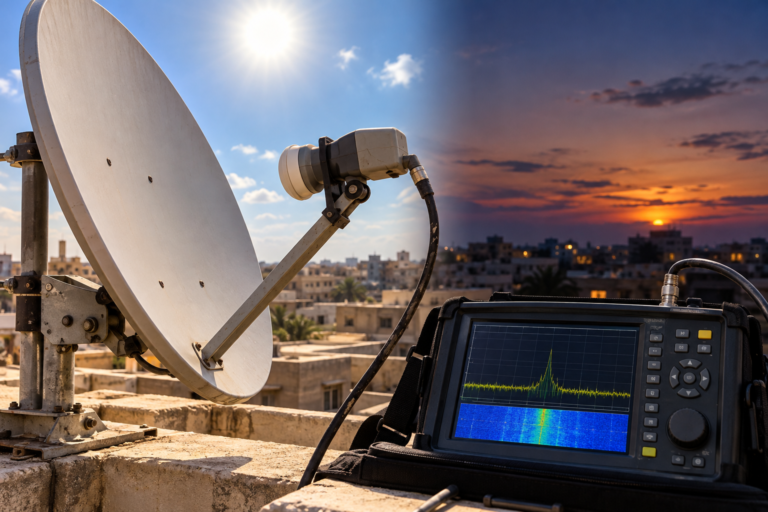
Make very small dish movements while monitoring difficult transponders.
Adjust LNB skew carefully.
Verify the LNB sits correctly within the focal position.
Check BER whenever possible.
The goal is not simply to receive channels.
The goal is maximizing signal margin across the entire satellite position.
For additional insight into hidden reception weaknesses, read The Hidden Problem Behind Weak Eutelsat 16E Signals.
Eutelsat 16E is not necessarily weaker than Astra. The difference is often that Eutelsat 16E leaves less room for alignment errors on certain installations. Signal margin, DVB-S2 sensitivity, and transponder behavior expose small imperfections that Astra users may never notice.
Eutelsat 16E often needs more accurate alignment than Astra because signal margin is typically less forgiving. Small dish pointing errors, incorrect LNB skew, limited signal reserve, and DVB-S2 sensitivity can all affect reception quality. Optimizing alignment for maximum quality rather than basic signal lock is the key to achieving stable long-term performance on Eutelsat 16E.
FAQ
| Question | Answer |
|---|---|
| Is Eutelsat 16E weaker than Astra? | Not necessarily. It is often less forgiving of alignment errors. |
| Why do some Astra installations fail on 16E? | Because Eutelsat 16E may require better optimization and signal margin. |
| Does LNB skew matter? | Yes. Incorrect skew can significantly reduce signal quality. |
| Why do HD channels show problems first? | DVB-S2 transmissions require cleaner decoding conditions. |
| Can a larger dish help? | Yes. Additional gain increases signal margin and stability. |
| What should I optimize during alignment? | Signal quality, BER, LNB skew, and overall signal margin. |