Why Total TV Channels Suddenly Become Blurry
Estimated reading time: 9 minutes.
- Blurry channels rarely mean the broadcaster changed picture quality.
- Signal quality determines how accurately the receiver rebuilds video.
- BER is one of the most important indicators of digital reception.
- DVB-S2 HD channels require cleaner decoding conditions.
- Poor alignment often affects picture sharpness before complete signal loss.
- LNB stability influences decoder accuracy.
- Increasing signal margin improves image consistency.
- The Broadcast Usually Has Not Changed
- Signal Quality Controls Image Sharpness
- Why BER Makes Pictures Look Soft
- DVB-S2 Requires Cleaner Reception
- Dish Alignment And Hidden Blur
- LNB Stability Affects Video Quality
- Receiver Decoding Under Stress
- Technical Comparison
- How To Restore Sharp Total TV Picture Quality
- Reality Check
- Final Verdict
- FAQ
The Broadcast Usually Has Not Changed
Satellite television works differently from internet streaming services.
With streaming platforms, video quality can change dynamically according to available internet bandwidth.
Traditional satellite broadcasting does not normally behave this way.
Every Total TV receiver inside the satellite footprint receives the same transmission.
If only your television suddenly looks blurry while other viewers continue receiving a normal picture, the problem almost always exists inside the reception chain rather than inside the satellite transmission.
Signal Quality Controls Image Sharpness
Many people pay attention only to signal strength.
Signal strength simply measures the amount of radio-frequency energy reaching the tuner.
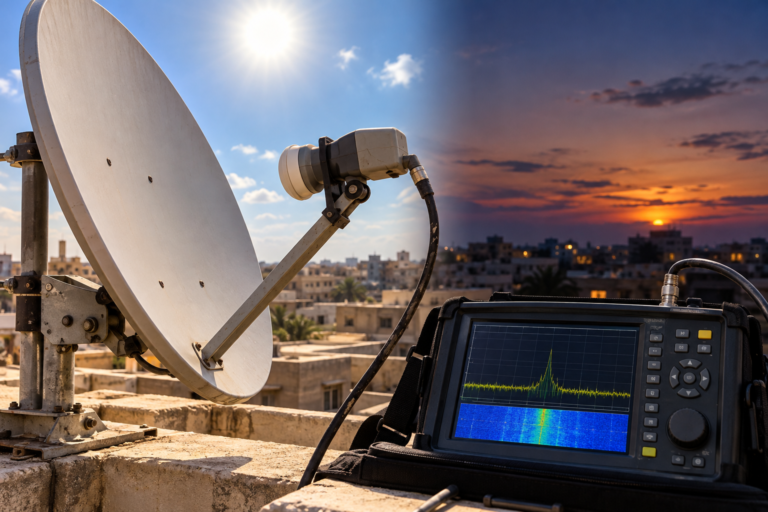
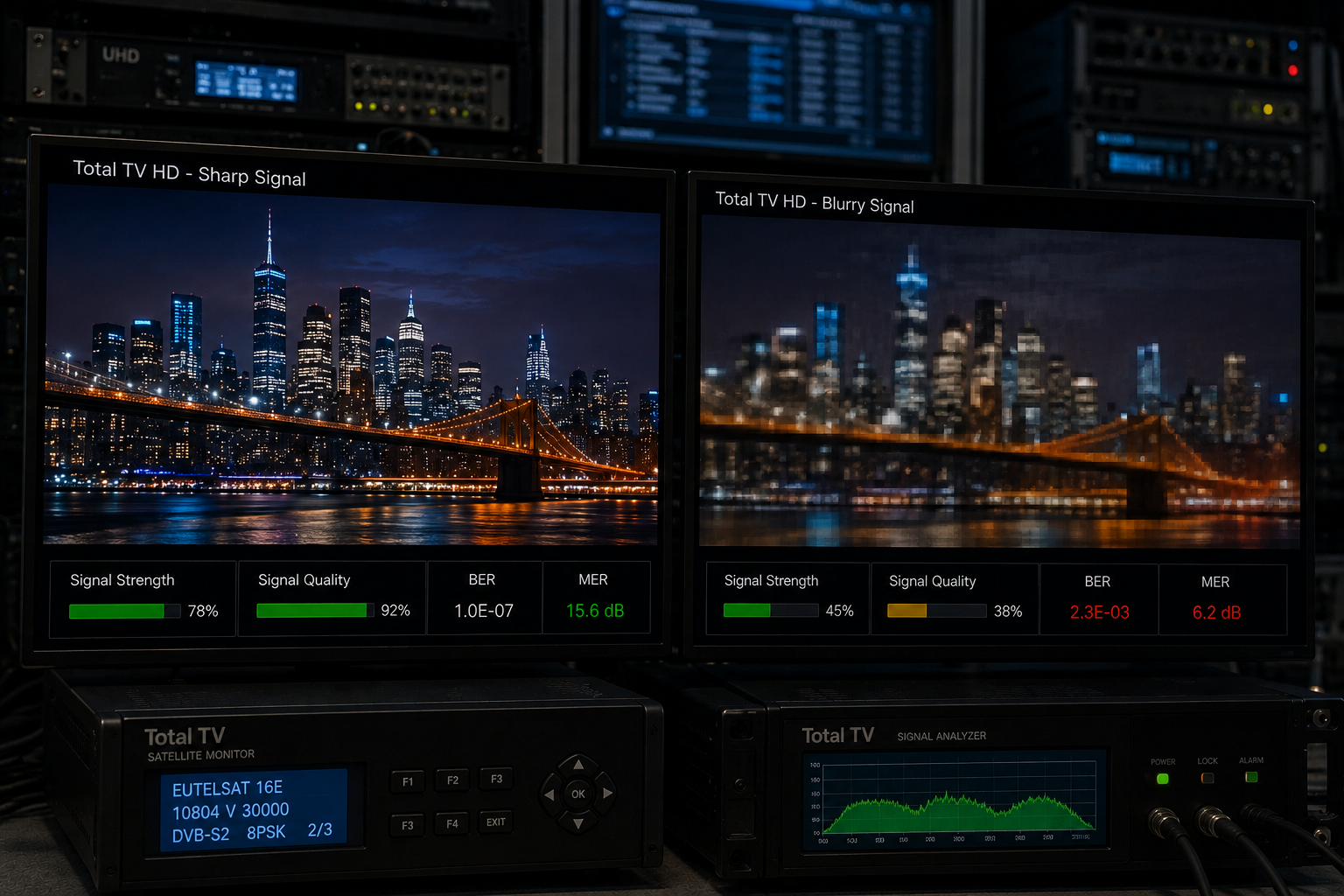
Signal quality measures how accurately that information can be decoded.
Digital television depends almost entirely on signal quality.
If quality falls because of noise, interference, poor alignment, or LNB instability, the receiver must work harder to reconstruct the video stream.
The result is often a picture that appears softer or less detailed before complete freezing begins. Lower BER generally indicates higher-quality reception and a more stable decoded picture.
Why BER Makes Pictures Look Soft
BER stands for Bit Error Rate.
Every satellite transmission contains a small number of errors caused by noise, attenuation, or interference.
Modern receivers automatically repair many of these errors using Forward Error Correction.
As BER increases, more correction becomes necessary.
When the receiver approaches its correction limit, reconstructed video frames become less reliable.
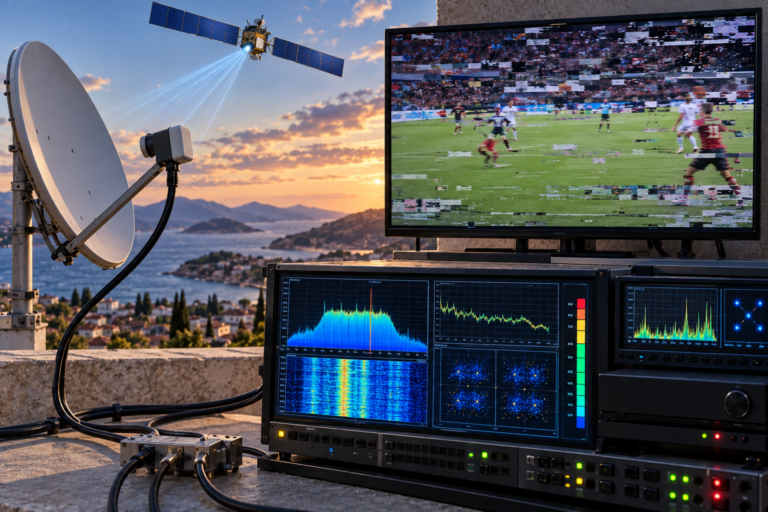
Viewers may notice reduced image sharpness, macroblocking, pixelation, or temporary softness before complete signal failure occurs. BER is widely used by satellite engineers as one of the primary indicators of reception quality.
DVB-S2 Requires Cleaner Reception
Most modern Total TV HD channels use DVB-S2 transmission.
DVB-S2 delivers better bandwidth efficiency and supports high-definition broadcasting.
However, these improvements also require cleaner reception conditions.
A small increase in noise that older DVB-S services might tolerate can become visible much sooner on DVB-S2 channels.
This explains why HD channels often appear blurry before standard-definition channels show any visible problems. DVB-S2 achieves higher efficiency through improved modulation and stronger error correction but depends on maintaining adequate signal quality.
Dish Alignment And Hidden Blur
A dish does not have to lose the satellite completely before quality begins falling.
Very small alignment errors reduce signal margin.
The receiver may continue displaying every channel while operating much closer to the decoding threshold.
During stable conditions this may not be noticeable.
As soon as weather changes slightly or BER increases, demanding HD channels begin losing fine image detail.
Many users mistakenly believe their alignment is perfect because channels still appear.
Professional installers optimize alignment using the weakest transponders rather than the strongest ones.
LNB Stability Affects Video Quality
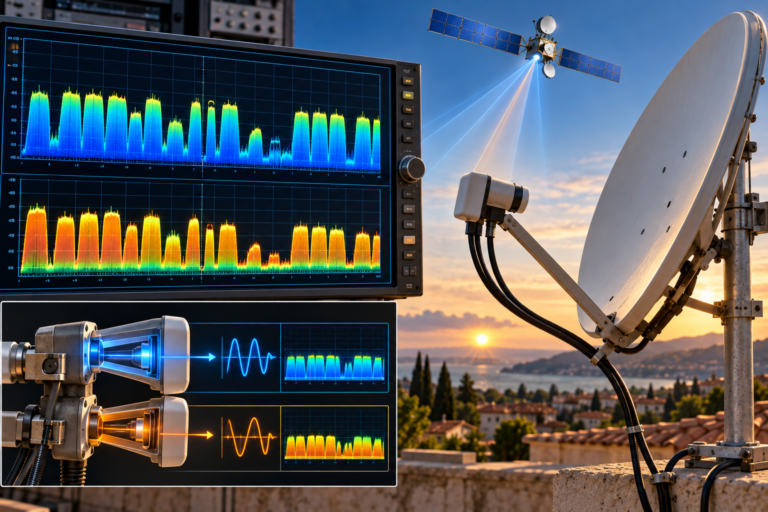
The LNB converts extremely weak satellite signals into frequencies the receiver can process.
Frequency stability inside the LNB is essential.
As components age, oscillator accuracy may decrease.
Temperature changes can introduce small frequency variations.
Although these variations are usually tiny, they increase decoder workload on demanding HD channels.
Replacing an aging LNB often improves picture consistency even when the original unit still appears functional.
Receiver Decoding Under Stress
Inside the receiver, compressed video packets are continuously decoded, corrected, buffered, and synchronized.
When reception quality is excellent, this process happens effortlessly.
When BER increases, the decoder must perform additional error correction.
Eventually the reconstructed picture begins losing precision.
Instead of complete freezing, the first visible symptom may simply be a softer image.
This often explains why viewers describe the picture as blurry even though the channel never disappears.
Technical Comparison
| Condition | Healthy Reception | Marginal Reception |
|---|---|---|
| Signal Quality | High | Fluctuating |
| BER | Low | Increasing |
| Signal Margin | Comfortable reserve | Near decoding limit |
| HD Picture | Sharp and detailed | Soft or blurry |
| Decoder Workload | Normal | High error correction |
| Overall Stability | Consistent | Sensitive to small changes |
How To Restore Sharp Total TV Picture Quality
Begin by checking signal quality rather than signal strength.
Optimize dish alignment while monitoring one of the weakest HD transponders.
Verify that the LNB skew angle is correctly adjusted.
Inspect outdoor connectors for corrosion or moisture.
Replace aging coaxial cable if shielding has deteriorated.
If the LNB has been installed for many years, consider replacing it with a stable low-noise model.
Increasing overall signal margin allows the receiver to decode every frame with fewer corrections, producing consistently sharp images throughout the day.
For more insight into reception changes caused by local signal conditions, read Why Total TV Looks Better Late At Night.
Blurry Total TV channels rarely indicate that the broadcaster reduced picture quality. In most situations the receiver is dealing with increased BER, reduced signal quality, or limited signal margin. Improving the reception chain usually restores full image sharpness without replacing the television.
When Total TV channels suddenly become blurry, the most likely cause is not the broadcast itself but the reception system. Reduced signal quality, increasing BER, marginal alignment, unstable LNB performance, and decoder error correction all influence how accurately HD video is reconstructed. Building more signal margin through careful installation and high-quality components produces sharper, more reliable pictures under all viewing conditions.
FAQ
| Question | Answer |
|---|---|
| Why do my Total TV channels suddenly look blurry? | Most often because signal quality has decreased and the receiver is correcting more transmission errors. |
| Does signal strength guarantee a sharp picture? | No. Signal quality and BER are much more important for digital television. |
| Can poor alignment make HD channels blurry? | Yes. Small alignment errors reduce signal margin and affect demanding HD transponders first. |
| Can an old LNB reduce picture quality? | Yes. Frequency instability and increased internal noise can affect decoder performance. |
| Why do only some channels become blurry? | Different transponders have different decoding requirements, so demanding channels show problems sooner. |
| What is the best solution? | Improve signal quality through precise alignment, a stable LNB, healthy cables, and maximum signal margin. |