Why Astra 19.2E Is Germany’s Most Important Satellite
Estimated Reading Time: 12 minutes
For German satellite viewers, 19.2 degrees East is more than another orbital position on a receiver list. It has developed into one of Europe’s most important television neighbourhoods, carrying a dense mixture of German public broadcasters, commercial channels, HD services, radio, and subscription platforms. A single correctly aligned dish can therefore provide access to a remarkably large part of the German satellite television ecosystem.
Its importance was not created by one technical advantage alone. Astra 19.2E combines decades of established broadcasting infrastructure, strong coverage over Germany and neighbouring countries, extensive Ku-band capacity, broadcaster commitment, modern DVB-S2 distribution, and long-term investment in replacement satellites. In 2026, that position remains strategically important enough that ARD extended satellite distribution through 2039, demonstrating that 19.2E is still part of Germany’s long-term broadcast architecture.
Astra 19.2E should be understood as an orbital television neighbourhood rather than one individual satellite. Multiple Astra spacecraft can operate around the same geostationary longitude and share the task of transmitting different transponders. The dish sees them as effectively the same pointing direction because they are maintained within a tightly controlled orbital region.
- What 19.2 Degrees East Actually Means
- Why Germany Became Central to Astra
- One Orbital Position Can Use Several Satellites
- Why the Coverage Works So Well for Germany
- How Transponder Capacity Created a TV Neighbourhood
- Why Public and Private Broadcasters Matter
- The Role of HD+ on Astra 19.2E
- How DVB-S2 Supports Modern German HD Television
- Why One Dish Can Receive So Many Services
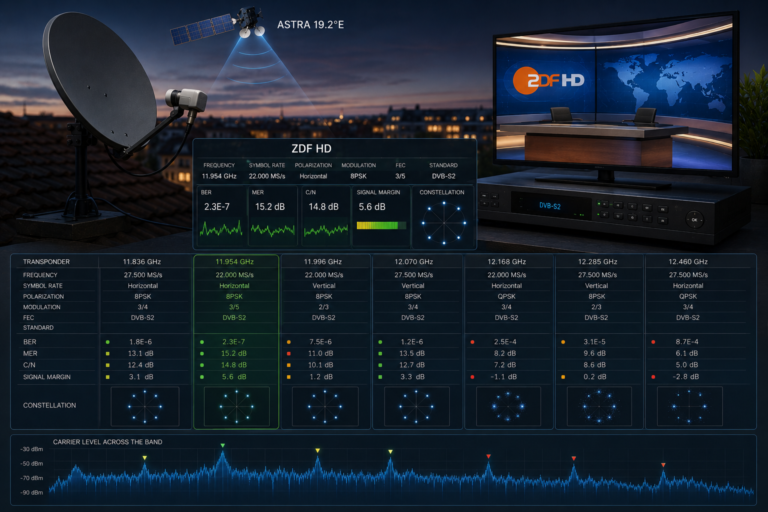
- Why Signal Margin Still Varies Between Transponders
- The Role of Astra 1P
- Why Satellite Still Matters Beside Streaming
- Why Long-Term Broadcaster Contracts Matter
- How to Receive Astra 19.2E Reliably
- Reality Check
- Final Verdict
- FAQ
What 19.2 Degrees East Actually Means
A geostationary satellite orbits approximately 35,786 kilometres above the equator at the same angular speed that Earth rotates. From the ground, it therefore appears to remain in almost the same direction in the sky.
The expression 19.2 degrees East describes the longitude of that geostationary orbital neighbourhood above the equator. A dish in Germany is aimed toward that position using the appropriate local azimuth and elevation.
Once aligned, the antenna does not follow individual television channels. It collects all compatible transponders arriving from satellites operating within that orbital neighbourhood.
Why Germany Became Central to Astra
Astra’s European television history began in the late 1980s, and Germany quickly became one of the most important markets for direct satellite broadcasting.
The effect became self-reinforcing. Broadcasters wanted to be available where large numbers of satellite dishes were already pointed, while viewers wanted to point their dishes where the largest number of useful channels could be found.
Over time, public broadcasters, private commercial groups, pay-TV platforms, radio services, and specialist channels concentrated around 19.2E.
SES has described Germany as a key video market, with the broader German-speaking DACH region remaining one of the strongest markets served from the position.
One Orbital Position Can Use Several Satellites
A common misunderstanding is that Astra 19.2E refers to one spacecraft.
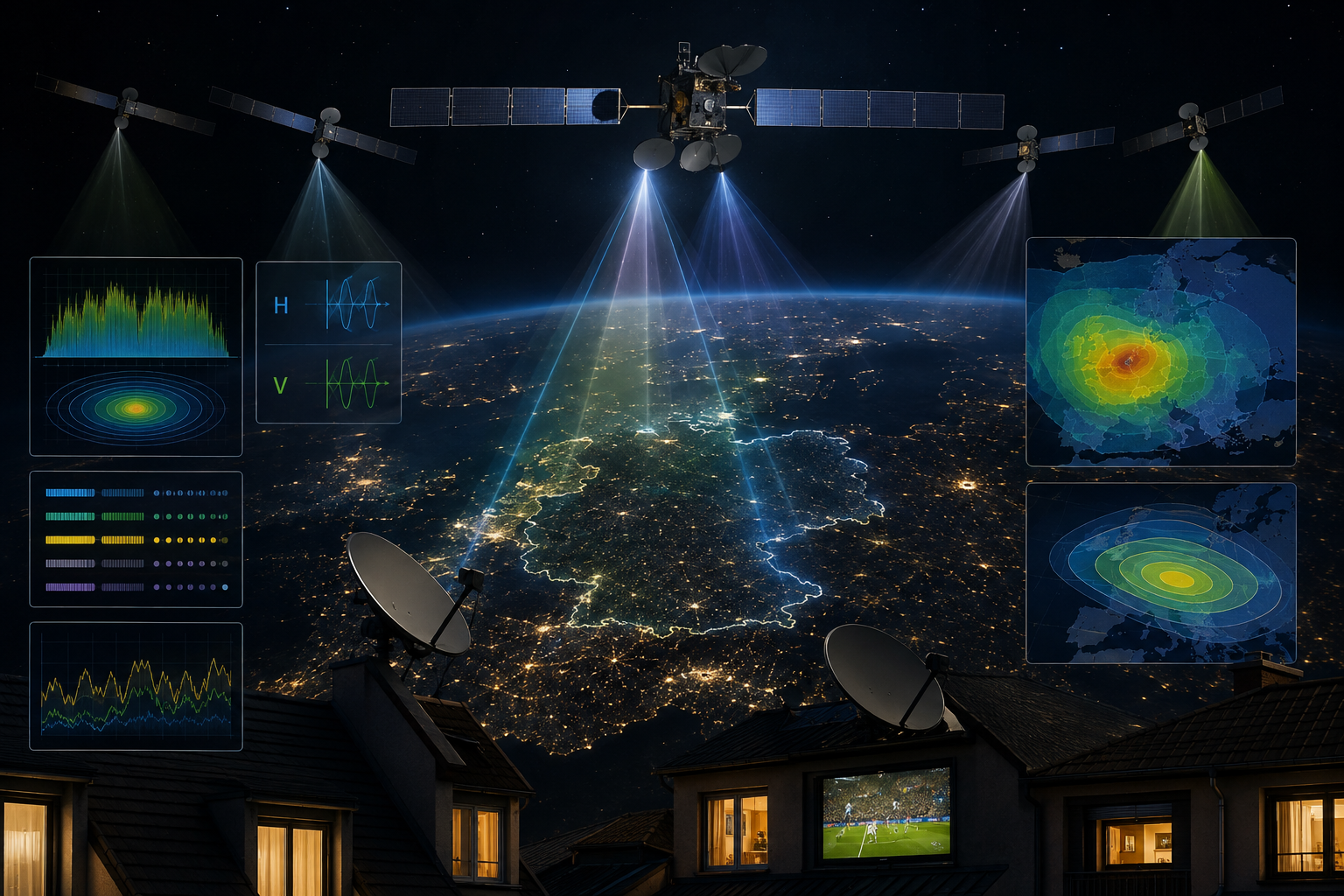
In reality, multiple satellites can be colocated around the same nominal longitude. Different spacecraft carry different transponders while ground antennas continue pointing in essentially the same direction.
A receiver therefore may list channels from Astra 1P and Astra 1N while the household uses only one fixed dish position.
This architecture allows SES to replace ageing spacecraft, increase capacity, improve reliability, and redistribute traffic without requiring millions of households to realign their antennas.
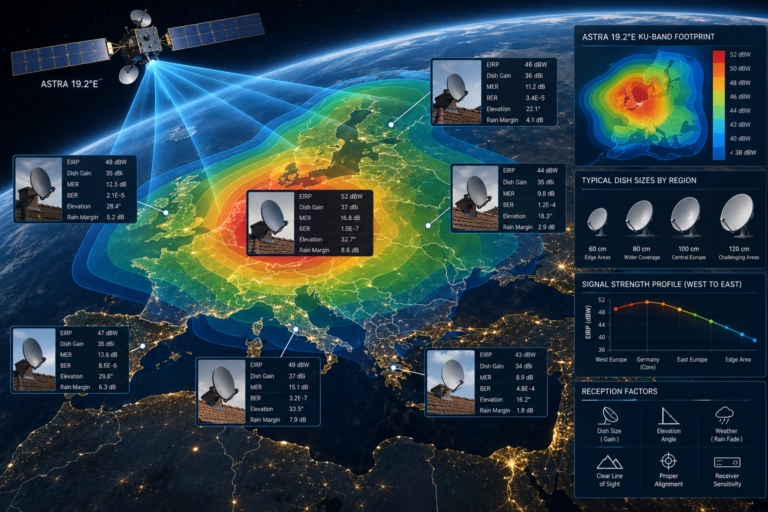
Why the Coverage Works So Well for Germany
Satellite beam design determines how transmitted RF power is distributed across Europe.
The Astra system at 19.2E has been engineered around major European television markets, including Germany. Strong wide-beam coverage makes practical domestic reception possible with relatively modest dish sizes across much of the country.
Good coverage improves carrier-to-noise performance and creates valuable signal margin. That margin helps DVB-S2 receivers remain synchronized during ordinary rain, small mechanical alignment errors, and normal variations in receiving equipment.
Coverage is not completely identical across every frequency, however. Different spacecraft and transponders can still produce different reception margins.
How Transponder Capacity Created a TV Neighbourhood
A satellite transponder carries a wideband RF carrier rather than one television channel.
Digital multiplexing allows many television, radio, and data services to share a single transponder. Several transponders can then operate across the Ku-band using different frequencies and polarizations.
Astra’s German channel database currently lists hundreds of services at 19.2E, illustrating the density of the orbital position.
This concentration has enormous practical value. One reflector, one correctly positioned LNB, and one receiving system can provide access to a large range of services without moving the dish between orbital positions.
| Technical Feature | Why It Matters | Effect for German Viewers |
|---|---|---|
| 19.2E orbital neighbourhood | Concentrates many broadcasters at one pointing direction | One fixed dish can receive a large channel ecosystem |
| Strong European Ku-band coverage | Provides useful carrier strength across Germany | Practical domestic dish sizes and healthy signal margin |
| Multiple colocated satellites | Allows capacity renewal and redundancy | Infrastructure can evolve without household dish movement |
| Large transponder capacity | Supports many multiplexes | Hundreds of television and radio services can coexist |
| DVB-S2 | Improves spectral and coding efficiency | Supports modern HD distribution efficiently |
| HD+ | Provides a major German private HD ecosystem | Strengthens the importance of 19.2E for commercial HD viewing |
| Long-term broadcaster agreements | Provides distribution continuity | Shows that satellite remains part of long-term German broadcasting |
Why Public and Private Broadcasters Matter
An orbital position becomes valuable when broadcasters and viewers both treat it as a default destination.
Astra 19.2E carries major German public and commercial television brands. Current SES and Astra information includes broadcasters and groups such as ARD, ZDF, RTL, ProSiebenSat.1, Sky Deutschland, and numerous regional and specialist services.
This mixture is important because it prevents the position from depending on one television business model.
Free-to-air public television, commercial channels, encrypted premium services, and radio can all coexist within the same satellite ecosystem.
The Role of HD+ on Astra 19.2E
HD+ adds another important layer to the German Astra ecosystem.
The platform provides access to a range of private German television services in HD and has developed additional hybrid television functionality around satellite reception.
From an engineering perspective, the important point is that the linear satellite signal and internet-based interactive functions can perform different jobs.
The satellite remains exceptionally efficient for sending the same linear television carrier to large numbers of viewers simultaneously. Internet connectivity can then add applications, programme restart, media libraries, metadata, and other interactive features.
This hybrid model strengthens rather than automatically replaces the role of the satellite RF path.
How DVB-S2 Supports Modern German HD Television
Modern HD broadcasting requires efficient use of satellite transponder capacity.
DVB-S2 provides improved Forward Error Correction and flexible modulation compared with the original DVB-S standard. Broadcasters can select combinations such as QPSK or 8PSK with suitable coding rates according to required capacity and link robustness.
Many German HD services also use modern video compression such as MPEG-4 AVC. It is important to separate these technologies.
DVB-S2 describes how digital information is transported across the satellite physical layer. The video codec determines how the television pictures are compressed inside that recovered data.
Why One Dish Can Receive So Many Services
Once a dish is accurately pointed at 19.2E, its reflector collects the complete usable Ku-band spectrum arriving from that direction.
The LNB selects polarization and frequency band according to commands from the receiver, then converts each requested satellite frequency into the intermediate-frequency range used by the tuner.
The receiver can therefore move electronically between transponders without physically moving the dish.
This is one of the reasons an established orbital neighbourhood has such value. Changing channels requires milliseconds of tuner and decoder processing rather than mechanical repositioning of the antenna.
Why Signal Margin Still Varies Between Transponders
The popularity of Astra 19.2E does not mean every transponder arrives with identical quality.
Different carriers can operate from different satellites, frequencies, polarizations, modulation formats, FEC configurations, and beam characteristics.
One transponder may show excellent MER while another has noticeably less decoding margin at the same location.
The receiving system also contributes. LNB response, cable attenuation, skew, local interference, and dish alignment can affect frequencies differently.
A correctly installed Astra system should therefore be evaluated across several representative transponders rather than only the strongest one.
The Role of Astra 1P
Astra 1P is an important example of SES continuing to renew the infrastructure at 19.2E.
The satellite was launched in June 2024 and entered service later that year. SES describes it as the most powerful wide-beam satellite to operate at the 19.2E television neighbourhood.
Its purpose includes serving public and private broadcasters across major European markets and supporting HD content delivery, including German HD+ services.
This investment matters because geostationary broadcast infrastructure must be renewed long before older satellites reach the end of their operational lives.
Why Satellite Still Matters Beside Streaming
Internet television has changed how viewers consume media, but satellite and broadband have fundamentally different distribution architectures.
A satellite transponder broadcasts one carrier over a large geographic area. One household or ten million households can receive that carrier without creating ten million separate video streams from the satellite.
Internet streaming generally delivers data through networks whose traffic and server infrastructure scale with audience demand.
For large linear audiences, satellite therefore retains a powerful one-to-many distribution advantage.
Broadcasters can combine that efficiency with broadband for personalized, interactive, and on-demand functions instead of forcing one technology to perform every job.
Why Long-Term Broadcaster Contracts Matter
A useful measure of an orbital position’s importance is whether major broadcasters continue committing to it.
In May 2026, SES announced that ARD had extended its distribution arrangement for another decade, keeping regional ARD television services in HD at 19.2E through 2039.
That commitment is significant because it shows that Astra’s importance to Germany is not simply historical.
Broadcasters continue planning long-term distribution around the orbital position even while streaming and hybrid television expand.
How to Receive Astra 19.2E Reliably
Reliable reception begins with an unobstructed line of sight toward the orbital position and a dish size appropriate for the receiving location.
Azimuth and elevation should be optimized using digital quality, MER, or BER rather than signal strength alone.
LNB skew must be adjusted correctly because poor polarization isolation can reduce modulation quality even when RF strength remains high.
The coaxial cable, connectors, switches, and wall plates should maintain low loss and good shielding across the full satellite intermediate-frequency range.
Several frequencies should then be tested across low and high bands and both polarizations. This confirms that the system has useful margin across the orbital position rather than only on one powerful transponder.
The physical-layer technology behind many modern services on this orbital position is explained in our guide to how DVB-S2 really works from satellite signal to TV picture, including modulation, synchronization, Forward Error Correction, and transport recovery inside the receiver.
Astra 19.2E is not important because every German channel is carried there, nor does one spacecraft transmit the entire German television market.
Its importance comes from the concentration of broadcasters, services, infrastructure, audience reach, and long-established reception equipment around one orbital neighbourhood.
Satellite also does not make broadband irrelevant. German television increasingly combines efficient one-to-many broadcasting with internet-based interactive services. These technologies are becoming complementary rather than mutually exclusive.
Astra 19.2E is Germany’s most important satellite television neighbourhood because decades of technical and commercial development have concentrated a major part of the German broadcast ecosystem around one geostationary position.
Strong Ku-band coverage, large transponder capacity, multiple colocated satellites, public and private broadcasters, HD+, DVB-S2 distribution, and practical fixed-dish reception all reinforce one another.
The position is also being actively renewed rather than maintained as legacy infrastructure. Astra 1P has strengthened the fleet, and major broadcasters continue making long-term distribution commitments, including ARD’s agreement extending HD satellite distribution through 2039.
For the viewer, the result is simple: one accurately aligned dish can connect the receiver to one of Europe’s densest and most mature television distribution systems. Behind that simplicity is a large RF infrastructure designed around coverage, capacity, redundancy, signal margin, and long-term broadcast reliability.
| Question | Answer |
|---|---|
| What does Astra 19.2E mean? | It refers to SES’s geostationary television neighbourhood around 19.2 degrees east longitude above the equator. |
| Is Astra 19.2E one satellite? | No. Multiple Astra spacecraft can operate around the same nominal orbital position and carry different transponders. |
| Why is 19.2E important in Germany? | It combines strong coverage with a large concentration of German public, commercial, HD, radio, and subscription services. |
| Can one fixed dish receive several Astra satellites at 19.2E? | Yes. Satellites colocated within the orbital neighbourhood appear in essentially the same direction to a normal domestic dish. |
| Does every Astra 19.2E transponder have the same signal quality? | No. Power, beam characteristics, frequency, polarization, modulation, FEC, and receiving-system performance can create different margins. |
| What is Astra 1P? | Astra 1P is a newer wide-beam SES satellite operating at 19.2E and supporting television distribution across major European markets. |
| Does Astra 19.2E carry HD+? | Yes. Astra 19.2E is the core satellite position used for HD+ television distribution in Germany. |
| Does HD+ use only satellite? | Its linear television distribution uses satellite while newer platform functions can also use internet connectivity for interactive and on-demand features. |
| Why is DVB-S2 important at 19.2E? | DVB-S2 provides flexible modulation and powerful error correction that allow satellite capacity to be used efficiently for modern digital and HD services. |
| Will Astra 19.2E disappear soon because of streaming? | Current infrastructure investment and long-term broadcaster agreements show that the position remains part of Germany’s broadcast strategy alongside broadband services. |
| How should an Astra dish be aligned? | Fine alignment should maximize digital quality, MER, and signal margin across several representative transponders rather than raw strength on one frequency. |