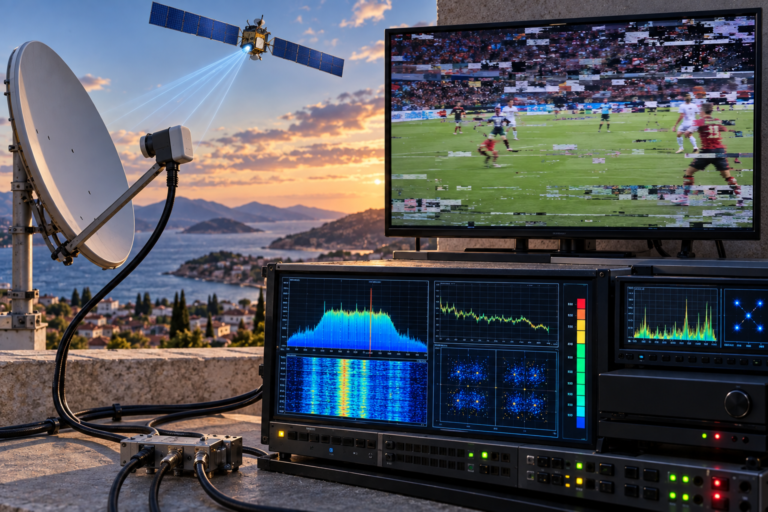
Why Some Hot Bird Transponders Are Harder to Lock
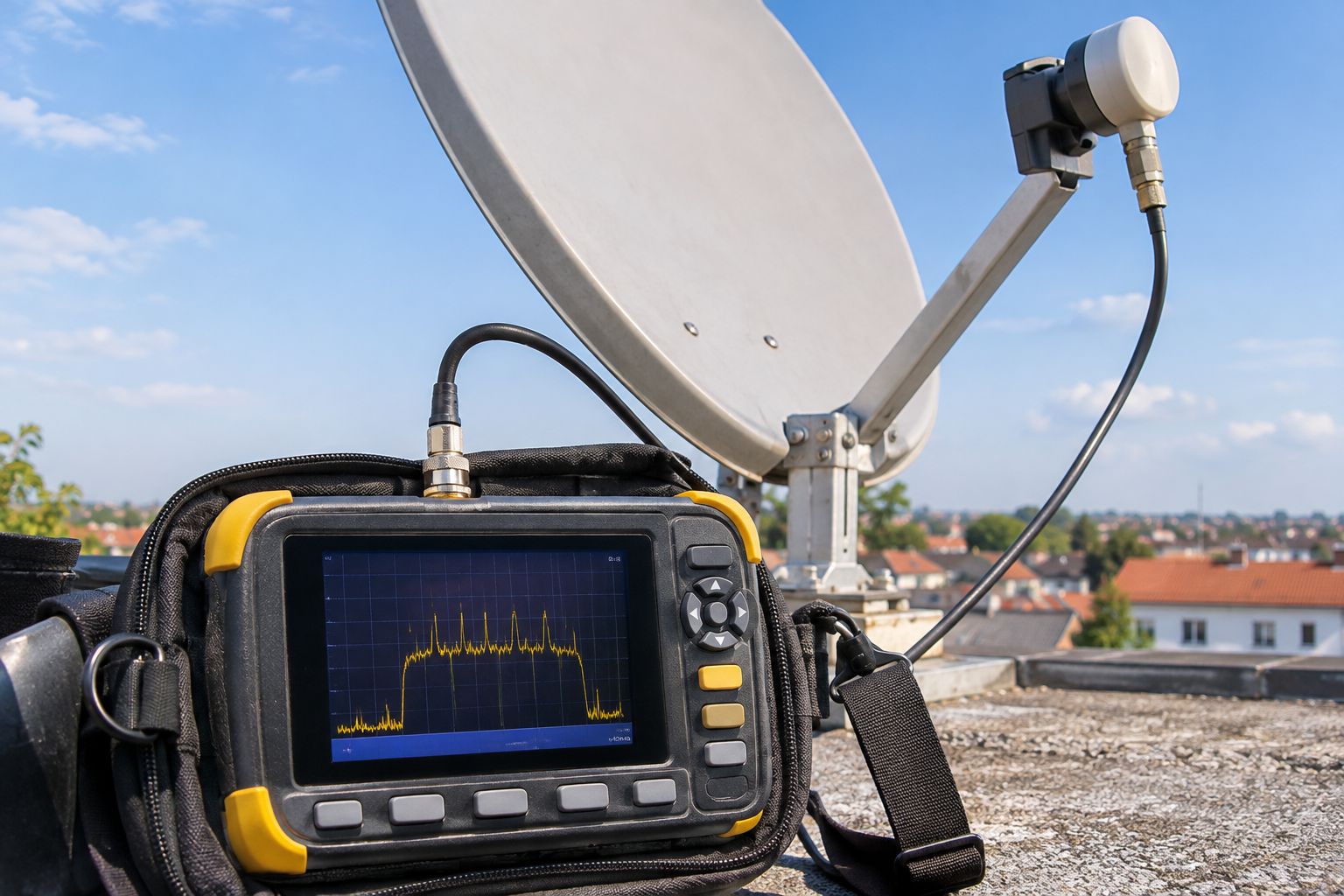
You select a Hot Bird 13°E transponder and the receiver locks almost immediately. Switch to another frequency, however, and the tuner searches for several seconds before displaying a signal. Sometimes it fails completely, only to lock successfully after another attempt. Why should two transponders arriving through the same dish behave so differently?
The answer often involves what happens before a satellite receiver can display a picture. A tuner must locate the carrier, recover symbol timing, establish synchronization, and recognize a supported digital transmission. Different signal conditions, frequency errors, and receiver implementations can make that process easier for one transponder than another. A carrier that takes longer to acquire is not necessarily weaker once reception becomes stable.
Hot Bird 13°E is served by Eutelsat’s HOTBIRD 13F and 13G satellites. Its transponders can use different transmission parameters and operate with different reception margins. Carrier acquisition is the process through which the receiving equipment establishes the synchronization needed to demodulate a selected signal. It is distinct from maintaining an already established lock or discovering television services after demodulation.
What Does Transponder Lock Actually Mean?
A receiver can detect RF energy without successfully demodulating the selected satellite transmission.
To achieve a usable digital lock, its tuner and demodulator must acquire the carrier and establish the synchronization required to recover the transmitted information.
Receivers may expose several internal states, including signal detection, carrier synchronization, physical-layer synchronization, and transport-stream availability.
However, consumer receivers do not necessarily display these stages separately.
A single lock indicator may represent different internal conditions depending on the hardware and software implementation.
Lock Is Not the Same as Finding a Channel
After successful demodulation, a receiver still needs to interpret the transmitted service information and identify the television or radio programs carried by the transponder.
Finding a service is therefore a separate operation from acquiring its underlying RF carrier.
If a transponder cannot lock, repeatedly scanning the associated channel list will not correct the underlying acquisition problem.
What Happens Before a DVB-S2 Receiver Achieves Lock?
Satellite reception involves several processing stages that must work together before reliable data recovery becomes possible.
The precise order and implementation vary between demodulator designs, but the major operations are broadly similar.
Carrier Detection and Frequency Search
The receiver first attempts to find the intended signal within its supported tuning and acquisition range.
The expected carrier frequency provides a starting point, but the actual received frequency can differ because of oscillator error and other conversion characteristics.
The receiver must accommodate that difference within the capabilities of its search and synchronization algorithms.
Symbol Timing Recovery
Digital satellite transmissions carry information through sequences of modulated symbols.
The demodulator must establish the timing required to sample those symbols correctly.
Timing recovery becomes more demanding when the signal contains substantial noise, timing uncertainty, or other impairments.
Different receivers use different algorithms and loop configurations to establish and maintain timing synchronization.
Carrier Frequency and Phase Synchronization
The receiver must also account for carrier frequency and phase errors.
These errors can originate from oscillator differences, phase noise, or the received signal itself.
Carrier recovery algorithms attempt to reduce these errors sufficiently for reliable demodulation.
Physical-Layer Frame Synchronization
For DVB-S2, synchronization also involves recognizing the physical-layer framing structure.
The receiver uses physical-layer signaling to interpret the transmission correctly, including relevant modulation and coding information.
Synchronization stages may interact, and implementations can perform some operations in parallel rather than following one fixed sequence.
A slow lock can result from one or more acquisition stages taking longer to converge. Once synchronization is established, the receiver may maintain stable reception without repeating the entire initial search process.
Why Some Hot Bird Transponders Take Longer to Acquire
Two transponders at the same orbital position can differ in transmission characteristics and the conditions under which their signals reach the receiver.
That does not mean one carrier is intrinsically difficult to receive. The difficulty emerges from the relationship between the transmitted waveform and the receiving equipment.
Different Modulation and Coding Configurations
Digital satellite transmissions can use different modulation formats and forward-error-correction settings.
These parameters influence the signal conditions required for successful reception.
A receiver may acquire one configuration more reliably than another when the available carrier quality is limited.
However, DVB-S2 should not automatically be considered harder to lock than DVB-S. The actual outcome depends on the transmission mode, receiver implementation, and operating conditions.
Different Initial Frequency Uncertainty
A receiver may have to search across a range of possible carrier frequency offsets.
If the expected tuning frequency differs significantly from the received carrier, acquisition may take longer or fail when the offset exceeds the supported search range.
This can occur even when adequate RF power reaches the tuner.
Different Receiver Search Strategies
Some demodulators use relatively narrow searches around expected carrier parameters. Others support broader acquisition procedures or blind-scan capabilities.
The firmware can also influence how aggressively the receiver retries unsuccessful synchronization attempts.
Consequently, two receiver models may show noticeably different lock behavior on the same transponder.
How Symbol Rate Influences Carrier Acquisition
Symbol rate describes how many modulation symbols are transmitted per second.
It is not the same as the final user-data bitrate, which also depends on modulation and coding.
Symbol rate matters because synchronization algorithms operate on the received symbol stream.
Why Lower Symbol Rates Can Be More Sensitive to Frequency Uncertainty
A given absolute carrier frequency error represents a larger fraction of the symbol rate when the symbol rate is lower.
That relationship can influence the design and performance of timing and carrier recovery algorithms.
Some receivers have difficulty acquiring certain lower-symbol-rate transmissions when the frequency offset is substantial.
Nevertheless, a low symbol rate does not automatically produce slow acquisition.
Receivers designed to support the relevant range may acquire such signals efficiently under suitable conditions.
Why Incorrect Symbol Rate Entries Cause Problems
If a receiver attempts to tune using an incorrect symbol rate, its acquisition process may fail to converge on the intended transmission.
Some devices can detect or compensate for symbol-rate uncertainty within supported limits.
Others depend more heavily on accurate user-entered parameters.
Before blaming the LNB or dish, verify the current transmission parameters from a reliable source.
How LNB Frequency Offset Can Delay Lock
The LNB converts the received Ku-band signal to a satellite intermediate frequency.
The receiver calculates its expected IF using the selected satellite downlink frequency and the configured local oscillator frequency.
A conventional universal Ku-band LNB commonly uses nominal oscillator frequencies of 9,750 MHz and 10,600 MHz.
If the oscillator’s actual frequency differs from its nominal value, the converted carrier will also be shifted from its expected position.
Frequency Offset Versus Frequency Drift
These two conditions should be distinguished.
- Frequency offset: The actual carrier is displaced from its expected frequency at a particular moment.
- Frequency drift: The frequency changes over time, potentially because of temperature or equipment instability.
A modest, stable offset may be corrected by the receiver’s acquisition system.
A larger offset or unstable oscillator may exceed the capabilities of a particular tuner, especially when combined with limited reception margin.
Why a Transponder May Lock After Several Attempts
Some receivers retry acquisition using different search conditions when an initial attempt fails.
The carrier may eventually be found, even though the first tuning attempt was unsuccessful.
This behavior can also depend on the receiver’s retained synchronization information and implementation.
Repeated success after a second attempt is therefore useful diagnostic evidence, but it does not independently prove an LNB oscillator fault.
Acquisition Margin Versus Stable Reception
One of the most important distinctions is the difference between initially acquiring a carrier and continuing to track it afterward.
Synchronization algorithms may behave differently during initial acquisition and steady-state operation.
Depending on the receiver design, a carrier can be difficult to acquire near a threshold yet remain stable after the relevant tracking loops have converged.
The opposite can also occur: a carrier acquires quickly but becomes unstable because of intermittent interference or changing signal conditions.
Why MER and C/N Still Matter
Carrier-to-noise conditions and modulation impairments affect the receiver’s ability to establish and maintain synchronization.
Measurements such as C/N and MER help characterize the available signal quality.
However, successful acquisition also depends on frequency uncertainty, waveform parameters, and receiver-specific algorithms.
The decoding requirements associated with a particular modulation and coding configuration should not be confused with one universal acquisition threshold.
Weak Frequencies Are a Related but Different Problem
If a carrier locks quickly but breaks up during playback, insufficient reception margin may be the more important issue.
Our related guide, Why Hot Bird Works but Some Frequencies Stay Weak, examines the influence of transponder characteristics, MER, LNB frequency response, cable losses, and antenna alignment on reception quality.
For a carrier that locks slowly but remains stable afterward, the investigation should also include acquisition behavior, local oscillator accuracy, and receiver tuning capabilities.
Why Receiver Hardware and Firmware Make a Difference
A satellite receiver’s advertised DVB compatibility does not describe every detail of its acquisition performance.
Supported symbol-rate ranges, tuner sensitivity, frequency-search capability, demodulator algorithms, and firmware implementation can all affect how successfully it acquires particular transmissions.
Manual Tuning Versus Blind Scanning
Manual tuning uses specified transmission parameters.
Blind scanning attempts to discover carriers across a search range using the receiver’s supported detection capabilities.
A receiver may find a carrier during blind scanning that it fails to acquire using an outdated manual entry.
However, blind scanning does not guarantee acquisition of every transmission, especially when its parameters or modulation mode fall outside the device’s supported capabilities.
Why a Second Receiver Is a Valuable Test
If one receiver repeatedly fails to lock a verified transponder while another compatible unit acquires it through an equivalent signal path, the difference may lie in tuner hardware, firmware, or configuration.
The comparison should use the same transmission parameters and, as far as practical, the same cabling and LNB conditions.
Otherwise, different signal paths may distort the conclusion.
What Different Lock Symptoms Reveal
| Observed Behavior | Possible Explanation | Recommended Check |
|---|---|---|
| Carrier takes several attempts to lock but then remains stable | Acquisition search behavior or frequency uncertainty | Verify parameters and compare tuning attempts |
| One receiver locks quickly while another struggles | Tuner implementation, firmware or configuration difference | Compare devices through an equivalent RF path |
| Carrier locks after frequency correction | Outdated tuning parameters or frequency offset | Verify current parameters and LNB configuration |
| Lock becomes slower as equipment warms | Possible temperature-dependent oscillator or equipment behavior | Record repeatable results under comparable conditions |
| Carrier repeatedly loses lock after acquisition | Low reception margin, interference or unstable hardware | Measure carrier quality and inspect the RF path |
| Blind scan detects a carrier that manual tuning misses | Incorrect stored parameters or different search behavior | Compare detected and manually entered settings |
| No compatible receiver can lock the selected carrier | Invalid parameters, unsupported waveform or reception impairment | Confirm current transmission and measure the signal |
These observations help prioritize testing. None proves a particular hardware defect without supporting measurements.
How to Diagnose a Difficult Hot Bird Transponder Step by Step
Step 1: Verify the Carrier Parameters
Confirm the currently active downlink frequency, polarization, symbol rate, and supported transmission mode.
Do not assume that a receiver’s preloaded transponder database is current.
Where additional parameters are required by the device, verify those as well.
Step 2: Record Acquisition Behavior
Select the affected transponder and observe how long the receiver takes to report lock.
Repeat the test under comparable conditions and record whether acquisition succeeds consistently.
For a fair comparison, distinguish a fresh acquisition from switching back to a recently tuned carrier, because receiver implementations may retain information that changes reacquisition behavior.
Step 3: Measure Signal Quality
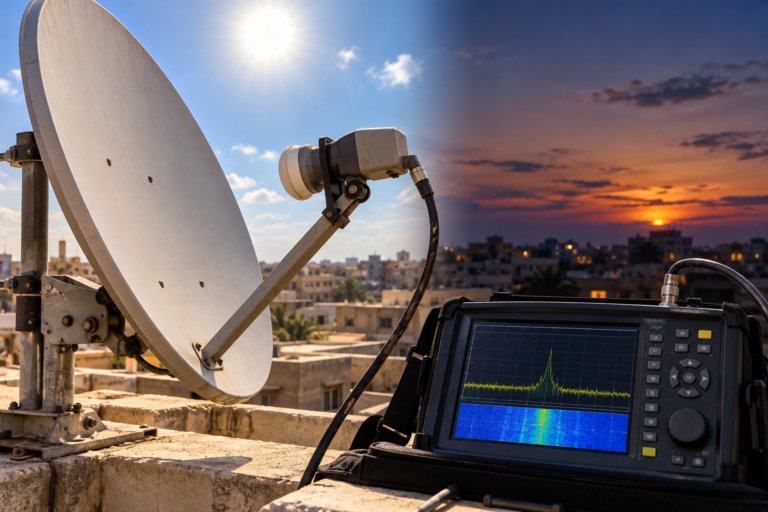
Where possible, use a satellite analyzer capable of reporting suitable carrier measurements.
Record MER, C/N, and relevant error indicators once the signal is acquired.
These measurements help determine whether insufficient signal quality is contributing to the problem.
Do not interpret receiver signal-strength percentages as standardized RF measurements.
Step 4: Check LNB Configuration and Frequency Accuracy
Verify the LNB type, local oscillator settings, and appropriate band and polarization switching configuration.
If measurement equipment supports it, check whether the received carrier is significantly offset from its expected converted frequency.
Do not compensate for suspected oscillator problems by randomly changing transponder entries.
Step 5: Compare With a Second Compatible Receiver
Test the same verified carrier through an equivalent signal path using another receiver known to support the transmission.
Record differences in acquisition time, lock consistency, and measured quality.
A repeatable receiver-specific difference provides stronger evidence than one unsuccessful tuning attempt.
Step 6: Check the RF Installation if Necessary
If both receivers struggle or the carrier has insufficient reception margin, investigate antenna alignment, feed skew, LNB performance, and cable conditions.
Adjust only one variable at a time.
Disconnect the relevant equipment from power before changing coaxial connections, and use appropriate tools for any powered-system measurements.
Verify parameters → Measure acquisition behavior → Check signal quality → Verify oscillator and LNB settings → Compare receivers → Investigate the RF installation.
This sequence separates receiver acquisition limitations from genuine signal-quality faults and reduces unnecessary equipment replacement.
Reality Check: Slow Lock Does Not Automatically Mean Weak Reception
A Hot Bird transponder that takes longer to acquire may still provide reliable reception after synchronization is established.
The cause could involve frequency search, oscillator offset, symbol timing recovery, or a receiver-specific algorithm rather than an unusually weak transmitted signal.
Conversely, a carrier that locks immediately can still have inadequate operating margin and suffer interruptions during viewing.
Lock time and steady-state signal quality are related measurements, but they are not interchangeable.
Neither a slow lock nor an unsuccessful scan is enough to justify replacing the dish or LNB without further testing.
Final Verdict
Some Hot Bird 13°E transponders are harder to lock because carrier acquisition depends on more than the amount of signal power reaching the tuner.
The receiver must search for the correct carrier, recover symbol timing, establish synchronization, and support the transmission’s modulation and coding configuration.
Frequency uncertainty, LNB oscillator behavior, available reception margin, and differences between tuner implementations can all influence the result.
When a carrier locks slowly but remains stable, investigate acquisition behavior before assuming that antenna gain is insufficient. When lock is repeatedly lost, measure carrier quality and examine the RF system.
A repeatable comparison using verified transponder parameters and compatible receiving equipment is the most reliable route to identifying the actual limitation.
Frequently Asked Questions
Why does one Hot Bird transponder take longer to lock than another?
Different transmission parameters, frequency uncertainty, available reception margin, and receiver acquisition algorithms can affect how quickly a carrier is acquired. A longer lock time does not automatically mean weaker steady-state reception.
Can an LNB cause slow transponder locking?
Yes. Excessive local oscillator frequency offset, instability, or other performance problems can interfere with acquisition. Receiver configuration and signal conditions should also be checked before blaming the LNB.
Are low-symbol-rate transponders always harder to lock?
No. Symbol rate influences synchronization requirements, but actual acquisition performance depends on the receiver design, frequency uncertainty, waveform parameters, and signal quality.
Why does a transponder lock successfully on the second attempt?
A subsequent attempt may succeed because of different search behavior, retained synchronization information, or changing signal conditions. Repeated measurements are needed to identify which explanation applies.
Can firmware affect Hot Bird transponder acquisition?
Yes. Receiver firmware can influence tuning procedures, retry behavior, supported parameters, and interactions with the demodulator. However, firmware updates cannot add hardware capabilities that a receiver fundamentally lacks.
Will a larger satellite dish fix slow locking?
It may help when inadequate reception margin is contributing to acquisition failure. It will not necessarily correct incorrect tuning parameters, unsupported transmission modes, or excessive frequency offset.
Does a successful transponder lock guarantee that channels will play?
No. After carrier acquisition, the receiver must discover the services and support their decoding requirements. Encrypted services also require legitimate access authorization.