Why Astra Is Strong but Hot Bird Is Weak on One Dish
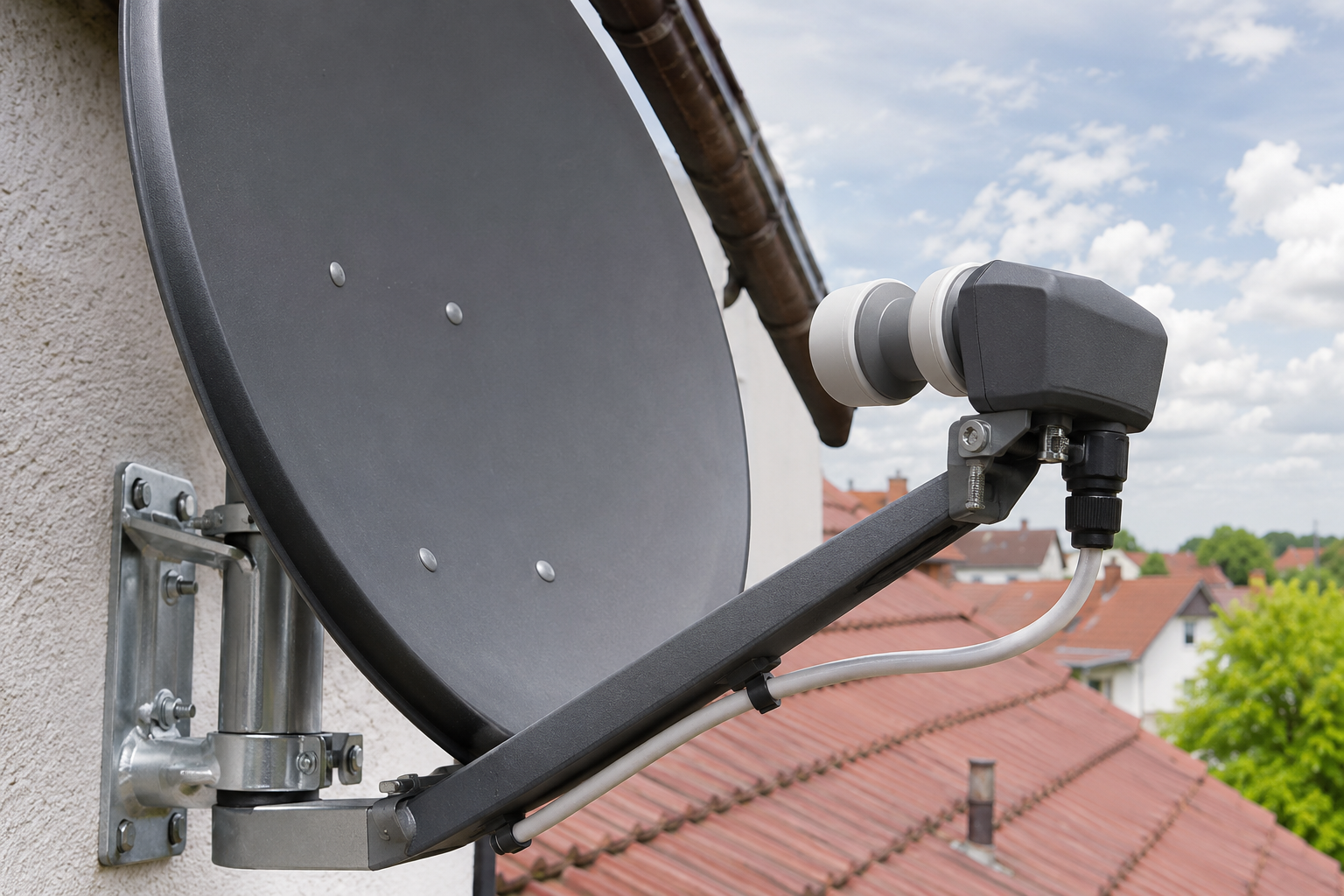
Astra 19.2°E works beautifully on your satellite dish. Channels lock quickly, reception remains stable, and the signal-quality reading looks excellent. But switch to Hot Bird 13°E and the situation changes. Some transponders struggle to lock, others break up, and a few seem completely unavailable. How can one reflector receive Astra so well while delivering poor Hot Bird reception?
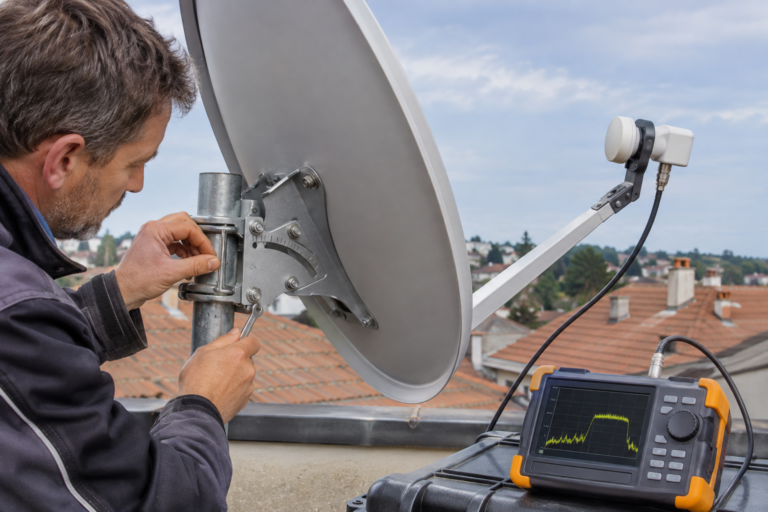
The explanation often lies in how the antenna system handles two different satellite directions. A monoblock or dual-feed installation uses the same reflector, but each feed occupies a different position relative to its focal geometry. The resulting receiving gain, polarization alignment, and available carrier margin may not be identical. Before moving the dish toward Hot Bird, determine whether the problem is caused by feed geometry, antenna alignment, local coverage, or an entirely different signal-path fault.
Astra 19.2°E and Hot Bird 13°E occupy neighboring geostationary orbital positions. They are approximately 6.2 degrees apart in orbital longitude, but their apparent angular separation at a receiving antenna depends on geographic location. A compatible monoblock or adjustable multi-feed arrangement can receive both positions through one reflector. Successful Astra reception does not guarantee that the Hot Bird feed has adequate gain or reception margin.
Why Two Satellites on One Dish Can Have Different Reception Quality
A satellite reflector receives electromagnetic energy from particular directions and focuses it toward an appropriately positioned feed.
In a conventional single-satellite installation, the feed assembly is positioned to use the reflector’s intended receiving geometry for one orbital position.
A dual-satellite installation must accommodate signals arriving from two slightly different directions.
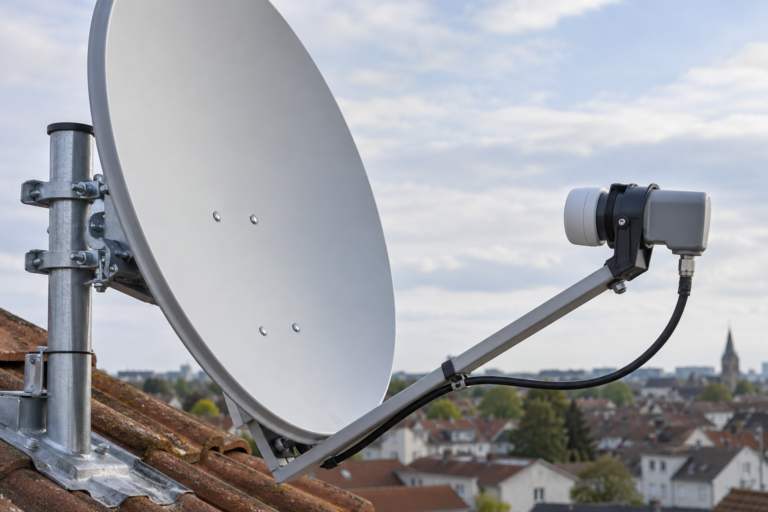
This can be accomplished with two separate LNBs on an adjustable holder or with a monoblock containing two integrated feed assemblies.
Although both satellite positions share the same reflector, the feeds do not necessarily experience identical effective antenna gain.
A Shared Reflector Does Not Guarantee Equal Performance
The receiving performance of each satellite path depends on how its corresponding feed illuminates the reflector and how accurately that feed is positioned.
Off-axis operation can introduce gain reduction and other performance differences compared with an optimized central feed.
The actual effects depend on the reflector geometry and feed design.
Additionally, the received power and transmission requirements of individual Astra and Hot Bird carriers are not identical.
Therefore, a direct comparison between two arbitrary receiver percentages cannot establish which satellite path has better antenna performance.
Primary Feed Versus Offset Feed: Why Position Matters
Many dual-satellite installations designate one feed as the primary mechanical reference for reflector alignment.
The other feed is displaced to receive a nearby orbital position.
The exact arrangement depends on the antenna system and the monoblock manufacturer’s installation design.
What Happens When Astra Is the Primary Reference?
If the dish is aligned primarily for Astra 19.2°E, Astra may receive close to the reflector’s best available gain.
Hot Bird then depends on the performance and positioning of the secondary feed.
If that feed is not located appropriately for the reflector’s geometry, the Hot Bird path may lose usable margin.
The effect may become visible only on the more marginal Hot Bird transponders.
Is the Secondary Feed Always Weaker?
No. The secondary feed may experience an off-axis performance penalty, but this does not guarantee lower measured reception quality on every carrier.
The satellite beam, carrier power, modulation requirements, feed efficiency, and receiver characteristics also influence the result.
A well-designed dual-feed installation may deliver reliable reception from both orbital positions.
Likewise, a poorly installed system can perform badly on either satellite regardless of which feed is nominally primary.
Do not assume that every monoblock places Astra at the primary feed or Hot Bird at the secondary feed. The intended mounting orientation and satellite assignment must be verified using the exact model’s installation instructions.
What Happens When the Dish Is Optimized for Astra Instead of Hot Bird?
One common cause of unequal reception is an alignment that provides excellent Astra performance but leaves insufficient margin for the Hot Bird feed.
The dish may be pointed accurately for one path while the other path is not at its optimum.
Why Small Adjustments Can Change the Balance
Moving the reflector changes how the incoming satellite signals are directed toward both receiving feeds.
A small adjustment may improve the quality of a marginal Hot Bird carrier.
However, the same adjustment can reduce the margin available on Astra.
This creates a practical alignment tradeoff.
The best overall setting is not necessarily the position that produces the highest reading on a single Astra transponder.
Why Maximizing Astra Alone Can Be Misleading
A strong Astra reference carrier might remain well above its required decoding threshold across a range of antenna positions.
Optimizing only that carrier can conceal inadequate Hot Bird performance.
A more useful alignment method compares several representative carriers from both orbital positions.
The objective is sufficient reliable margin on all required services, not identical signal-quality percentages.
Why Monoblock Geometry Can Make Hot Bird Weak
A monoblock LNB contains two receiving feeds with a fixed mechanical relationship.
This arrangement simplifies installation, but it also means that feed spacing and geometry are designed around particular antenna characteristics.
Orbital Separation Is Not the Whole Story
Astra 19.2°E and Hot Bird 13°E differ by 6.2 degrees in orbital longitude.
However, the angular separation visible from a receiving location is not automatically identical to that numerical difference.
The required feed placement also depends on the reflector’s optical geometry and focal length.
Consequently, a monoblock advertised for approximately six-degree satellite separation is not automatically compatible with every dish.
Dish Diameter and F/D Ratio
The F/D ratio expresses the relationship between reflector focal length and its diameter.
It is an important geometric characteristic when evaluating feed placement and illumination.
Two reflectors with the same nominal diameter can have different focal ratios.
Likewise, a monoblock designed for one antenna geometry may not provide the intended feed positions on a substantially different reflector.
As a concrete manufacturer example, Inverto offers a six-degree monoblock designed for an 80cm offset dish with F/D = 0.6.
This illustrates why matching the manufacturer’s intended dish geometry matters.
It does not mean every 80cm reflector has F/D = 0.6 or that all six-degree monoblocks share identical specifications.
Why a Larger Dish May Not Solve a Geometry Mismatch
A larger dish generally provides more theoretical gain when other relevant factors are equal.
But it may also have a narrower main beam, making accurate feed positioning more critical.
If the monoblock’s fixed spacing is poorly matched to the reflector, increasing dish size alone may not produce the expected improvement.
In some installations, separate LNBs on an adjustable multi-feed bracket provide greater flexibility.
Could Satellite Coverage Explain the Difference?
Before assuming that feed geometry is responsible, consider the actual downlink conditions at the receiving location.
Astra 19.2°E and Hot Bird 13°E use different satellites, coverage beams, and transmission characteristics.
Even within one orbital position, individual transponders may have different reception margins.
Why Comparing Two Arbitrary Channels Is Not Enough
Suppose an Astra channel uses a carrier with comfortable margin, while the selected Hot Bird channel operates closer to its decoding threshold.
The Astra service may remain stable despite moderate installation losses.
Meanwhile, the Hot Bird carrier may freeze or lose lock.
That difference does not prove that the reflector delivers less gain toward Hot Bird.
The two carriers may simply have different overall link budgets.
Use the Appropriate Coverage Information
Coverage maps provide useful information about the expected satellite downlink power across different regions.
However, an EIRP contour is not a guarantee of reliable reception with a particular reflector.
Dish gain, receiving-system noise, atmospheric conditions, and the modulation requirements of the selected carrier must also be considered.
For reliable troubleshooting, compare the measured carrier quality with the requirements of the corresponding transmission rather than interpreting raw percentages as equal performance indicators.
Why Some Hot Bird Transponders Fail Before Others
When an installation has limited available margin, the problem often becomes visible on certain transponders first.
Some carriers may continue locking while others fail under the same antenna conditions.
That behavior can result from differences in carrier power, modulation, coding, and receiving-system performance.
Successful Lock Does Not Prove Optimal Alignment
A dish can receive Hot Bird even when the corresponding feed is not positioned for maximum practical performance.
Robust carriers may tolerate the loss, while marginal carriers cannot.
Our related article, Why Your Dish Finds 13E but Misses Weak Carriers, explains how small pointing errors, feed alignment, and limited reception margin can prevent some carriers from locking despite successful satellite identification.
In a dual-satellite system, that same principle must be evaluated alongside the geometric compromise of receiving two directions through one reflector.
How Monoblock Rotation and Polarization Alignment Affect Hot Bird
Both Astra and Hot Bird use linearly polarized Ku-band transmissions.
Accurate feed polarization alignment helps limit unwanted signal pickup from the orthogonal polarization.
Incorrect rotation can reduce isolation and potentially degrade carrier quality.
Monoblock Rotation Is Not Just a Cosmetic Adjustment
The physical orientation of a monoblock can influence the relative positions of its two feeds as well as their polarization alignment.
The intended tilt and mounting instructions must therefore be followed for the specific model.
Changing the rotation without understanding the manufacturer’s geometry can improve one receiving path while degrading the other.
Skew Is Not the Same as Electronic Polarization Selection
In conventional universal LNB systems, nominal 13V and 18V control states select the appropriate polarization path.
Feed rotation is a separate geometric matter.
If an entire polarization group is unavailable, investigate the relevant switching and distribution mechanisms before concluding that the monoblock simply needs to be rotated.
When the Problem Is DiSEqC Rather Than Weak Reception
Some apparent Hot Bird weakness problems are actually satellite-selection problems.
A monoblock commonly includes internal switching so the receiver can select the desired satellite feed.
Depending on the product, DiSEqC commands control which path is delivered to the receiver.
Why Port A and Port B Must Be Verified
Manufacturers do not all use the same satellite-to-port assignment across their monoblock products.
For example, a particular Inverto six-degree monoblock specifies Hot Bird 13°E as Satellite A and Astra 19.2°E as Satellite B.
Other products may use different assignments.
Always consult the exact model documentation before configuring DiSEqC ports.
How Wrong Port Selection Changes the Symptoms
If the receiver requests Hot Bird but selects the Astra feed, its signal-strength indicator may still respond to received RF energy.
However, the expected Hot Bird carrier may not lock.
This is different from a genuine weak Hot Bird carrier that locks with insufficient margin.
Before making mechanical adjustments, confirm that the selected feed delivers the intended satellite.
Hot Bird locks but quality is low: Investigate carrier margin, feed geometry, alignment, and RF performance.
Hot Bird never locks on verified carriers: First confirm the satellite feed, DiSEqC mapping, receiver settings, and actual orbital position.
How to Compare Astra and Hot Bird Reception Correctly
Comparing two different satellite systems requires more care than reading their signal-strength percentages.
A useful test should focus on verified carriers, repeatable measurements, and the available operating margin.
Choose Representative Transponders
Select currently active reference carriers on Astra 19.2°E and Hot Bird 13°E.
Where practical, include different frequency ranges and polarizations.
Confirm each carrier’s current transmission parameters before testing.
Measure More Than RF Level
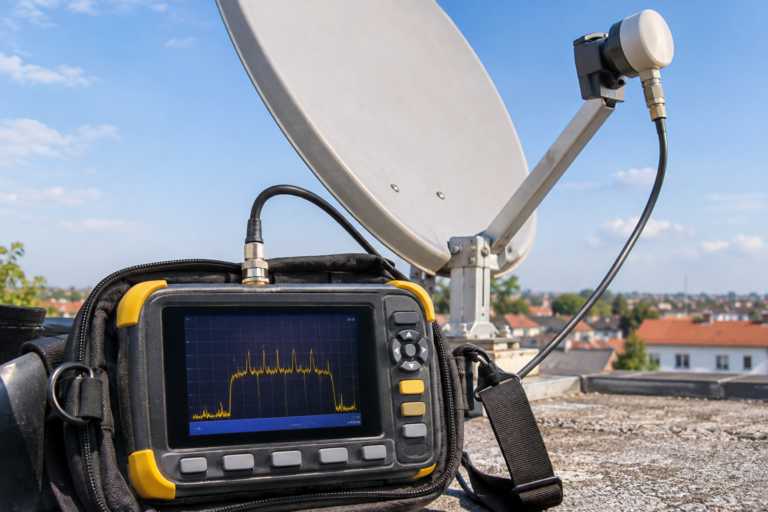
Professional satellite analyzers can report carrier-to-noise ratio, modulation error ratio, lock status, and relevant error measurements.
These readings help distinguish inadequate signal quality from a simple change in input level.
However, different modulation and coding configurations have different reception requirements.
A higher MER reading on one arbitrary transponder does not automatically prove that its entire satellite path has more margin.
Compare Margin Relative to Requirements
Where the necessary information is available, evaluate measured quality relative to the selected carrier’s required operating conditions.
This is more meaningful than trying to make both satellites display the same signal-quality percentage.
The objective is dependable reception of the required services across both satellite positions.
Step-by-Step: Improve Weak Hot Bird Reception Without Losing Astra
Step 1: Confirm Both Orbital Positions
Verify that the receiver can identify Astra 19.2°E and Hot Bird 13°E using suitable known carriers and service information.
Do not rely exclusively on the satellite names stored in its menu.
Step 2: Identify the LNB Arrangement
Determine whether the system uses a monoblock, two independent LNBs, or another multi-feed configuration.
Identify which feed is intended for which satellite and how switching is controlled.
Step 3: Check the Manufacturer’s Mounting Specifications
For a monoblock, verify the intended dish diameter, focal geometry, mounting arrangement, and satellite separation.
Confirm that the reflector and monoblock are compatible.
Step 4: Record Current Performance
Measure representative carriers on both Astra and Hot Bird before moving anything.
Record lock status, MER, C/N, and relevant error information where supported.
Also document the antenna’s current mechanical position.
Step 5: Investigate Hot Bird’s Feed Path
Check mounting stability, feed position, monoblock orientation, and appropriate polarization alignment.
Look for configuration or switching faults that could prevent the expected path from being selected.
Step 6: Optimize the Dual-Satellite Balance
If the hardware is compatible and the configuration is correct, a qualified installer can evaluate controlled alignment adjustments.
Monitor the most marginal required carriers on both orbital positions.
A change that improves Hot Bird but causes unacceptable Astra degradation is not a successful overall adjustment.
Step 7: Recheck After Securing the Installation
Tightening brackets and feed clamps can sometimes alter the final geometry.
Repeat the carrier measurements after the installation is secured.
Record the results so later reception changes can be evaluated against a known baseline.
Confirm both satellites → Identify feed mapping → Verify monoblock compatibility → Measure Astra and Hot Bird → Inspect geometry → Optimize the available margin → Recheck both paths.
Do not move the reflector toward Hot Bird until the satellite-selection configuration and feed arrangement have been verified.
What Different Astra and Hot Bird Reception Patterns Reveal
| Observed Pattern | Possible Explanation | First Useful Check |
|---|---|---|
| Astra stable, Hot Bird locks with low margin | Feed geometry, pointing bias, or different link margin | Measure representative Hot Bird carriers |
| Astra stable, no Hot Bird carrier locks | Wrong feed selection, settings, alignment, or path fault | Verify DiSEqC mapping and satellite identity |
| Hot Bird improves when the dish moves but Astra worsens | Dual-satellite alignment compromise | Evaluate both paths against required margins |
| Only one Hot Bird polarization is affected | Skew, polarization switching, or distribution issue | Check feed orientation and control path separately |
| Only selected Hot Bird carriers fail | Marginal link conditions or carrier-specific impairment | Verify carrier parameters and quality |
| Weakness began after replacing the monoblock | Different geometry, mounting, or hardware performance | Compare compatibility and installation position |
| Both satellites become unreliable in wind | Mechanical instability | Inspect mast and brackets safely |
| Astra services appear under the Hot Bird menu | Wrong satellite mapping or channel database assignment | Identify actual carrier source and switch settings |
These observations help prioritize diagnosis. They do not prove a specific hardware fault without additional verification.
When to Adjust the Dish, Change the Monoblock, or Use Separate LNBs
Once the problem has been isolated, the appropriate solution depends on the source of the performance imbalance.
Fine Alignment
If both feeds are compatible with the reflector and Hot Bird is only marginal, controlled alignment may recover useful margin.
Measure the effect on Astra before accepting the change.
Correct the Monoblock Configuration
If the wrong feed is being selected, correct the receiver’s DiSEqC assignment according to the exact hardware model.
Changing dish position will not repair a simple port-mapping error.
Use a Compatible Monoblock
If the existing unit is poorly matched to the dish’s focal geometry, a compatible model may improve the result.
Check the manufacturer’s intended dish dimensions, F/D ratio, feed arrangement, and switching specifications before purchasing a replacement.
Consider Separate Adjustable LNBs
Separate feeds on an appropriate adjustable multi-feed bracket can provide more flexibility when fixed monoblock geometry is unsuitable.
However, the arrangement must still match the reflector and be aligned correctly.
Using two independent LNBs does not guarantee better reception without an appropriate design.
Evaluate Dish Size Only After Geometry
A larger reflector may provide additional gain when insufficient antenna aperture is the actual limitation.
But replacing the dish without addressing an incompatible monoblock or incorrect feed positioning may not solve the problem.
Reality Check: Astra Is Not Universally Stronger Than Hot Bird
Astra 19.2°E displaying better reception than Hot Bird 13°E on one installation does not establish that Astra is universally stronger.
The comparison involves different satellite beams, carriers, transmission requirements, and potentially different feed positions on the same reflector.
A receiver’s signal-quality percentages are not calibrated measurements that can be compared blindly across two orbital positions.
Diagnose the actual Hot Bird reception margin and the geometry of its feed path before assuming that the satellite itself is the problem.
Final Verdict
Astra 19.2°E can work reliably while Hot Bird 13°E remains weak on the same dish because dual-satellite reception does not provide identical conditions for both orbital positions.
Feed positioning, reflector alignment, monoblock geometry, polarization performance, and differences in carrier link margin can all contribute.
However, incorrect DiSEqC mapping or receiver configuration can imitate weak reception when the intended Hot Bird path is not selected at all.
The most reliable solution begins with verifying both satellites and the feed arrangement, followed by measurements on representative carriers.
Optimize the installation for sufficient usable margin on the services you need from both Astra and Hot Bird, rather than maximizing one satellite at the expense of the other.
Frequently Asked Questions
Why is Astra stronger than Hot Bird on the same dish?
The Astra receiving path may have more usable margin because of feed geometry, alignment, satellite coverage, or transmission differences. The result does not mean Astra is universally stronger than Hot Bird.
Should I point the main dish toward Hot Bird instead of Astra?
Not automatically. The intended alignment depends on the monoblock or multi-feed design. Follow the manufacturer’s geometry and evaluate reception margins on both satellites before changing the reflector position.
Can rotating a monoblock improve weak Hot Bird reception?
Controlled rotation may affect feed geometry and polarization alignment, depending on the model. However, random adjustments can worsen reception or disturb the other satellite. Use the manufacturer’s instructions and suitable measurements.
Does Hot Bird need a larger dish than Astra?
Not as a universal rule. The required antenna size depends on local coverage, selected transponders, receiver performance, weather margin, and installation geometry.
Why are only some Hot Bird transponders weak?
Individual carriers can have different received power, modulation requirements, interference conditions, and available margins. A marginal installation may reveal problems on certain transponders before others.
Can incorrect DiSEqC settings make Hot Bird appear weak?
Incorrect switching can select the wrong satellite feed. This may produce an RF-level indication without locking the intended Hot Bird carriers. Verify the actual satellite and the model-specific port mapping before adjusting the dish.
Can a 6-degree monoblock work with any satellite dish?
No. Feed spacing and intended satellite separation must be compatible with the reflector’s focal geometry. Some monoblocks are designed for particular dish sizes and F/D ratios.
When should I replace a monoblock with two separate LNBs?
Separate adjustable LNBs may be useful when fixed monoblock geometry cannot provide suitable performance on both satellites. The reflector, feed holder, switching arrangement, and installation still need to be compatible.