Why Your Dish Finds 13E but Misses Weak Carriers
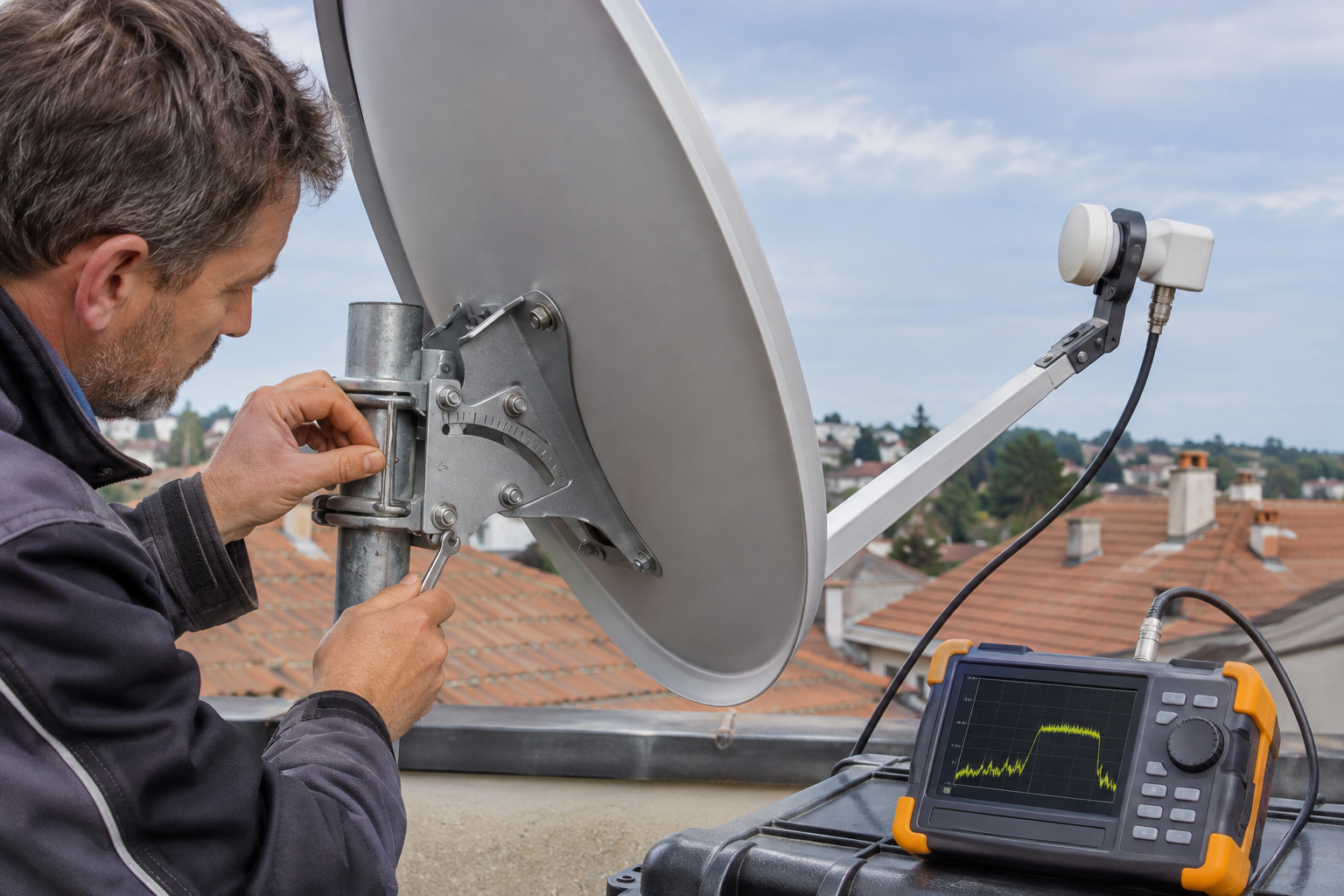
Your satellite dish finds Hot Bird 13°E, the receiver identifies the satellite, and several transponders lock without difficulty. But when you check less reliable carriers, their quality drops sharply or the receiver cannot lock them at all. If the dish is already pointing at the correct satellite, why are some frequencies still missing?
Finding a satellite and optimizing reception are two different achievements. A dish can be aligned closely enough to receive carriers with comfortable signal margins while still losing valuable antenna gain through a small pointing error. Other problems, including feed positioning, polarization alignment, and mechanical instability, can produce similar results. The goal is to determine whether your installation has genuinely reached its best reception point, not simply whether the first strong transponder works.
Hot Bird 13°E is an orbital position served by Eutelsat’s HOTBIRD 13F and 13G satellites. Individual transponders can differ in received power, transmission characteristics, and required decoding conditions. A carrier with less available reception margin may fail even while other carriers remain stable. Accurate antenna pointing can recover some lost margin, but not every missing transponder is caused by dish misalignment.
Finding Hot Bird Is Not the Same as Optimizing Reception
A satellite dish receives energy from a range of directions determined by its antenna radiation pattern.
Its maximum receiving gain is normally achieved when the antenna’s main beam is accurately directed toward the intended satellite position.
However, the receiver does not require maximum antenna gain to lock every carrier.
A sufficiently strong transmission may remain decodable even when the dish is not perfectly pointed.
This is why the first successful lock can create a misleading sense that alignment is complete.
The Difference Between Initial Acquisition and Final Alignment
During initial installation, a technician may use an active reference carrier to identify the intended orbital position.
Once the correct satellite is confirmed, the antenna should be fine-tuned for the best practical reception margin.
Stopping at the first successful lock may leave part of the reflector’s potential gain unused.
That unused gain may not matter for robust carriers, but it can be important for transponders operating close to their required reception thresholds.
Why a Strong Carrier Can Hide an Alignment Problem
Imagine two hypothetical Hot Bird transponders.
Carrier A has comfortable reception margin, while Carrier B is only slightly above its decoding threshold.
A small pointing error could reduce the received quality enough to make Carrier B unavailable, while Carrier A remains stable.
The issue is not necessarily that Carrier B is transmitted with less power. It may have less usable margin at the particular receiving installation.
How Small Pointing Errors Reduce Antenna Gain
A parabolic reflector concentrates incoming satellite energy toward its feed assembly.
The antenna’s directional response has a main beam, with maximum gain near its intended pointing direction.
Moving away from that direction generally reduces gain according to the antenna’s radiation pattern.
Understanding Boresight and Pointing Loss
Boresight describes the antenna’s principal pointing direction.
Pointing loss is the reduction in antenna gain caused by an angular difference between the intended satellite direction and the antenna’s actual orientation.
The amount of loss depends on the antenna design, operating frequency, and angular error.
It is not technically valid to assume that every small dish movement produces the same signal loss.
Different reflectors have different beamwidths and sidelobe characteristics.
Why Larger Dishes Require More Precise Pointing
At the same operating frequency, a larger effective antenna aperture generally produces a narrower main beam.
This means a larger reflector can provide more gain but may also be more sensitive to pointing errors.
A larger dish that is not accurately aligned may fail to deliver the improvement expected from its greater diameter.
Correct installation is therefore just as important as antenna size.
A receiver reporting a high signal-strength percentage does not prove that the dish is at its maximum-gain pointing position. Receiver percentages are generally equipment-specific and should not replace suitable carrier-quality measurements during alignment.
Azimuth and Elevation: Why Both Adjustments Matter
A satellite dish must be directed toward the correct apparent position of the satellite in the local sky.
For a fixed receiving installation, this involves the appropriate azimuth and elevation angles.
Azimuth: Horizontal Pointing Direction
Azimuth describes the horizontal direction in which the antenna points.
A small error can shift the reflector’s main beam away from the desired satellite direction.
Depending on the available margin, some carriers may remain decodable while others become unreliable.
Elevation: Vertical Pointing Direction
Elevation describes the antenna’s pointing angle above the local horizon.
An incorrect elevation setting can cause a similar reduction in receiving gain.
Changing azimuth alone cannot necessarily compensate for an elevation error.
Both adjustments need to be optimized using the appropriate measurements.
Why Random Dish Movement Often Makes Things Worse
Moving the reflector without recording its initial position can make troubleshooting difficult.
A receiver may respond slowly to changes, and its quality indicator may use smoothing or other processing.
Rapid adjustments can therefore cause the installer to overshoot the best reception point.
A controlled alignment procedure uses small, deliberate movements with sufficient time for the measurement instrument to respond.
When working on exposed rooftops or elevated structures, use a qualified installer with appropriate access and fall-protection equipment.
How Feed Position and LNB Skew Affect Marginal Carriers
Dish pointing is only one part of antenna alignment.
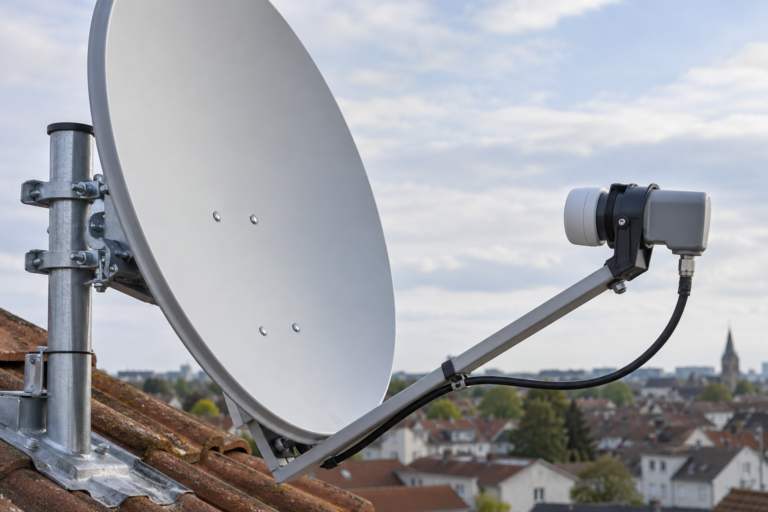
The LNB and feed assembly must also be positioned appropriately relative to the reflector.
The Importance of Focal Position
A parabolic reflector is designed to concentrate incoming energy toward a specific feed region.
If the feed is installed incorrectly, the receiving system may lose efficiency through poor illumination or other optical mismatches.
This can reduce available carrier quality even when the reflector itself points correctly toward Hot Bird.
Different LNB feedhorn designs may have different effective phase-center locations, so identical mounting depth does not guarantee identical performance.
LNB Skew and Polarization Isolation
Hot Bird Ku-band services use linear polarization.
Correct feed rotation helps align the receiving polarization axes with the incoming signals.
An incorrect skew setting can reduce polarization discrimination and increase unwanted contributions from the orthogonal polarization.
Some transponders may be affected more noticeably than others depending on the available margin and interference conditions.
However, skew correction should not be confused with repairing electrical polarization switching.
If an entire horizontal or vertical group is missing, verify the relevant LNB control and distribution settings before assuming that feed rotation is responsible.
Mechanical Problems That Can Affect Weak Hot Bird Carriers
Even a correctly aligned dish may not remain in its original position indefinitely.
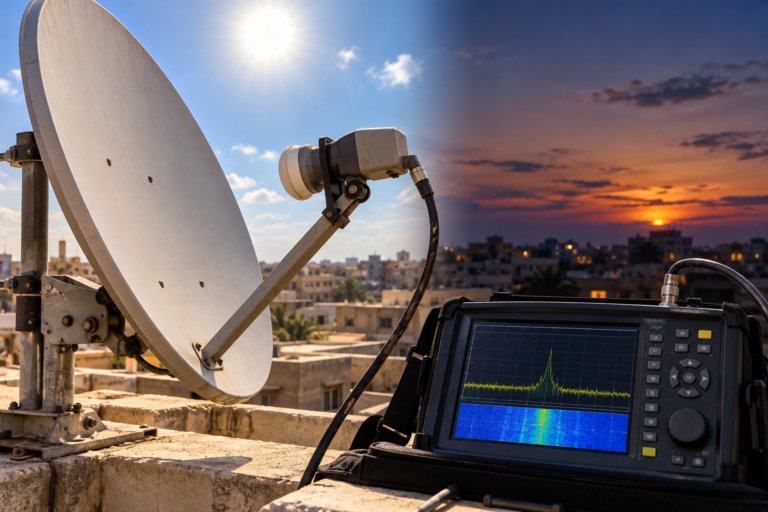
Outdoor antenna systems are exposed to wind, temperature changes, vibration, and mechanical stress.
Loose Mounting Hardware
A loose azimuth clamp, elevation adjustment bracket, or supporting mast can allow small changes in pointing direction.
Strong carriers may continue working while transponders with limited margin become intermittent.
If reception changes during wind gusts, investigate mechanical stability before making repeated receiver scans.
Reflector Distortion
Damaged or distorted reflectors may no longer focus incoming energy as effectively as intended.
Physical damage can result from impact, excessive mounting stress, or unsuitable installation practices.
An apparently small deformation may influence performance, but the actual significance depends on the reflector and operating conditions.
Obstructions Near the Reception Path
Trees, buildings, and other objects can obstruct the line of sight toward the intended satellite.
Vegetation may also create changing attenuation as branches move or become wet.
If the dish has a partially obstructed view, precise alignment alone may not provide sufficient margin.
The receiving location may need to be reconsidered.
Why Some Hot Bird Carriers Fail Before Others
The term weak carrier can be misleading because the weakest-performing transponder on a receiver is not necessarily the one transmitted with the lowest power.
Received performance depends on several factors:
- Satellite beam coverage and downlink power at the receiving location.
- Transmission modulation and coding configuration.
- Carrier-to-noise and interference conditions.
- Antenna gain and pointing accuracy.
- Feed illumination and polarization isolation.
- Frequency-dependent LNB and cable characteristics.
- Receiver demodulation capabilities.
These factors determine the usable margin available to each carrier.
Reception Margin Is More Useful Than Raw Signal Strength
Carrier-to-noise measurements and modulation error ratio can help characterize reception quality.
The relationship between measured quality and the relevant transmission requirements is important when evaluating usable margin.
A carrier operating close to its threshold may fail after a relatively small deterioration.
By contrast, a carrier with greater margin can remain stable under the same conditions.
A Difficult Carrier Is Not Always a Misaligned-Dish Problem
A transponder may be difficult to acquire because of receiver search behavior, frequency uncertainty, unsupported transmission parameters, or inadequate signal quality.
These are different fault categories.
Our related article, Why Some Hot Bird Transponders Are Harder to Lock, explains how carrier synchronization, symbol rate, oscillator behavior, and tuner implementation influence acquisition.
If a carrier locks slowly but remains stable once acquired, investigate receiver acquisition behavior before assuming the antenna is incorrectly pointed.
How to Optimize Hot Bird Alignment Using Multiple Carriers
Using several representative carriers gives a more meaningful picture of antenna performance than relying on the first transponder that locks.
Step 1: Confirm the Actual Satellite
Verify that the antenna is receiving Hot Bird 13°E rather than another nearby orbital position.
Do not rely solely on the satellite name stored in the receiver.
Use verified current carrier parameters and, where supported, service or network identification information.
Step 2: Select Representative Reference Carriers
Choose several currently active Hot Bird transponders with known parameters.
Where practical, include carriers from different frequency ranges and both polarizations.
Avoid using a single carrier as proof that the entire installation is correctly configured.
Step 3: Record the Initial Measurements
Before changing the antenna position, record lock status and available signal-quality measurements.
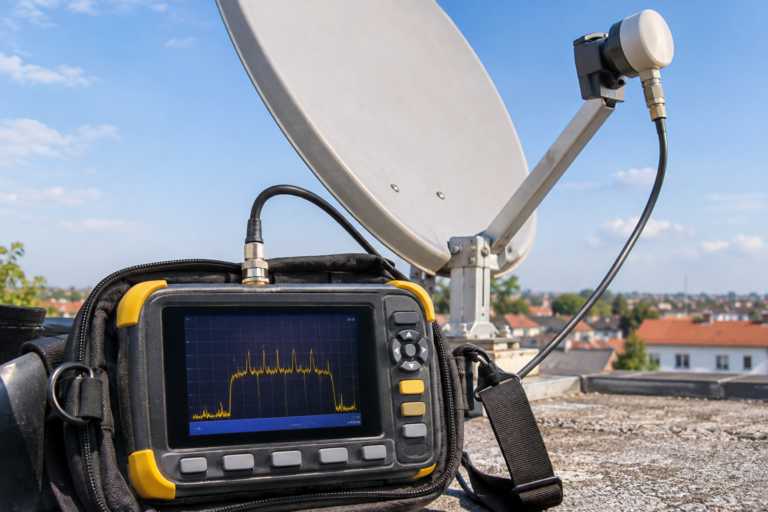
Professional satellite analyzers can provide information such as C/N, MER, and relevant error indicators.
Measurements should be interpreted according to the transmission mode and the equipment’s capabilities.
Step 4: Optimize Azimuth Carefully
Using a suitable instrument, make controlled horizontal pointing adjustments around the current position.
Observe how representative carriers respond.
Identify the position offering the best overall usable reception, rather than optimizing only one strong carrier.
Step 5: Optimize Elevation
Repeat the controlled process for elevation.
After changing one axis, it may be useful to recheck the other because the antenna’s mechanical adjustments can interact.
Avoid applying arbitrary angular increments that are unsuitable for the reflector’s beamwidth and adjustment mechanism.
Step 6: Evaluate Feed Position and Skew
Once reflector pointing is stable, verify that the feed assembly is installed according to the antenna manufacturer’s requirements.
Check polarization alignment using representative carriers.
Do not rotate the LNB randomly or assume that maximizing one transponder guarantees the best result for all others.
Step 7: Tighten and Recheck
Secure the mounting hardware according to the manufacturer’s specifications.
Recheck reception after tightening because mechanical stress can slightly alter pointing.
Record the final measurements for future troubleshooting.
Confirm 13°E → Verify reference carriers → Record baseline quality → Optimize azimuth → Optimize elevation → Check feed and skew → Secure hardware → Repeat measurements.
A professional measurement approach minimizes unnecessary equipment replacement and provides evidence of whether antenna pointing was actually responsible.
When Dish Alignment Is Not the Problem
If careful alignment produces no meaningful improvement, investigate other parts of the receiving system.
Incorrect LNB or Receiver Configuration
Wrong local oscillator settings, band selection, polarization switching, or DiSEqC routing can make specific transponders unavailable.
A conventional universal Ku-band LNB commonly uses nominal local oscillator frequencies of 9750 MHz and 10600 MHz.
These settings must match the actual hardware. Quattro and single-cable distribution systems require their own appropriate configurations.
Frequency-Dependent Cable Loss
Coaxial cable attenuation generally varies with frequency.
Long cable runs, damaged connectors, and unsuitable distribution components may reduce reception quality or disrupt the LNB control path.
Antenna adjustment cannot correct a defective coaxial connection.
Limited Satellite Coverage or Insufficient Antenna Gain
At some receiving locations, a particular carrier may have insufficient margin even with a correctly aligned antenna.
A larger or more efficient reflector may help when antenna gain is genuinely the limiting factor.
However, the appropriate dish size depends on local coverage, receiving-system performance, transmission requirements, and desired weather availability.
Do not assume that increasing dish diameter will repair every missing-carrier problem.
What Different Reception Patterns Reveal
| Observed Pattern | Possible Explanation | First Useful Check |
|---|---|---|
| Strong carriers work but marginal carriers do not | Pointing loss or insufficient reception margin | Measure representative carriers and verify alignment |
| Several carriers improve after a small pointing adjustment | Original antenna pointing was suboptimal | Repeat measurements after securing the mount |
| Only horizontal or vertical groups fail | LNB switching, skew or distribution problem | Verify polarization control and feed alignment |
| Only one frequency band fails | Band switching, oscillator settings or distribution issue | Check LNB configuration and the affected RF path |
| Reception changes during wind gusts | Dish or mast movement | Inspect mechanical stability |
| Carrier locks slowly but remains stable | Acquisition behavior or tuning uncertainty | Verify parameters and compare compatible receivers |
| All carriers remain marginal after correct alignment | Insufficient system margin or broader RF impairment | Evaluate antenna gain, cable path and receiving equipment |
| Carrier locks but its channels are absent | Service database or compatibility problem | Check current service information and receiver support |
These patterns guide troubleshooting but do not establish a definitive diagnosis without supporting measurements.
Reality Check: A Successful Satellite Lock Does Not Prove Perfect Alignment
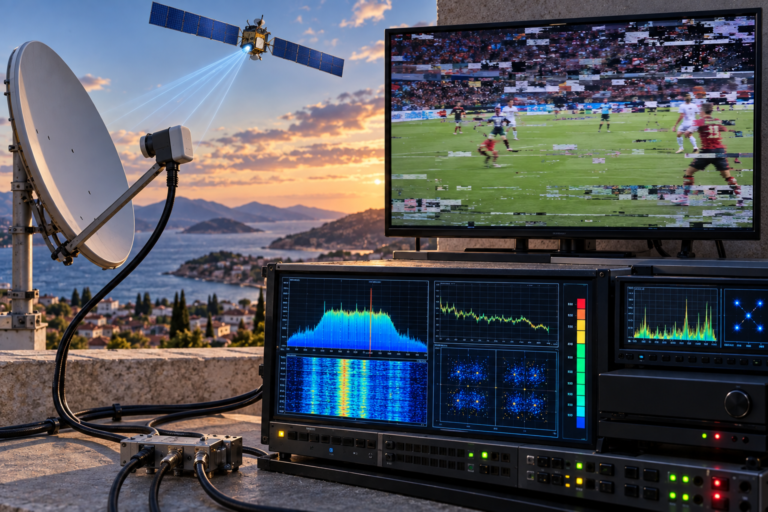
A dish can successfully receive Hot Bird 13°E without delivering its maximum available antenna gain.
Carriers with comfortable reception margins may remain stable despite small pointing errors, while more marginal carriers fail.
However, missing transponders can also result from incorrect tuning parameters, LNB switching problems, cable losses, incompatible receiver hardware, or inadequate local coverage.
Do not move the dish simply because one transponder is missing. First confirm that the carrier is active, the receiver supports its parameters, and the existing installation is correctly configured.
Final Verdict
If your dish finds Hot Bird 13°E but misses weaker carriers, the first successful lock may not represent the best possible antenna alignment.
Small pointing errors, incorrect feed position, polarization misalignment, or mechanical instability can reduce the reception margin available to marginal transponders.
The most reliable approach is to verify current carrier parameters, compare multiple representative transponders, and optimize antenna pointing using meaningful signal-quality measurements.
If reception does not improve, investigate the LNB configuration, cabling, receiver compatibility, and available satellite link margin before replacing equipment.
Correct alignment is not defined by how many bars appear on a receiver screen. It is defined by reliable reception with sufficient margin across the services the installation is intended to receive.
Frequently Asked Questions
Why does my dish find Hot Bird but miss some transponders?
The dish may be close enough to the correct pointing direction for carriers with comfortable margins but not sufficiently optimized for more marginal transmissions. Incorrect receiver settings, cable problems, and other RF limitations can also cause selective failures.
Can a small dish alignment error affect only weak carriers?
Yes. A pointing error can reduce antenna gain. Carriers with less usable reception margin may fall below their decoding thresholds while stronger-performing carriers remain available.
Should I align Hot Bird using the strongest transponder?
A reliably identified carrier is useful for initially locating the satellite, but final alignment should consider several representative carriers and their reception quality. Maximizing one receiver percentage is not sufficient proof of overall optimization.
Can LNB skew cause some Hot Bird frequencies to disappear?
Incorrect feed rotation can reduce polarization isolation and affect reception quality. However, missing frequency groups may also result from electrical switching or distribution faults, which require separate checks.
Will an 80cm dish fix missing weak Hot Bird carriers?
A larger, properly aligned reflector may improve reception margin when insufficient antenna gain is the cause. It will not correct outdated transponder parameters, incompatible receiver hardware, or defective switching connections.
Why does a transponder work on one receiver but not another?
Receivers can differ in tuning algorithms, supported transmission modes, firmware, and configuration. Compare both units using verified parameters and equivalent RF conditions before attributing the failure to dish pointing.
Can bad weather reveal a dish alignment problem?
Yes. Weather-related attenuation can reduce available reception margin, making previously marginal carriers fail. However, wet connectors and wind-related dish movement can create similar symptoms.