Why ZDF HD Appears More Stable Than Some Channels
Estimated Reading Time: 12 minutes
ZDF HD can appear remarkably stable on an Astra 19.2E installation. A viewer may find that ZDF HD continues working normally while another channel begins to pixelate, freeze, or disappear during marginal reception. The tempting explanation is that ZDF HD simply has a stronger signal, but satellite reception is more complicated than one strength percentage.
ZDF HD is carried through its own DVB-S2 transponder configuration, and its behaviour depends on the complete RF link. Satellite beam conditions, received carrier power, modulation, Forward Error Correction, MER, BER, dish alignment, LNB skew, cable losses, interference, and the remaining signal margin all influence stability. ZDF HD may therefore provide excellent reception on one installation while another transponder exposes weaknesses that ZDF HD does not.
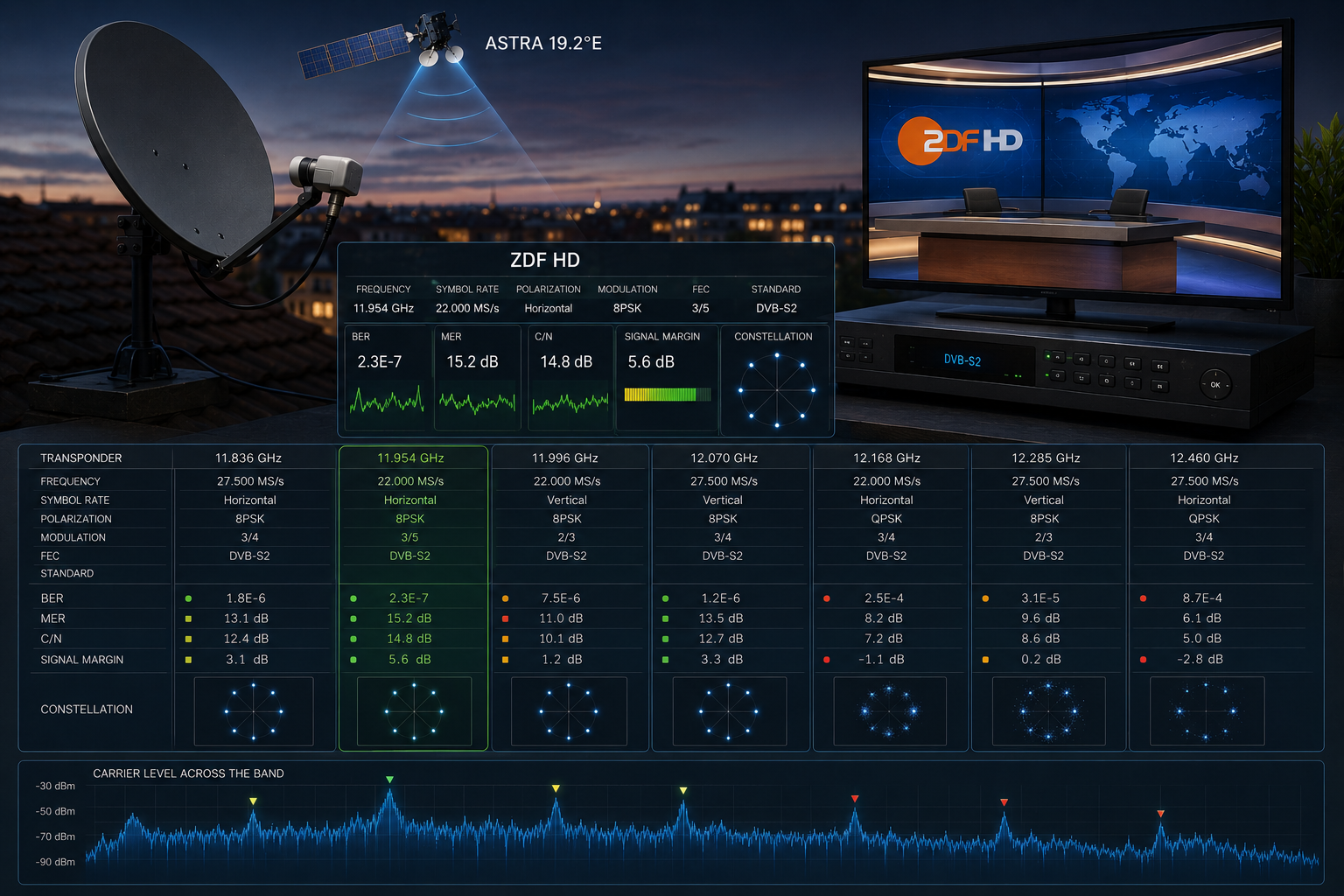
ZDF HD is transmitted from Astra 19.2E using DVB-S2 and 8PSK. Its published satellite parameters include 11.362 GHz horizontal polarization, a symbol rate of 22 MS/s, and FEC 2/3. These parameters describe the transmission, but they do not guarantee that ZDF HD will always outperform every other channel. Actual stability depends on how far the received carrier remains above its required decoding threshold at a particular installation.
- What Makes a Satellite Channel Appear Stable
- How ZDF HD Reaches the Receiver
- Why Signal Strength Alone Cannot Explain Stability
- How DVB-S2 and 8PSK Affect ZDF HD
- Why FEC 2/3 Matters
- Signal Margin Is the Real Key
- What MER Reveals About ZDF HD
- How BER Changes Before Reception Fails
- Why Another Channel Can Fail First
- How Dish Alignment Changes the Comparison
- Why LNB Skew Matters
- Frequency and LNB Performance
- Rain and Environmental Effects
- Why Channels on the Same Transponder Behave Together
- What Happens Inside the Receiver Near the Threshold
- How to Compare ZDF HD With an Unstable Channel
- Reality Check
- Final Verdict
- FAQ
What Makes a Satellite Channel Appear Stable
A stable digital satellite picture means the receiver has enough usable RF quality to remain comfortably above the decoding threshold.
The receiver does not need a perfect signal. DVB-S2 is specifically designed to operate in the presence of noise and transmission errors.
Forward Error Correction repairs many errors before they can damage the television picture.
If sufficient margin remains, normal changes in weather, temperature, or RF conditions are absorbed by the system without becoming visible.
A channel therefore appears stable when its complete link provides enough reserve, not simply when the receiver displays a high strength percentage.
How ZDF HD Reaches the Receiver
ZDF HD is distributed through the Astra 19.2E satellite system used extensively for German television.
The transmitted Ku-band carrier travels from the satellite toward the European coverage area. The receiving dish collects a small portion of this microwave energy and concentrates it onto the LNB feed.
The LNB amplifies the signal and converts the satellite frequency into an intermediate frequency suitable for coaxial cable.
The receiver then tunes the required carrier, recovers the 8PSK modulation, performs DVB-S2 Forward Error Correction, reconstructs the broadcast data, identifies ZDF HD, and sends the compressed video and audio to its media decoders.
Every one of these stages depends on successful RF reception occurring first.
Why Signal Strength Alone Cannot Explain Stability
Consumer satellite receivers often display signal strength and signal quality as percentages, but these numbers are not standardized engineering measurements across different receiver brands.
Strength mainly indicates how much RF energy is reaching the tuner. It does not prove that the wanted modulation is clean.
A strong carrier affected by interference, phase noise, or cross-polarization leakage can have worse digital quality than a somewhat weaker but cleaner carrier.
This is why a receiver might show 90 percent strength on an unstable channel and a lower number on ZDF HD while ZDF HD continues working perfectly.
MER, BER, carrier-to-noise conditions, and available decoding margin provide a much better explanation.
How DVB-S2 and 8PSK Affect ZDF HD
ZDF HD uses DVB-S2 with 8PSK modulation.
8PSK represents data using eight principal phase states. Each symbol can therefore represent three bits before coding overhead is considered.
This provides greater spectral efficiency than QPSK, which uses four states and represents two bits per symbol.
The tradeoff is that the eight constellation states are closer together. Noise, interference, phase errors, and distortion can make it more difficult for the demodulator to determine which state was transmitted.
8PSK therefore needs adequate modulation quality. However, modulation cannot be evaluated alone because Forward Error Correction has a major effect on the actual decoding requirement.
Why FEC 2/3 Matters
ZDF HD’s published DVB-S2 configuration uses an FEC rate of 2/3.
Forward Error Correction introduces controlled redundancy into the transmitted data. This redundancy allows the receiver to reconstruct information that was damaged during the satellite link.
With a 2/3 coding rate, the relationship between useful information and error-protection data is different from configurations using rates such as 3/4 or 5/6.
DVB-S2 uses powerful LDPC coding together with BCH coding to perform this recovery.
The complete 8PSK 2/3 MODCOD determines the physical-layer requirements more accurately than simply describing the service as HD or DVB-S2.
| Technical Factor | Effect on Reception | Why It Matters When Comparing Channels |
|---|---|---|
| Transponder power and coverage | Changes received carrier level | Different carriers can arrive with different margins |
| 8PSK modulation | Requires clear separation of eight phase states | Modulation quality directly affects synchronization |
| FEC 2/3 | Adds substantial error protection | Helps the receiver recover damaged information |
| MER | Measures modulation quality | Shows how cleanly the receiver sees the constellation |
| BER | Measures digital errors | Shows how hard error correction is working |
| Signal margin | Provides reserve above decoding threshold | Determines how much degradation can occur before failure |
| Dish alignment | Changes wanted carrier quality | Marginal transponders expose alignment errors first |
| LNB skew | Changes polarization isolation | Poor skew can reduce MER on selected carriers |
Signal Margin Is the Real Key
Signal margin is the difference between current reception quality and the minimum quality required for reliable decoding.
This explains why two channels that both look perfect can have very different reliability.
Suppose ZDF HD has comfortable margin at a particular installation while another DVB-S2 transponder is only slightly above its required threshold.
Under clear weather, both channels produce perfect pictures.
When rain introduces additional attenuation, both carriers become weaker. ZDF HD may still remain above its threshold, while the other carrier loses its final margin and begins to pixelate.
The visible difference is therefore created by the reserve available before failure.
What MER Reveals About ZDF HD
MER, or Modulation Error Ratio, is one of the most useful measurements for comparing digital satellite carriers.
It describes how closely the received modulation symbols match their ideal constellation positions.
A healthy MER means the 8PSK states are clearly distinguishable by the receiver.
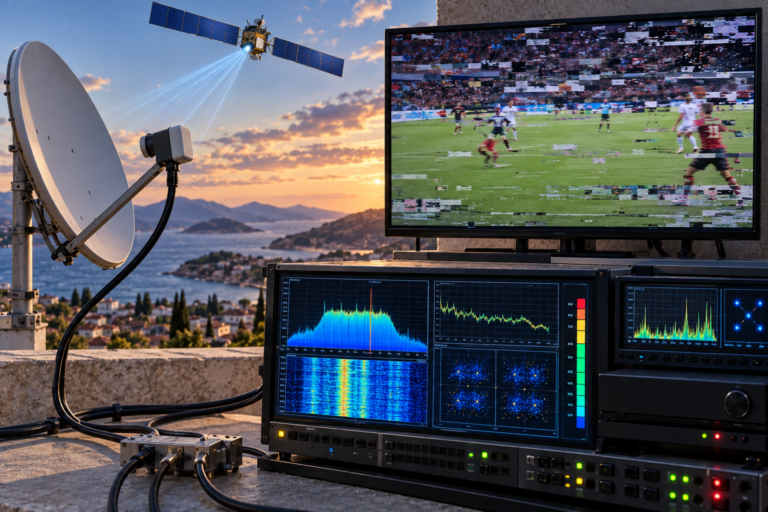
As noise, interference, phase errors, or distortion increase, the constellation points spread away from their ideal positions and MER falls.
A professional comparison between ZDF HD and another transponder should therefore include MER rather than relying entirely on receiver strength bars.
How BER Changes Before Reception Fails
BER measures the proportion of incorrectly recovered bits.
A DVB-S2 receiver can tolerate a certain level of raw error because its LDPC and BCH Forward Error Correction stages repair damaged data.
This is why ZDF HD can continue producing a completely clean picture even while some errors exist in the RF link.
As conditions deteriorate, pre-FEC BER rises. The correction system must recover more damaged information.
Once the errors become too severe, the receiver can no longer reconstruct every codeword successfully. Post-correction errors then damage the recovered stream or synchronization is lost entirely.
The transition can happen quickly, creating the familiar digital cliff between perfect reception and severe failure.
Why Another Channel Can Fail First
Another German channel can use a different frequency, polarization, satellite transponder, modulation, FEC rate, or beam condition.
It can therefore have a completely different reception margin even though both channels originate from the Astra 19.2E orbital neighbourhood.
The receiving installation can amplify these differences.
Cable loss varies with intermediate frequency. LNB performance is not perfectly flat across its entire operating range. Local interference can affect selected frequencies, and polarization errors can hurt one carrier more than another.
A channel that fails before ZDF HD is therefore not necessarily transmitted badly. It may simply be the first carrier to reveal a weakness in the complete receiving link.
How Dish Alignment Changes the Comparison
A satellite dish has a narrow directional response designed to concentrate energy from the wanted orbital position onto the feed.
Small azimuth or elevation errors reduce the available carrier quality.
The strongest transponders can continue working and make the installation appear correctly aligned.
A carrier with less margin will reveal the error first.
This is why aligning a dish using only ZDF HD or another strong carrier can be misleading. A professional installation should be checked across several representative transponders and both polarizations.
The goal is not merely to obtain a picture. The goal is to maximize the worst-case useful margin across the services the household actually watches.
Why LNB Skew Matters
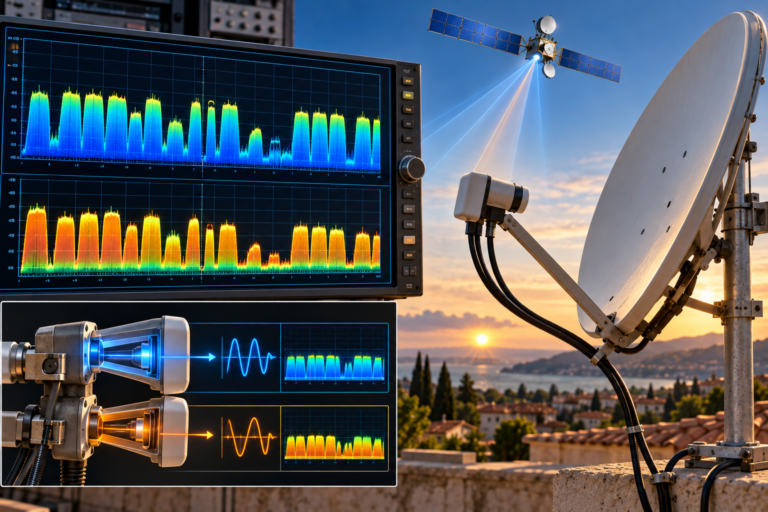
Astra transponders reuse frequency resources through horizontal and vertical polarization.
The LNB must be rotated correctly so its receiving probes align with the polarization orientation arriving at the dish.
Incorrect skew allows additional energy from the opposite polarization to enter the wanted signal path.
That unwanted energy can act as interference and reduce MER.
Because ZDF HD uses horizontal polarization, its performance should also be compared with other horizontal and vertical services when diagnosing an installation.
If one polarization consistently has poorer MER, LNB skew, receiver voltage, cable resistance, or switching hardware should be investigated.
Frequency and LNB Performance
The LNB does more than amplify the satellite signal.
It also performs frequency conversion using an internal local oscillator. Gain, noise performance, oscillator stability, and phase noise can vary across frequency and between individual LNBs.
A healthy LNB should provide reliable performance across the intended band, but an ageing or defective unit can affect some transponders before others.
Coaxial cable introduces another frequency-dependent effect. Attenuation generally increases as the intermediate frequency becomes higher.
Long cable runs, poor connectors, wall plates, and distribution switches can therefore create differences between transponders that were not present at the dish feed itself.
Rain and Environmental Effects
Astra television uses Ku-band microwave frequencies that can be attenuated by precipitation.
Rain absorbs and scatters part of the microwave energy, reducing the carrier available at the receiving antenna. This is commonly known as rain fade.
A transponder with generous clear-sky margin can tolerate more attenuation before reaching its DVB-S2 threshold.
A marginal transponder fails sooner.
Wind can create another problem if the dish mount is weak. A small movement may reduce MER temporarily even though the reflector returns to its normal position after the gust.
Temperature can also expose ageing LNB oscillators, connectors, or receiver electronics.
Why Channels on the Same Transponder Behave Together
One of the most useful troubleshooting principles is to compare services sharing the same transponder.
ZDF HD and other services multiplexed into the same physical carrier pass through the same satellite RF path, modulation, FEC, and demodulation process.
If the complete transponder loses lock, all services carried inside it should be affected because the receiver has lost the common physical-layer data stream.
If ZDF HD alone has a problem while other services on the same carrier remain completely stable, the fault is unlikely to be caused by dish alignment or MER.
The investigation should then move toward service-level processing, channel data, receiver software, or another issue occurring after the transponder has already been recovered.
What Happens Inside the Receiver Near the Threshold
As the ZDF HD carrier reaches the tuner, automatic gain and tuning circuits prepare it for demodulation.
The DVB-S2 demodulator tracks frequency, phase, and symbol timing while distinguishing the eight 8PSK states.
Noise and distortion create incorrect symbol decisions. These become bit errors that enter the Forward Error Correction system.
LDPC decoding performs the main error-correction work, while BCH coding provides additional protection against residual errors.
As long as enough information can be recovered, the transport stream remains valid and the television picture looks perfect.
When the carrier falls below the usable threshold, the decoder can no longer reconstruct reliable data. Pixelation, freezing, audio loss, and eventually complete loss of synchronization follow.
How to Compare ZDF HD With an Unstable Channel
First identify the transponder parameters of both services. Do not compare them only by channel name or HD resolution.
Check frequency, polarization, symbol rate, modulation, and FEC. Then compare digital quality under the same weather conditions.
MER is particularly useful if a suitable receiver or field meter provides it. BER can reveal whether one carrier is operating much closer to its correction limit.
Observe whether the unstable channel belongs to a particular polarization or frequency range. This can expose skew, band switching, cable, LNB, or interference problems.
Also compare several services on the same unstable transponder. If all of them fail together, the evidence points toward the common RF carrier rather than an individual television programme.
The wider engineering reason that two satellite frequencies can behave differently is explained in our guide to why some satellite frequencies work better than others, including beam conditions, modulation, FEC, LNB response, cable attenuation, and signal margin.
ZDF HD is not universally more stable than every other German satellite channel.
Its apparent stability depends on the receiving location, dish size, alignment, LNB, distribution system, interference environment, weather, and the characteristics of the transponders being compared.
The technically correct conclusion is that ZDF HD can appear particularly stable when its 8PSK 2/3 carrier provides healthy MER and sufficient margin at the receiving installation. Another channel with less margin can fail first even when both pictures look equally perfect under clear conditions.
ZDF HD can appear more stable than some Astra 19.2E channels because satellite reliability is determined by the complete RF link rather than the HD label or a receiver’s signal-strength percentage.
ZDF HD uses a DVB-S2 8PSK transmission with FEC 2/3 and a symbol rate of 22 MS/s. The receiver must maintain sufficient modulation quality for this carrier, correct transmission errors, and remain above its physical-layer decoding threshold.
When ZDF HD has generous signal margin at a particular installation, ordinary rain, noise, or small RF variations can occur without visible interruption. Another transponder with less margin may cross its threshold first and begin pixelating even though ZDF HD remains completely stable.
The correct comparison therefore uses MER, BER, transponder parameters, polarization, dish alignment, LNB performance, and signal margin. ZDF HD is not magically resistant to reception problems. A healthy RF path simply gives its receiver enough reserve to hide those problems before they reach the television picture.
| Question | Answer |
|---|---|
| Why does ZDF HD seem more stable than some channels? | Its transponder may provide greater usable decoding margin at your receiving location than the channels being compared. |
| What satellite carries ZDF HD? | ZDF HD is distributed through the Astra 19.2E satellite television system used extensively for German broadcasting. |
| What modulation does ZDF HD use? | ZDF publishes ZDF HD with DVB-S2 and 8PSK modulation. |
| What is the ZDF HD symbol rate? | The published satellite configuration uses a symbol rate of 22 MS/s. |
| What FEC does ZDF HD use? | The published configuration uses FEC 2/3. |
| Does high signal strength explain ZDF HD stability? | Not by itself. MER, BER, interference, modulation quality, and signal margin are more useful for understanding digital stability. |
| Can another HD channel fail while ZDF HD works? | Yes. Different HD channels can use different transponders with different RF characteristics and decoding margins. |
| Can poor dish alignment affect some channels before ZDF HD? | Yes. Stronger or higher-margin carriers can hide a small alignment error while more marginal transponders fail first. |
| Does LNB skew affect ZDF HD? | Yes. Incorrect skew can increase cross-polarization interference and reduce MER. |
| Why does rain affect one channel before another? | Rain reduces Ku-band signal margin. The transponder with less reserve reaches its decoding threshold first. |
| If ZDF HD fails, should I replace the LNB? | Not immediately. Compare other services on the same transponder and check MER, BER, alignment, polarization, cables, connectors, and weather behaviour first. |
| What is the best way to compare two satellite channels? | Compare their complete transponder parameters and measured digital quality rather than relying on channel resolution or raw signal-strength percentages. |