Astra 19.2 vs 28.2 Key Differences
Estimated reading time: 16 minutes.
At first glance, Astra 19.2E and Astra 28.2E may look similar. Both are part of the Astra satellite system, both broadcast hundreds of channels, and both operate in the same orbital arc. However, in real world reception, they behave very differently. Users often notice that one satellite is easy to receive while the other requires precise setup.
The difference is not random. It comes from how each satellite is designed, how its signal is distributed, and what type of broadcast it is intended for. Understanding these key differences helps you choose the right setup and explains why reception results vary across regions.
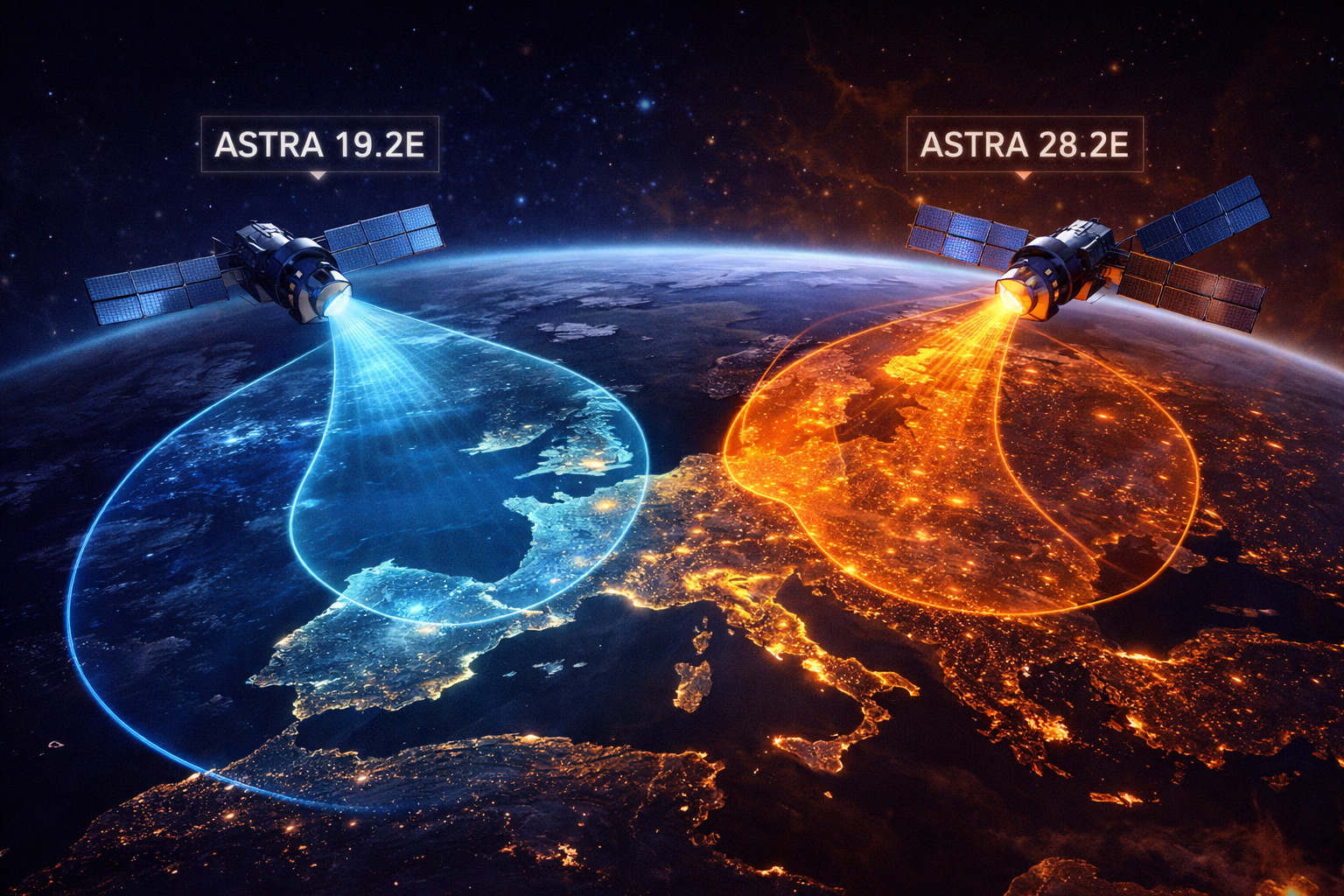
Astra 19.2E mainly covers central Europe with wide beams and German channels, while Astra 28.2E focuses on the UK with tighter beams and different signal behavior. These differences affect dish alignment, signal strength, and channel availability.
- Orbital position and pointing difference
- Coverage footprint differences
- Channel distribution and content type
- Signal strength and quality behavior
- Transponder structure differences
- Dish alignment and installation impact
- Reception difficulty across regions
- Analytical comparison table
- Which one to choose in real setups
- FAQ
Orbital position and pointing difference
Astra 19.2E and Astra 28.2E are located at different orbital positions. This means your dish must point in slightly different directions to receive each satellite.
The difference may seem small in degrees, but in satellite alignment it is significant. Even a few degrees can completely change reception results.
This is why switching between the two satellites requires careful dish adjustment or a multi satellite setup.
Coverage footprint differences
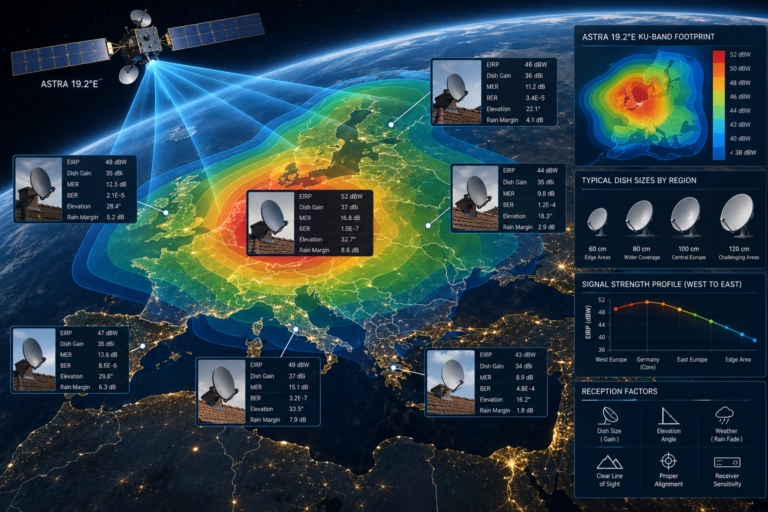
Astra 19.2E uses wide beams that cover most of Europe. This makes it relatively easy to receive in many countries with moderate dish sizes.
Astra 28.2E, on the other hand, includes focused beams designed mainly for the UK and nearby regions. These beams are stronger in the UK but weaker outside it.
This difference explains why Astra 28.2E can be difficult to receive in southern or eastern Europe compared to Astra 19.2E.
Channel distribution and content type
Astra 19.2E is known for German and European channels. It carries a wide range of free to air and encrypted services targeting central Europe.
Astra 28.2E focuses mainly on UK content. It carries British channels and uses beam patterns designed for that audience.
This difference in content also affects signal design and distribution strategy.
Signal strength and quality behavior
Astra 19.2E generally provides stable signal levels across Europe. Its wide beam ensures consistent reception in most regions.
Astra 28.2E may provide very strong signals inside the UK but weaker and less stable signals outside its core coverage area.
This leads to differences in signal quality, especially at the edges of the coverage footprint.
Transponder structure differences
Both satellites use DVB S2 transponders, but their distribution and signal margins differ.
Astra 19.2E transponders are designed for broad coverage. Astra 28.2E includes transponders with focused beams and tighter signal patterns.
This affects how channels behave and how sensitive they are to alignment and signal conditions.
Dish alignment and installation impact
Astra 19.2E is generally more forgiving in alignment. Small errors may still allow acceptable reception.
Astra 28.2E often requires more precise alignment, especially outside the UK. Slight misalignment can result in signal loss.
This makes installation more critical for Astra 28.2E reception.
Reception difficulty across regions
In central Europe, Astra 19.2E is easy to receive with standard dish sizes. Astra 28.2E may require larger dishes or more precise alignment.
In the UK, Astra 28.2E provides strong signals, while Astra 19.2E remains stable but may not be the primary choice for local content.
Reception difficulty depends on your location relative to each satellite’s coverage footprint.
Analytical comparison table
| Feature | Astra 19.2E | Astra 28.2E |
|---|---|---|
| Coverage | Wide European beam | Focused UK beam |
| Channel focus | German and European | UK channels |
| Signal stability | Stable across Europe | Strong in UK weaker outside |
| Alignment sensitivity | Moderate | High outside UK |
| Reception difficulty | Easy in most regions | Region dependent |
Which one to choose in real setups
The choice depends on your location and viewing needs. If you are in central Europe and want German channels, Astra 19.2E is the natural choice.
If you are in the UK or want UK channels, Astra 28.2E is more suitable.
In some setups, users combine both satellites using multi LNB systems to access both channel groups.
Astra 19.2E and Astra 28.2E are designed for different audiences. Their differences are intentional and affect every aspect of reception.
The key difference between Astra 19.2E and Astra 28.2E lies in coverage, signal design, and target audience. Understanding these factors allows you to choose the right satellite and optimize your reception setup effectively.
FAQ
| Question | Answer |
|---|---|
| What is the main difference between Astra 19.2E and 28.2E | Coverage area and channel focus are the main differences. |
| Which satellite is easier to receive | Astra 19.2E is generally easier across Europe. |
| Why is Astra 28.2E harder outside the UK | Because of its focused beam design. |
| Can I receive both satellites with one dish | Yes using multi LNB setup. |
| Do they use the same technology | Yes both use DVB S2 but with different signal design. |