Why Sky Italia Works Fine One Day And Fails The Next
Estimated reading time: 11 to 13 minutes.
Sky Italia can feel perfectly stable one day and suddenly unreliable the next. Many users assume something is broken, but in reality, this behavior is normal for modern streaming systems. The system itself has not changed. The environment around it has.
Streaming depends on dynamic conditions that constantly shift. Network load, routing paths, server demand, and even device state can vary from day to day. Because these factors are not fixed, performance is never exactly the same twice.
Quick Context. Sky Italia performance changes from day to day due to network variability, latency fluctuations, server load, and adaptive streaming behavior.
Table of Contents
Network conditions change constantly
Latency variation and timing instability
Server demand and traffic spikes
Why streaming feels random
Streaming performance is not controlled by a single factor. It depends on multiple systems working together.
When one of these systems changes, even slightly, the overall experience changes.
This creates the impression that streaming behaves randomly, even though it follows technical patterns.
The key is understanding that nothing in the system is fixed.
Network conditions change constantly
Internet networks are shared environments. Traffic levels change throughout the day depending on user activity.
Higher demand leads to congestion, while lower demand improves performance.
Even small changes in network usage can affect data delivery.
This is one of the main reasons performance varies from one day to another.
Latency variation and timing instability
Latency is not constant. It can increase or decrease depending on network load and routing.
Streaming depends on consistent timing. When latency fluctuates, playback becomes unstable.
Even a fast connection can experience timing issues if latency is inconsistent. :contentReference[oaicite:0]{index=0}
This is often mistaken for a speed problem, but it is actually a timing problem.
Routing path differences
Data does not always follow the same path across the internet. Routing can change based on network conditions.
Different routes have different delays and performance characteristics.
One day, your data may take a faster route. The next day, it may be redirected through a slower path.
This invisible change affects streaming behavior.
Server demand and traffic spikes
Streaming platforms must handle varying numbers of users. During peak periods, demand increases significantly.
This affects how quickly servers respond to requests.
Even large scale systems can experience temporary pressure under high load.
This is why performance can degrade on certain days or during specific events.
Adaptive streaming reactions
Sky Italia uses adaptive streaming to adjust quality based on current conditions.
When the system detects instability, it lowers bitrate to avoid interruptions.
This can make the stream look worse even if it continues playing.
Adaptive behavior makes changes more visible but helps maintain continuity.
Device state and background processes
Your device also affects performance. Background apps, memory usage, and system load can change daily.
A device that was idle yesterday may be under heavy load today.
This affects how efficiently it processes streaming data.
Device conditions are often overlooked when diagnosing issues.
Real world scenario
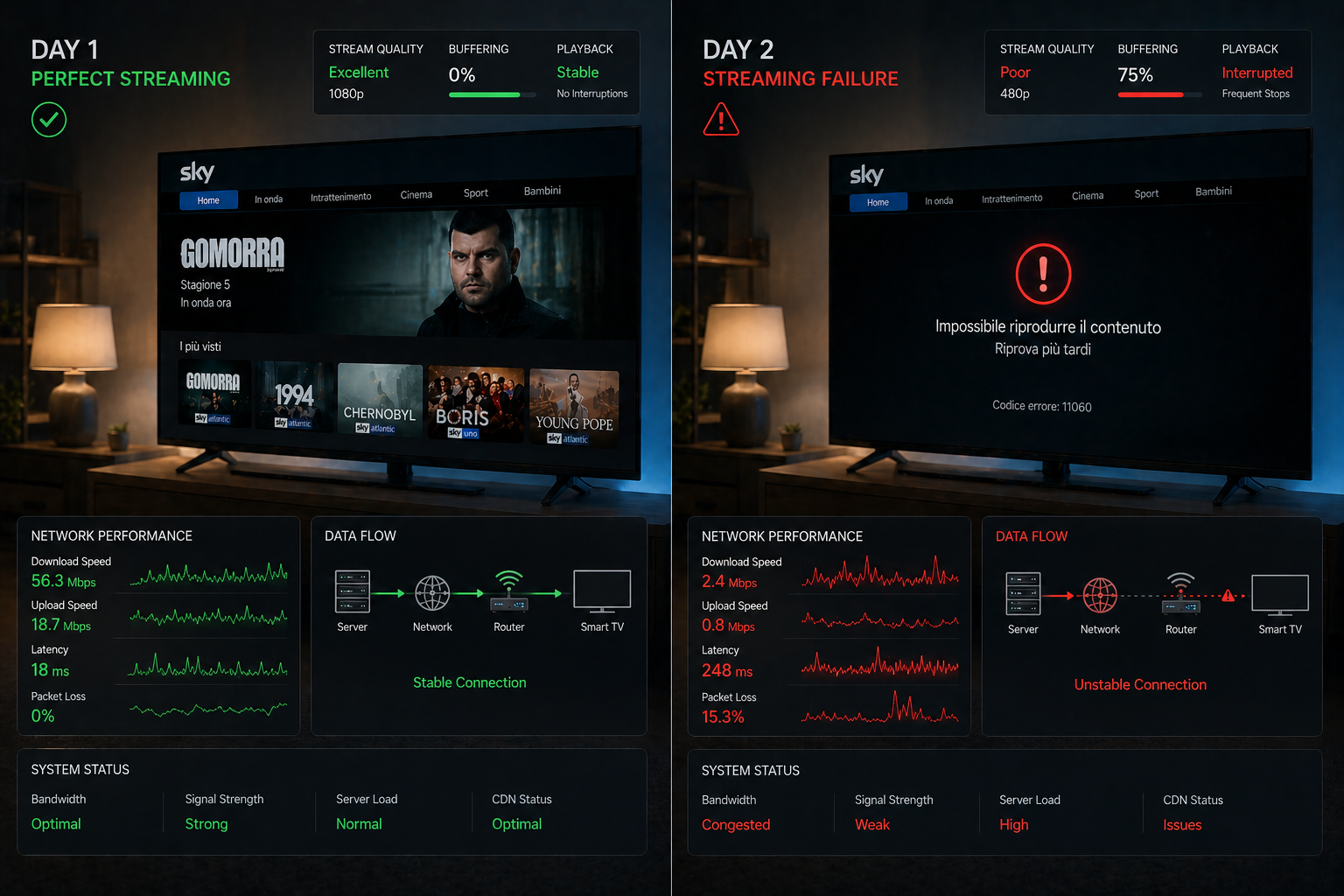
One day, you watch a stream in the afternoon with low network traffic. Everything works smoothly.
The next day, you watch at night during peak hours. Network congestion increases, latency fluctuates, and server demand rises.
The system reacts by lowering quality or buffering more often.
For a deeper explanation of how large scale demand is handled, see this guide How Sky Italia Handles Millions Of Viewers.
| Factor | Day 1 Condition | Day 2 Condition | Result |
|---|---|---|---|
| Network load | Low | High | Performance drop |
| Latency | Stable | Variable | Playback issues |
| Routing | Efficient path | Longer path | Delay increase |
| Server demand | Normal | High | Slower response |
| Device state | Idle | Busy | Processing lag |
Reality Check
Streaming does not fail randomly. It reacts to changing conditions across multiple layers. What looks like inconsistency is actually the system adapting to different environments.
Final Verdict
Sky Italia works fine one day and fails the next because streaming depends on dynamic conditions. Network load, latency, routing, server demand, and device state all change over time. These changes affect how data is delivered and processed. Understanding this explains why performance is never perfectly consistent and why stability depends on multiple interacting factors rather than a single cause.
FAQ
| Question | Answer |
|---|---|
| Why does streaming change daily | Because network and system conditions are always changing |
| Is my internet the problem | Not always. Many factors affect performance |
| What is the main cause | Network variability and latency changes |
| Can I fix this completely | No. You can improve stability but not eliminate variability |
| Does time of day matter | Yes. Peak hours increase network load and reduce performance |