Why Live Sports Streaming Buffers Even With Fast Internet
Estimated reading time: 18 minutes.
Many users assume that having fast internet automatically guarantees smooth live sports streaming. In reality, buffering can still happen even with high download speeds. This is because streaming performance depends on multiple technical factors, not just bandwidth.
Live sports streaming is especially sensitive because it requires continuous real-time data delivery. Any interruption in data flow, even for a short moment, can cause buffering. Understanding the technical reasons behind this helps explain why the problem persists even on fast connections.
Buffering is caused by unstable data flow, latency variation, packet loss, and server response time, not just internet speed.
Why speed is not the only factor
Internet speed measures how much data can be downloaded per second. However, streaming requires consistent data flow rather than peak speed.
Even if your connection is fast, small interruptions or fluctuations can break the continuous stream required for live video.
This is why users with high speed connections can still experience buffering.
Latency and real time data delivery
Latency is the time it takes for data to travel from the server to your device.
High latency or unstable latency affects how quickly video segments arrive.
In live streaming, delays in data arrival can empty the playback buffer, causing buffering.
Packet loss and data interruption
Streaming data is transmitted in packets. If some packets are lost during transmission, the video stream becomes incomplete.
The system may request missing data again, which introduces delay.
Even small levels of packet loss can cause noticeable buffering in live streams.
How buffering actually works
Streaming platforms preload small segments of video into a buffer.
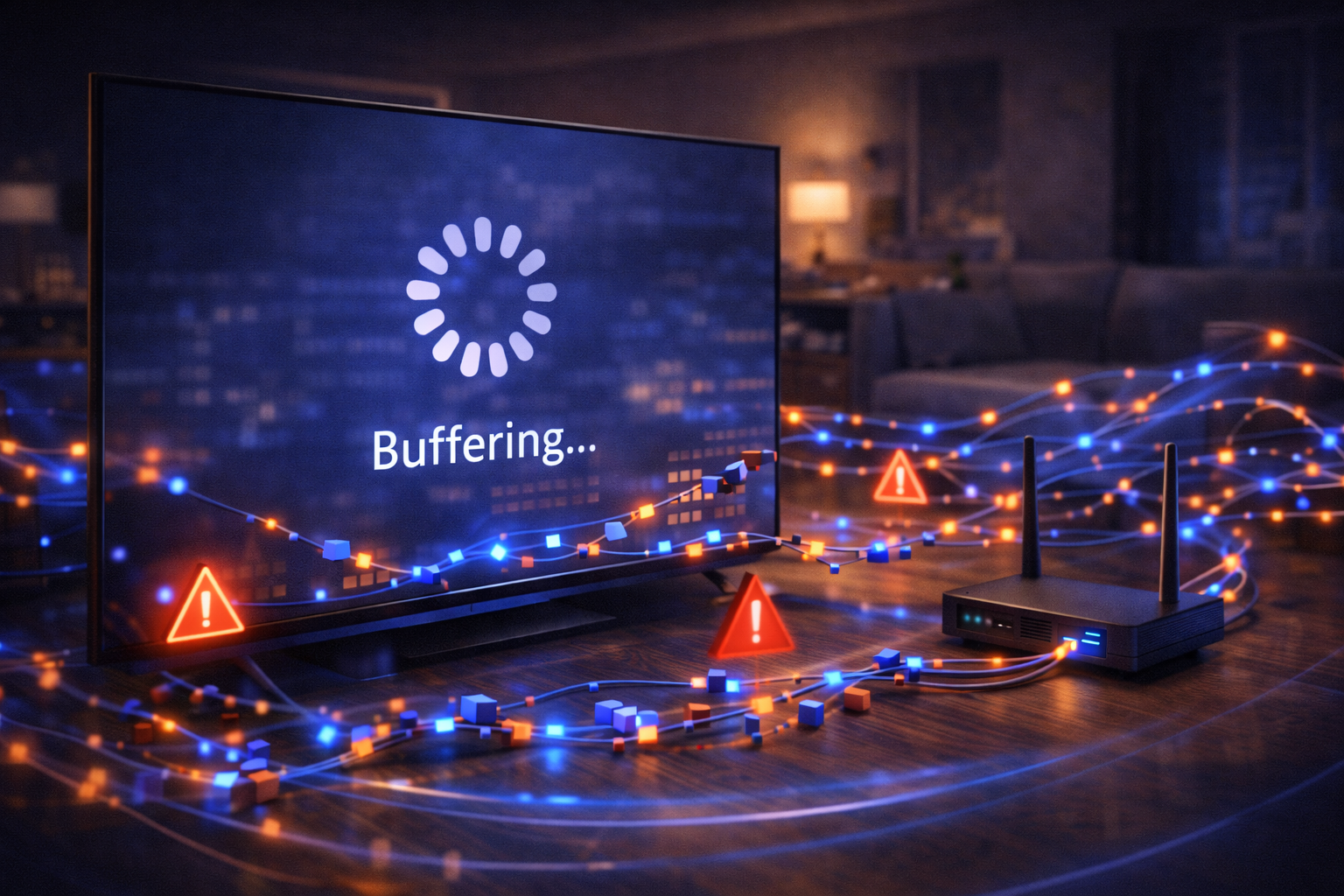
If data arrives slower than playback speed, the buffer empties and playback pauses.
Buffering is essentially the system waiting for more data to continue playback.
Role of CDN servers
Content Delivery Networks distribute streaming data through multiple servers worldwide.
The system selects the nearest server to reduce latency.
However, server load and routing can still affect performance.
Network instability and fluctuations
Network conditions can change rapidly due to interference, routing changes, or ISP behavior.
These fluctuations affect how consistently data is delivered.
Stable speed does not guarantee stable streaming if the connection is unstable.
Peak hour congestion impact
During peak usage hours, many users share the same network resources.
This can reduce available bandwidth and increase latency.
Live sports events often occur during these peak times, increasing the likelihood of buffering.
Technical causes breakdown
| Factor | Impact on Streaming | Result |
|---|---|---|
| Latency | Delays data arrival | Buffer empty |
| Packet loss | Missing data | Playback interruption |
| Network fluctuation | Unstable flow | Buffering spikes |
| Server load | Slow response | Delayed segments |
| Congestion | Reduced bandwidth | Quality drop or buffering |
Real world buffering scenarios
A user may have high internet speed but experience buffering during a live match due to network congestion.
Another user may experience smooth playback at lower speed because their connection is stable.
This shows that consistency is more important than raw speed.
Fast internet does not guarantee smooth streaming. Stability and data flow consistency are more important than peak speed.
Live sports streaming buffers not because of low speed, but بسبب instability in data delivery. Factors like latency, packet loss, and network congestion play a bigger role than raw bandwidth. Understanding these factors is key to solving buffering issues.
FAQ
| Question | Answer |
|---|---|
| Why does buffering happen with fast internet | Because streaming depends on stable data flow not just speed |
| What is packet loss | It is missing data during transmission which disrupts streaming |
| Does higher speed fix buffering | Not always stability matters more |
| What causes streaming delay | Latency and buffering mechanisms |
| Can buffering be completely eliminated | No but it can be reduced with stable connection |