Why Signal Quality Matters More Than Signal Strength
Estimated Reading Time: 11 minutes
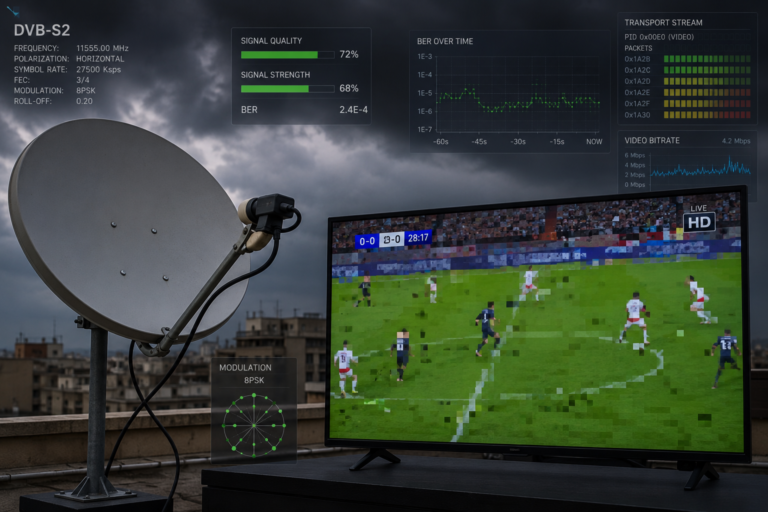
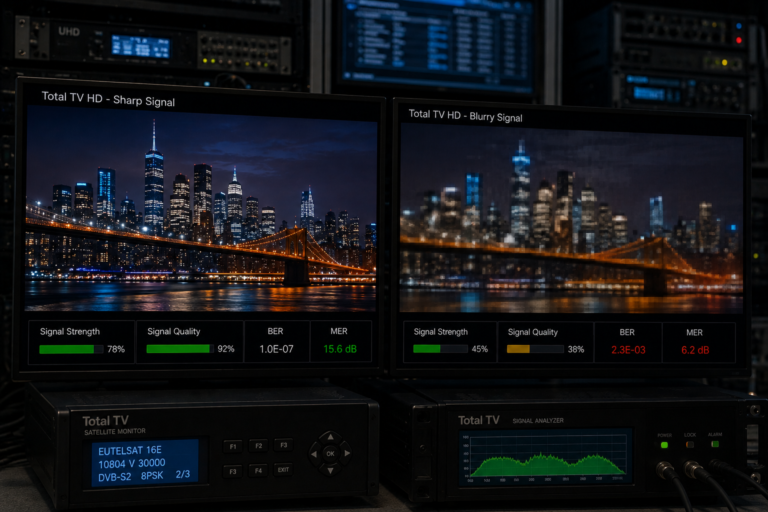
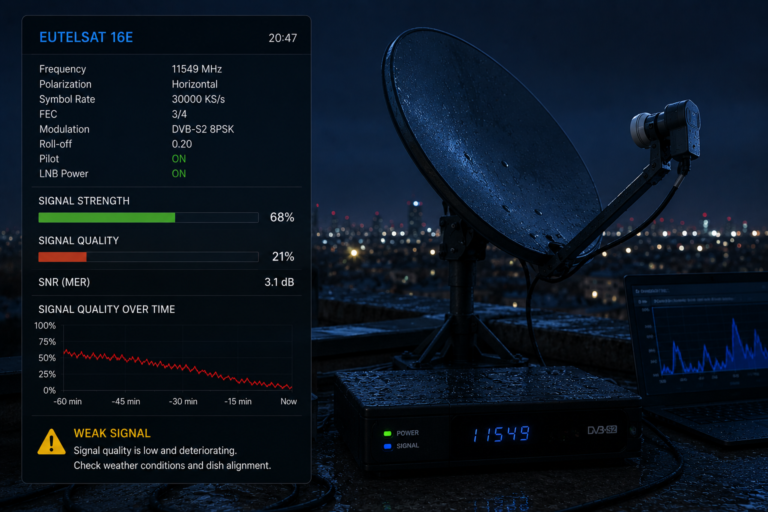
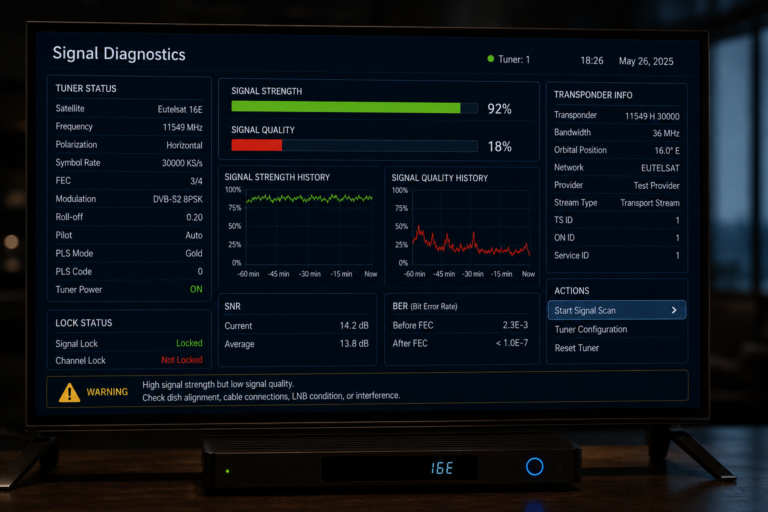
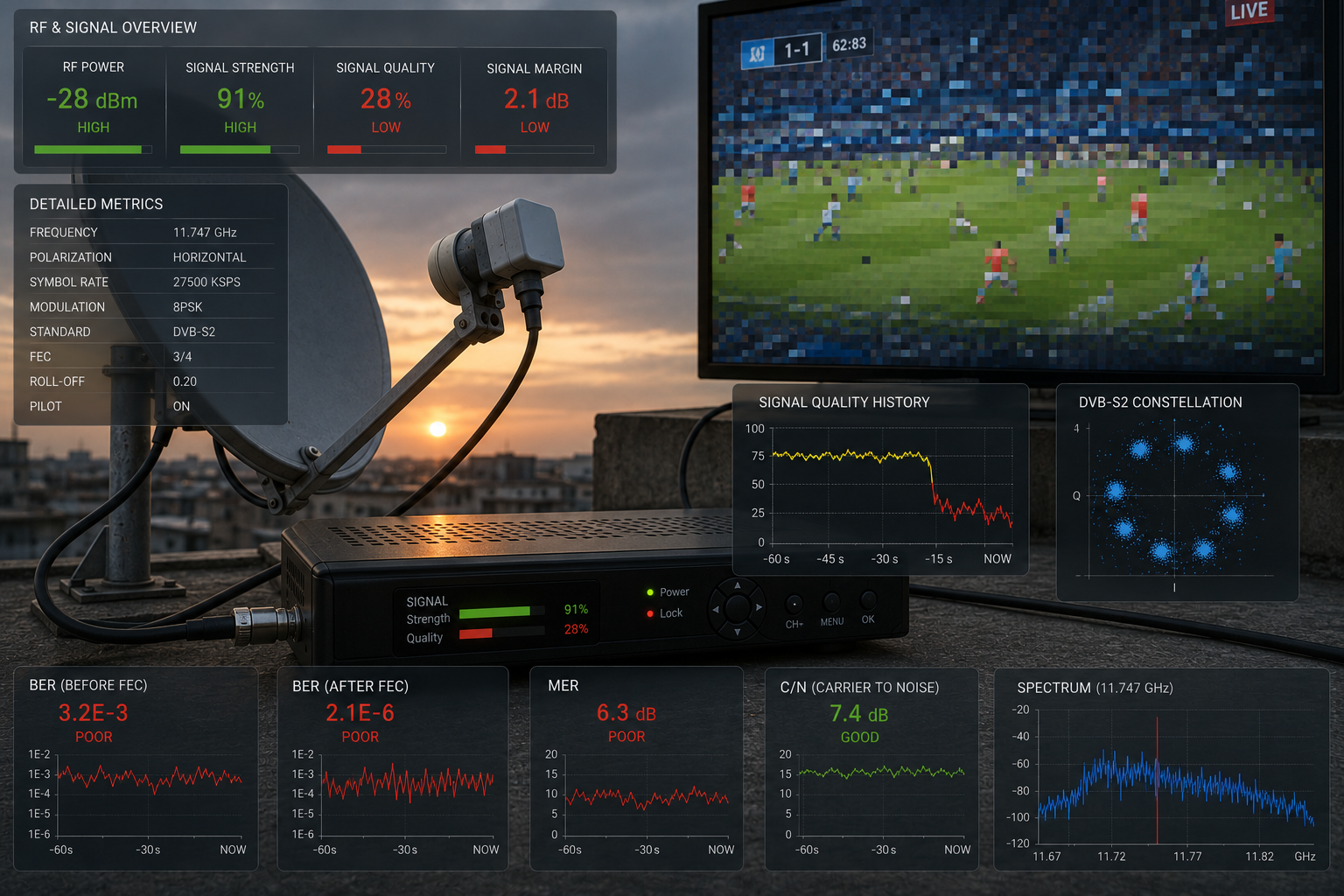
A satellite receiver can show 90 percent signal strength and still display pixelation, freezing, or no picture at all. At the same time, another receiver may show a much lower strength reading while decoding the same channel perfectly. This apparent contradiction becomes easier to understand once signal strength and signal quality are treated as two different measurements.
Signal strength tells the receiver how much radio-frequency energy is entering its tuner. Signal quality indicates whether the wanted satellite carrier can be separated from noise, interference, distortion, and competing signals well enough to be decoded. For digital satellite television, usable quality is therefore more important than raw power.
A strong reading does not always represent a clean satellite signal. The receiver may be measuring wanted energy, unwanted noise, interference, or a combination of all three. Reliable DVB-S2 reception depends on the condition of the wanted carrier, the error rate, and the remaining margin above the decoder’s minimum operating threshold.
- Signal Strength and Signal Quality Are Not the Same
- What Signal Strength Actually Measures
- What Signal Quality Is Trying to Represent
- Why a Strong Signal Can Still Produce No Picture
- The Importance of Carrier-to-Noise Ratio
- How BER Reveals Reception Problems
- Why MER Is Valuable During Dish Alignment
- Signal Margin and the Digital Cliff
- How Dish Alignment Changes Quality
- Why LNB Skew Affects Reception
- Interference, Cables, and Connectors
- How to Diagnose the Problem Correctly
- Reality Check
- Final Verdict
- FAQ
Signal Strength and Signal Quality Are Not the Same
Signal strength is primarily a measurement of received RF power. Signal quality is an assessment of how usable that signal is for demodulation and decoding.
The distinction matters because a satellite tuner does not need power alone. It needs the correct carrier at the expected frequency, symbol rate, polarization, modulation mode, and coding rate. The carrier must also remain sufficiently clear of noise and interference.
A receiver may detect plenty of RF energy while still being unable to identify the symbols contained within the DVB-S2 waveform. When that happens, the strength bar can remain high even though the quality bar falls to zero.
What Signal Strength Actually Measures
The strength meter normally reflects the total power detected within part of the receiver’s tuning range. Depending on the receiver design, this may be derived from automatic gain control, tuner input level, or another internal estimate.
It does not necessarily prove that the dish is aligned with the correct satellite. Pointing a dish towards a nearby orbital position may still produce a strong reading because the LNB is receiving energy from another satellite.
The meter may also respond to broadband noise, terrestrial interference, an incorrect transponder, or energy from an adjacent satellite. This is why signal strength can increase before the receiver has locked onto a valid transport stream.
Strength remains useful. It can confirm that the LNB is powered, that RF energy is reaching the tuner, and that the coaxial path is not completely open. It should not, however, be treated as proof of successful reception.
What Signal Quality Is Trying to Represent
Signal quality is a simplified receiver indication of how confidently the tuner and demodulator can recover the wanted transmission.
Different receiver manufacturers calculate the quality percentage in different ways. One receiver may derive it mainly from carrier-to-noise ratio. Another may use BER, MER, decoder margin, or a combination of internal measurements.
This means that a quality reading of 75 percent on one receiver cannot be compared directly with 75 percent on another model. The useful comparison is usually how the same receiver behaves before and after an adjustment.
If a small dish movement raises quality from 58 percent to 72 percent while strength changes very little, the adjustment has improved the wanted carrier without greatly changing the total RF power.
Why a Strong Signal Can Still Produce No Picture
A strong but unusable signal can occur for several reasons.
The dish may be aimed at the wrong satellite. The LNB skew may be incorrect, allowing unwanted energy from the opposite polarization to enter the tuner. The receiver may also be using the wrong frequency, symbol rate, polarization, modulation type, or FEC setting.
In other cases, the correct carrier is present but heavily contaminated by noise or interference. The tuner detects substantial power, yet the demodulator cannot distinguish the transmitted symbols accurately enough to reconstruct the data.
Receiver compatibility also matters. An older DVB-S tuner may detect the strength of a DVB-S2 carrier but remain unable to demodulate it. Similarly, a receiver without the required video codec may lock onto the transport stream but fail to display the programme.
| Receiver Condition | Strength Reading | Quality Reading | Likely Meaning |
|---|---|---|---|
| No LNB power or disconnected cable | Very low or zero | Zero | No usable RF path reaches the tuner |
| Dish pointed near a satellite but not correctly aligned | Moderate or high | Low or zero | RF energy is present, but the wanted carrier is not locked |
| Correct satellite with poor alignment | High | Unstable | The carrier is present but has limited decoding margin |
| Correct alignment with healthy margin | Moderate or high | High and stable | The receiver can decode the transmission reliably |
| Strong interference or excessive noise | High | Low | Total power is high, but the wanted carrier is contaminated |
The Importance of Carrier-to-Noise Ratio
Carrier-to-noise ratio compares the power of the wanted carrier with the noise surrounding it. A carrier that is clearly stronger than the noise is easier for the receiver to demodulate.
This measurement explains why simply amplifying everything does not always improve reception. An amplifier placed after a noisy signal path may increase both the wanted carrier and the noise. The receiver sees more total power, but the relationship between carrier and noise may remain almost unchanged.
An amplifier can compensate for excessive cable loss when it is chosen and positioned correctly. It cannot restore information that has already been buried beneath noise, interference, or distortion.
DVB-S2 supports several modulation and coding combinations with different reception requirements. More demanding modes can carry more information but generally require a cleaner link than more robust combinations. The DVB-S2 system uses structured modulation and channel coding modes, including LDPC and BCH error protection, to operate efficiently over satellite channels. :contentReference[oaicite:0]{index=0}
How BER Reveals Reception Problems
Bit Error Rate, or BER, measures the proportion of received bits that do not match the transmitted data.
A receiver may continue displaying a perfect picture while errors are present because Forward Error Correction repairs them before they reach the video decoder. This is one of the major strengths of digital broadcasting.
As reception deteriorates, the number of raw errors rises. The correction system must work harder until it reaches a point where it can no longer recover every damaged codeword. Uncorrected data then reaches the transport stream, producing pixelation, audio interruptions, freezing, or complete loss of lock.
BER can therefore change significantly while the strength meter remains almost fixed. The amount of energy arriving at the tuner may be stable, but the proportion of correctly recoverable information is becoming worse.
Professional measurements distinguish between error rates measured before and after error correction. Consumer receivers often simplify these measurements into a quality percentage or an error indicator, so the exact scale depends on the manufacturer.
Why MER Is Valuable During Dish Alignment
Modulation Error Ratio, or MER, indicates how closely the received modulation symbols match their ideal positions.
A clean QPSK or 8PSK signal produces well-defined groups of constellation points. Noise, phase instability, interference, distortion, and alignment errors spread those points away from their ideal locations.
Higher MER generally represents a cleaner modulation result and greater confidence that the receiver can distinguish one symbol from another. Professional field meters use modulation and error measurements because they reveal signal condition more accurately than a basic power reading.
MER is especially useful while fine-tuning dish direction and LNB skew. A tiny adjustment may produce almost no visible change in strength while creating a worthwhile improvement in modulation quality.
A poor MER result does not identify one specific fault by itself. Several impairments can contribute to the final measurement, including noise, phase noise, interference, nonlinear distortion, polarization errors, and frequency instability. :contentReference[oaicite:1]{index=1}
Signal Margin and the Digital Cliff
Signal margin is the safety distance between current reception quality and the minimum quality required by the selected modulation and coding mode.
A receiver operating with comfortable margin can tolerate moderate rain attenuation, small temperature changes, normal LNB drift, and minor mechanical movement without losing the channel.
A receiver operating just above the decoding threshold may appear perfect in dry, calm conditions. A very small reduction in carrier quality can then push it below the threshold.
Digital television does not always provide a long visual warning. Error correction can maintain an almost perfect picture until the remaining margin becomes too small. Reception then deteriorates rapidly, creating the familiar digital cliff.
This is why two installations can display the same channel clearly during testing but behave differently during rain. One has additional margin. The other is only just maintaining lock.
How Dish Alignment Changes Quality
A satellite dish concentrates microwave energy onto the feedhorn of the LNB. The reflector must be aligned accurately in azimuth and elevation so that the wanted signal reaches the focal point efficiently.
Poor alignment reduces the wanted carrier and may increase the relative effect of noise or adjacent-satellite interference. The result can be a reasonable strength reading but weak quality and limited margin.
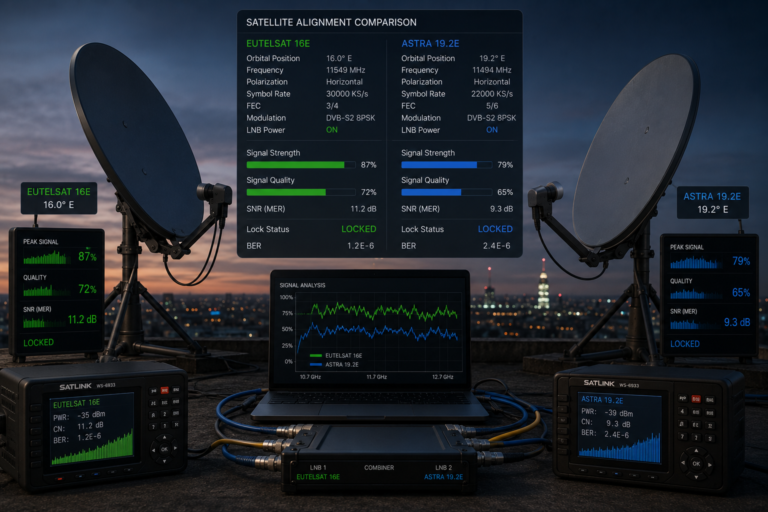
Dish alignment should therefore be optimised using a known active transponder and the quality, MER, or carrier-to-noise reading. Maximising the strength bar alone can produce an inaccurate result because that bar may react to total RF power rather than the wanted carrier.
The final alignment should also be checked across more than one transponder. A reflector can be slightly distorted, an LNB holder can be misplaced, or the dish can be aligned in a way that favours one part of the band while producing poorer results elsewhere.
Why LNB Skew Affects Reception
Satellite transponders reuse frequencies by transmitting signals on different polarizations. Correct LNB rotation helps the receiving probe separate the wanted polarization from the opposite one.
Incorrect skew reduces polarization isolation. Energy from the unwanted polarization can then behave like interference, lowering the usable quality of the selected transponder.
The strength meter may remain high because the LNB is still receiving substantial RF energy. The quality reading falls because part of that energy now belongs to a competing transmission rather than the wanted carrier.
Skew becomes particularly important when the installation is far east or west of the satellite’s orbital longitude, or when two transponders on opposite polarizations use nearby frequencies.
Interference, Cables, and Connectors
The receiving chain does not end at the dish. Coaxial cable, connectors, switches, splitters, wall plates, and the receiver input can all affect the final result.
Long or poor-quality cable introduces attenuation, especially at higher intermediate frequencies. A damaged connector can create impedance discontinuities, intermittent contact, moisture ingress, or shielding problems.
Poor shielding may allow terrestrial interference to enter the cable. Mobile communications equipment, electrical devices, power supplies, and local transmitters can raise the noise level around certain frequencies.
A faulty power supply can also affect the LNB voltage or introduce noise into the system. Because the receiver controls polarization and band selection through voltage and tone signalling, unstable power can create faults that resemble dish alignment problems.
These problems demonstrate why additional strength is not always the answer. The correct objective is a clean, stable carrier with enough decoding margin throughout the complete receiving path.
How to Diagnose the Problem Correctly
Begin by checking whether quality appears on the expected satellite and transponder. A high strength reading with zero quality often indicates the wrong satellite, incorrect tuning data, an incompatible receiver, or a serious polarization problem.
If quality is present but unstable, observe whether it changes with rain, wind, temperature, or movement of the cable. Weather-related deterioration usually points towards insufficient signal margin. Wind-related changes suggest mechanical movement. A fault triggered by touching the cable often indicates a damaged connector or conductor.
Next, optimise dish alignment and LNB skew while monitoring quality rather than strength. Test several transponders on both polarizations and across the low and high bands.
Inspect every outdoor connector for corrosion, loose shielding, and moisture. Remove unnecessary splitters or adapters, and confirm that switches are suitable for the frequencies and control signals used by the installation.
When a receiver shows strong signal but the picture repeatedly breaks into digital blocks, our explanation of why satellite channels suddenly become blurry examines how transport stream errors and video compression make reception problems visible on screen.
Consumer receiver percentages are not calibrated engineering measurements. A reading of 80 percent does not represent the same RF level or decoding margin on every device. Strength and quality bars are most useful for comparing changes on the same receiver, transponder, and installation.
The objective is not to achieve a particular percentage. The objective is to maintain stable reception with enough margin to survive normal changes in weather, temperature, and equipment behaviour.
Signal strength confirms that RF energy is reaching the receiver, but it does not prove that the wanted satellite carrier is clean or decodable. Signal quality matters more because it reflects the receiver’s ability to separate the wanted modulation from noise, interference, distortion, and competing transmissions.
For reliable satellite television, optimise dish alignment, LNB skew, BER, MER, carrier-to-noise performance, and signal margin. A moderate but clean signal will usually outperform a powerful signal contaminated by noise or interference.
| Question | Answer |
|---|---|
| Why does my receiver show high strength but zero quality? | The tuner is detecting RF energy, but it may be aimed at the wrong satellite, using incorrect tuning parameters, receiving interference, or failing to lock onto the wanted carrier. |
| Which reading should I use when aligning a dish? | Use signal quality, MER, carrier-to-noise ratio, or decoding margin. Strength can help confirm that RF energy is present, but it should not be the main fine-alignment measurement. |
| Can an amplifier improve signal quality? | It may compensate for cable loss in a correctly designed system, but it cannot restore a carrier already damaged by noise, interference, poor alignment, or polarization errors. |
| Why does quality fall during rain while strength remains high? | Rain can reduce the wanted carrier’s relationship to noise and lower the available decoding margin without producing an equally obvious change in the receiver’s strength percentage. |
| Is a 100 percent quality reading always necessary? | No. Receiver scales differ. Stable operation and sufficient margin across different weather conditions are more important than reaching a specific percentage. |
| Can bad LNB skew reduce quality? | Yes. Incorrect skew allows more energy from the opposite polarization to interfere with the wanted transponder. |
| Why do two receivers show different percentages on the same dish? | Manufacturers use different tuner designs, thresholds, and software formulas, so their percentage scales are not directly comparable. |