Why Satellite TV Works Until It Suddenly Doesn’t
Estimated Reading Time: 11 minutes
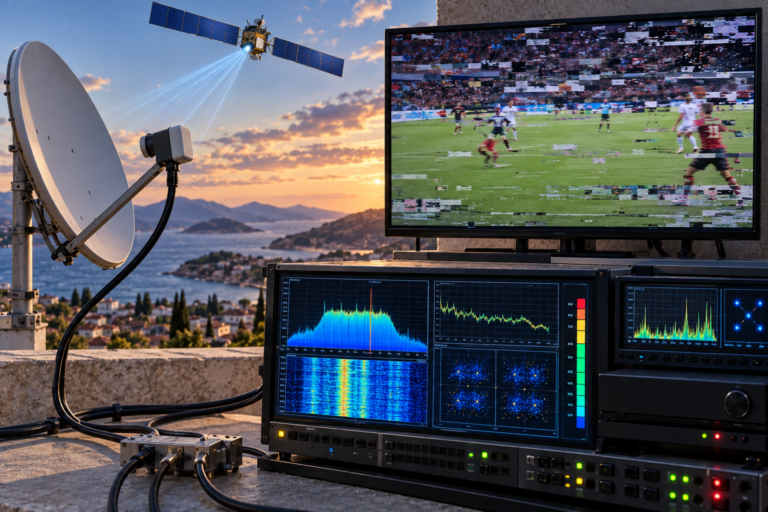
Digital satellite television can behave in a way that seems almost impossible. The picture may remain perfectly sharp for hours, with clean audio and no visible warning, and then suddenly break into blocks, freeze, or disappear. Viewers often assume that something failed at that exact moment, but the receiving system may actually have been operating close to its limit long before the screen changed.
The reason is one of the most important concepts in digital broadcasting: a receiver can reconstruct an essentially perfect programme while the incoming RF signal is gradually becoming worse. Forward Error Correction hides many transmission errors, and the decoder continues operating until the remaining signal margin becomes too small. Once reception crosses the required DVB-S2 threshold, errors can rise very quickly. This abrupt transition is commonly described as the digital cliff.
A perfect digital picture does not prove that a satellite installation has plenty of reception margin. It only proves that the receiver is currently recovering enough correct data to decode the programme. A system operating several decibels above its threshold can tolerate significant changes. A system operating barely above the threshold may look identical on screen but fail after a very small reduction in signal quality.
- Why Digital Reception Can Hide a Weak Signal
- What the Receiver Is Doing While You Watch TV
- Signal Margin Is the Hidden Safety Reserve
- Why Signal Strength Does Not Tell the Whole Story
- How BER Changes Before the Picture Fails
- How Forward Error Correction Keeps the Picture Alive
- What Happens When FEC Reaches Its Limit
- The Digital Cliff Explained
- Why MER Matters Before Signal Loss
- Why the Receiver Suddenly Loses Lock
- How Rain Can Push a Working System Over the Edge
- Why Dish Movement Causes Sudden Failure
- How the LNB Can Reduce the Remaining Margin
- Why Some Channels Fail Before Others
- How the Receiver Recovers After Signal Loss
- How to Diagnose a System That Suddenly Fails
- Reality Check
- Final Verdict
- FAQ
Why Digital Reception Can Hide a Weak Signal
Analogue television usually deteriorated gradually. Noise became visible as the received carrier weakened, giving the viewer an obvious indication that reception was getting worse.
Digital television behaves differently because the screen does not directly display the quality of the RF waveform. The receiver converts that waveform into symbols and bits, corrects errors, rebuilds the transport stream, and then decodes compressed video.
As long as this reconstruction process succeeds, the output can remain virtually identical to the original broadcast. A receiver with generous signal margin and another receiver operating dangerously close to failure can therefore display equally clean pictures.
The difference becomes visible only when conditions deteriorate further. The well-designed installation continues working, while the marginal system suddenly falls below the decoding threshold.
What the Receiver Is Doing While You Watch TV
Receiving a DVB-S2 television channel requires several continuous processes inside the receiver.
The tuner first selects the required intermediate frequency from the LNB. Carrier recovery determines the exact carrier frequency and phase. Symbol timing recovery identifies the correct sampling points. The demodulator then interprets QPSK, 8PSK, or another supported constellation.
The resulting information passes through the DVB-S2 channel decoder. Powerful LDPC and BCH Forward Error Correction algorithms attempt to repair damaged data before the receiver reconstructs the baseband stream and ultimately the programme transport data.
DVB-S2 was specifically designed around powerful LDPC coding combined with BCH protection, allowing highly efficient operation close to theoretical communications limits. The official DVB-S2 specification defines a wide range of modulation and coding configurations for satellite broadcasting.
All of these receiver processes must remain synchronized continuously. A television picture that appears effortless on screen is actually the final result of constant RF tracking, mathematical error correction, packet recovery, and video decoding.
Signal Margin Is the Hidden Safety Reserve
Signal margin describes how far current reception conditions remain above the minimum requirement for reliable decoding.
Imagine that a particular DVB-S2 transmission requires a certain minimum carrier quality. If the installation operates comfortably above that point, there is reserve available for rain attenuation, slight dish movement, LNB temperature changes, cable ageing, and other losses.
If the receiver operates only slightly above the required threshold, there is almost no protection. The picture may still look completely normal, but a small environmental change can remove the remaining margin.
This is why professional installers are interested in margin rather than simply achieving channel lock. Lock proves that reception works now. Margin indicates how likely it is to continue working when conditions change.
Why Signal Strength Does Not Tell the Whole Story
Signal strength indicates received RF power, but the receiver needs more than power. It needs a clean wanted carrier that can be separated from noise, interference, phase errors, and unwanted transmissions.
A receiver can therefore report substantial signal strength while operating with poor signal quality. Incorrect LNB skew may introduce cross-polarization interference. Poor dish alignment may increase the relative contribution of an adjacent satellite. A noisy amplifier may increase power without improving the relationship between the wanted carrier and unwanted energy.
The strength indicator may barely change during these conditions, while BER increases and MER falls.
This explains why a receiver can apparently have plenty of signal immediately before the picture disappears.
How BER Changes Before the Picture Fails
Bit Error Rate measures how many bits are being recovered incorrectly.
As reception begins to deteriorate, raw bit errors usually increase before the viewer notices anything. Forward Error Correction repairs those errors, allowing the programme to continue normally.
A rising pre-FEC BER is therefore an important warning. It shows that the demodulator is making more incorrect decisions even though the correction system may still be producing clean output.
Eventually the error rate becomes too high for complete correction. Post-FEC errors appear and damaged information begins reaching later processing stages.
The first visible symptoms may be occasional blocks, a short audio interruption, or a fraction of a second of frozen video. A further deterioration can produce complete loss of reception.
| Reception State | What Happens Inside the Receiver | What the Viewer Sees |
|---|---|---|
| Large signal margin | Low BER and easy FEC correction | Perfect stable picture |
| Margin begins shrinking | Pre-FEC errors increase but remain correctable | Picture still appears perfect |
| Near decoding threshold | FEC works close to its correction limit | Occasional blocks or brief freezes may appear |
| Threshold crossed | Uncorrected errors rise rapidly | Heavy pixelation, audio loss, or freezing |
| Synchronization lost | Carrier or demodulator lock fails | No picture or no signal |
How Forward Error Correction Keeps the Picture Alive
Satellite transmission is expected to encounter noise and other impairments, so DVB-S2 does not simply send unprotected programme data.
Additional coding information is included to allow the receiver to reconstruct data that was received incorrectly. DVB-S2 uses LDPC coding as its main error-correction mechanism together with an outer BCH code.
The correction process can recover substantial numbers of errors without requiring retransmission. This is essential for broadcast satellite television because the satellite sends the same transmission continuously to many receivers and cannot resend individual damaged packets to each household.
The result is impressive but sometimes misleading from a troubleshooting perspective. An installation can be deteriorating while the correction system hides the evidence from the viewer.
What Happens When FEC Reaches Its Limit
Forward Error Correction is powerful, but it cannot recover unlimited damage.
As the received constellation becomes less distinct, the demodulator makes increasingly uncertain symbol decisions. LDPC decoding attempts to recover the correct codeword, while BCH provides additional protection against residual errors.
Once too much information is uncertain or incorrect, the decoder cannot determine the original data reliably.
Damaged information then reaches the programme processing chain. Transport packets may be unusable, compressed video frames may become incomplete, and audio packets may be missing.
The transition can happen quickly because the decoder moves from successfully correcting most errors to failing on many codewords across a narrow range of RF conditions.
The Digital Cliff Explained
The digital cliff describes the sharp deterioration that occurs near the reception threshold of a digital communications system.
Well above the threshold, improved signal quality may not produce any visible improvement because the picture is already being reconstructed correctly.
Near the threshold, however, even a small reduction in carrier quality can produce a large increase in uncorrected errors. The television can move from perfect reception to severe pixelation across a surprisingly small change in RF conditions.
A further small reduction can cause complete loss of synchronization.
This is why viewers often describe digital satellite failure as sudden. The RF signal did not necessarily disappear suddenly. The receiver simply crossed the point where reliable mathematical recovery was no longer possible.
Why MER Matters Before Signal Loss
MER, or Modulation Error Ratio, provides a useful indication of how closely received constellation points match their ideal positions.
Noise, phase instability, interference, distortion, and alignment errors spread the received symbols away from those ideal positions.
When MER is healthy, the receiver can distinguish the symbols confidently. As MER decreases, symbol decisions become more difficult and BER generally begins increasing.
MER can therefore expose deteriorating reception before visible picture failure occurs. A strength bar may remain almost unchanged while MER reveals that the real decoding margin is disappearing.
Why the Receiver Suddenly Loses Lock
The receiver must maintain several forms of synchronization. It must track carrier frequency and phase, identify symbol timing, recognise DVB-S2 physical-layer structures, and keep the decoded data aligned correctly.
At low signal quality, these processes become less reliable.
The receiver may initially maintain carrier lock while transport data becomes damaged. Under worse conditions it may lose frame synchronization or fail to maintain reliable demodulation.
Eventually the receiver can no longer recognise the selected DVB-S2 carrier as a usable digital transmission. Quality may fall to zero and a no-signal message appears.
The RF carrier can still physically be present at the tuner input. What has disappeared is the receiver’s ability to decode it reliably.
How Rain Can Push a Working System Over the Edge
Rain introduces additional attenuation into satellite links, particularly at Ku-band frequencies commonly used for direct television broadcasting.
A healthy installation normally contains enough fade margin to tolerate ordinary changes in weather. The carrier becomes weaker during rainfall, but it remains sufficiently far above the decoding threshold.
A marginal installation behaves differently. If only a small amount of margin exists in clear weather, rainfall can remove that reserve quickly.
BER begins increasing, MER deteriorates, FEC approaches its limit, and the picture can move rapidly from clean to unusable.
The sudden screen failure therefore does not mean the rain instantly blocked the entire satellite signal. It means atmospheric attenuation reduced the link enough to cross the receiver’s operating threshold.
Why Dish Movement Causes Sudden Failure
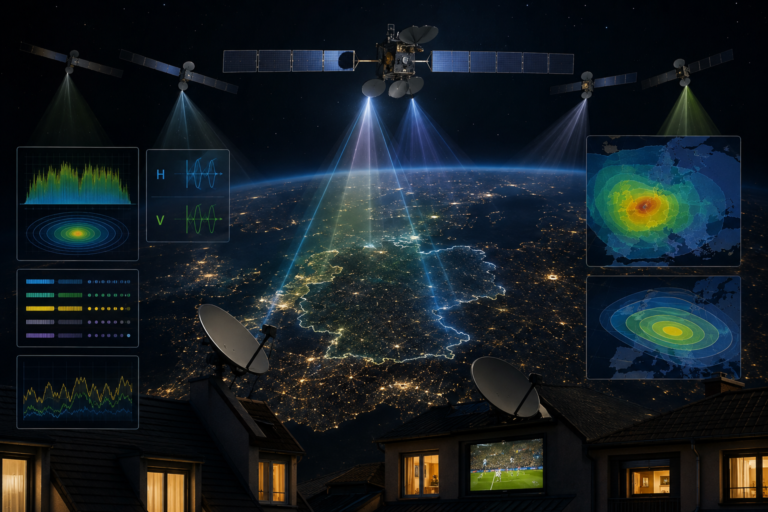
A parabolic satellite antenna has a directional reception pattern. The wanted satellite must remain close to the centre of that pattern for maximum carrier quality.
Wind can move a weak mounting structure by a very small angle. Bolts can loosen gradually. A pole can twist or bend. The reflector or LNB support arm can also deform.
These movements may be almost impossible to notice visually, but they reduce the wanted signal and therefore the available margin.
If the system already operates close to threshold, a small temporary movement during a wind gust can cause immediate pixelation or loss of lock. When the dish returns to its previous position, the picture can recover just as suddenly.
How the LNB Can Reduce the Remaining Margin
The LNB is the first active RF stage in the domestic satellite receiving chain.
It amplifies the extremely weak microwave signal while attempting to add as little noise as possible. It then converts the received satellite band to an intermediate frequency suitable for coaxial cable.
LNB noise performance, local oscillator stability, phase noise, temperature, skew, and electrical condition all influence the quality delivered to the receiver.
An ageing or unstable LNB does not always fail completely. It may simply reduce performance enough to remove part of the installation’s safety margin.
The system then works normally under ideal conditions but becomes unreliable during temperature changes, rain, or other small impairments.
Why Some Channels Fail Before Others
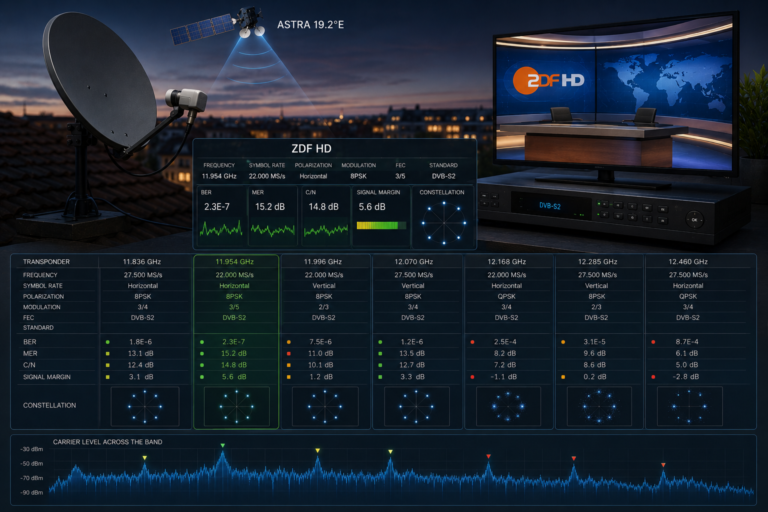
Satellite channels are distributed across different transponders, and those transponders do not necessarily arrive with identical margins.
They can use different modulation formats, FEC rates, frequencies, polarizations, beam patterns, and transmitted power levels.
A robust QPSK service can remain usable while a more demanding 8PSK transmission has already crossed its threshold. One transponder can also suffer more from local interference or polarization errors than another.
This is why the failure of one group of channels does not automatically prove that the receiver itself is defective.
Channels sharing the same failing transponder should be compared. Their common behaviour can provide an important diagnostic clue.
How the Receiver Recovers After Signal Loss
When conditions improve, the receiver cannot always resume video instantly. It must rebuild synchronization through several stages.
Carrier recovery identifies and tracks the signal again. Symbol timing is restored. DVB-S2 frame structures are detected, error correction begins producing reliable data, and the programme stream is reconstructed.
The video decoder may then need a suitable reference frame before it can display a complete picture again.
This explains why the signal meter can recover before the television picture returns. RF lock and video reconstruction are different stages of the chain.
How to Diagnose a System That Suddenly Fails
Begin by determining whether the failure affects one channel, one transponder, one polarization, one frequency band, or every satellite service.
Observe signal quality rather than relying only on strength. If available, monitor MER and BER before, during, and after the failure.
A gradual fall in MER combined with rising BER strongly suggests that reception is approaching the digital threshold.
Record whether the problem is associated with rain, wind, afternoon heat, or movement of the coaxial cable. These patterns can identify insufficient rain margin, mechanical dish movement, LNB temperature instability, or connector faults.
Inspect the dish mount, reflector, LNB holder, F-connectors, coaxial cable, switches, and wall plates. Fine-tune azimuth, elevation, and LNB skew while monitoring the weakest important transponders rather than only the strongest frequency.
Understanding the error rate is particularly useful when the picture appears perfect before suddenly collapsing. Our guide to what BER really means on a satellite receiver explains why data errors can increase significantly before they become visible on screen.
A channel that works perfectly today is not proof that the installation is correctly optimized. Digital receivers can hide substantial deterioration through Forward Error Correction.
The important engineering question is not simply whether the receiver has lock. It is how much margin remains above the required decoding threshold.
Consumer signal percentages should also be interpreted carefully because manufacturers calculate them differently. A quality value of 80 percent on one receiver is not necessarily equivalent to 80 percent on another.
Satellite television appears to work until it suddenly does not because digital reception is threshold based. The receiver can correct increasing numbers of errors and continue delivering a perfect programme while RF conditions are gradually deteriorating.
As signal margin disappears, MER falls and BER rises. Forward Error Correction eventually reaches its practical limit, transport data becomes unreliable, and the receiver moves rapidly through pixelation, freezing, synchronization failure, and complete loss of lock.
The sudden failure visible on the television is therefore usually the final stage of a problem that has been developing invisibly inside the RF and decoding chain. Good dish alignment, correct LNB skew, low BER, strong MER, stable hardware, clean cabling, and sufficient weather margin keep the system safely away from that digital cliff.
| Question | Answer |
|---|---|
| Why can satellite TV look perfect just before losing signal? | Forward Error Correction can repair increasing numbers of errors while the receiver remains above its decoding threshold, so the picture can stay clean until very little signal margin remains. |
| What is the digital cliff? | It is the rapid transition from reliable digital reception to severe errors or complete signal loss when reception crosses the required decoding threshold. |
| Does sudden signal loss mean the RF signal completely disappeared? | No. The carrier may still be present, but the receiver may no longer have enough signal quality to synchronize and decode it reliably. |
| Why does BER rise before the picture fails? | The demodulator begins making more incorrect symbol decisions as reception deteriorates, while Forward Error Correction initially repairs those errors. |
| Why does rain cause sudden failure? | Rain attenuation reduces the available satellite link margin. A marginal system can cross its DVB-S2 decoding threshold after a relatively small additional loss. |
| Can high signal strength still produce sudden failure? | Yes. Signal strength measures RF power, while noise, interference, phase errors, poor MER, and rising BER can make that power difficult to decode. |
| Can a slightly misaligned dish work normally? | Yes. It can remain above threshold during good conditions but have too little margin to tolerate rain, wind, or other changes. |
| Can the LNB cause intermittent signal loss? | Yes. Noise, oscillator instability, phase noise, incorrect skew, temperature effects, or ageing can reduce the quality and margin delivered to the receiver. |
| Why do some channels fail while others still work? | Different transponders can use different modulation, FEC, frequencies, polarizations, beams, and reception margins. |
| Why does the picture take time to return after the signal meter recovers? | The receiver must restore carrier and frame synchronization, reconstruct reliable programme data, and provide the video decoder with enough valid information to display a complete frame. |
| What should be optimized during dish alignment? | Quality, MER, BER, and available signal margin are more useful than maximizing raw signal strength alone. |