Why Astra Signal Changes Across Europe
Estimated Reading Time: 12 minutes
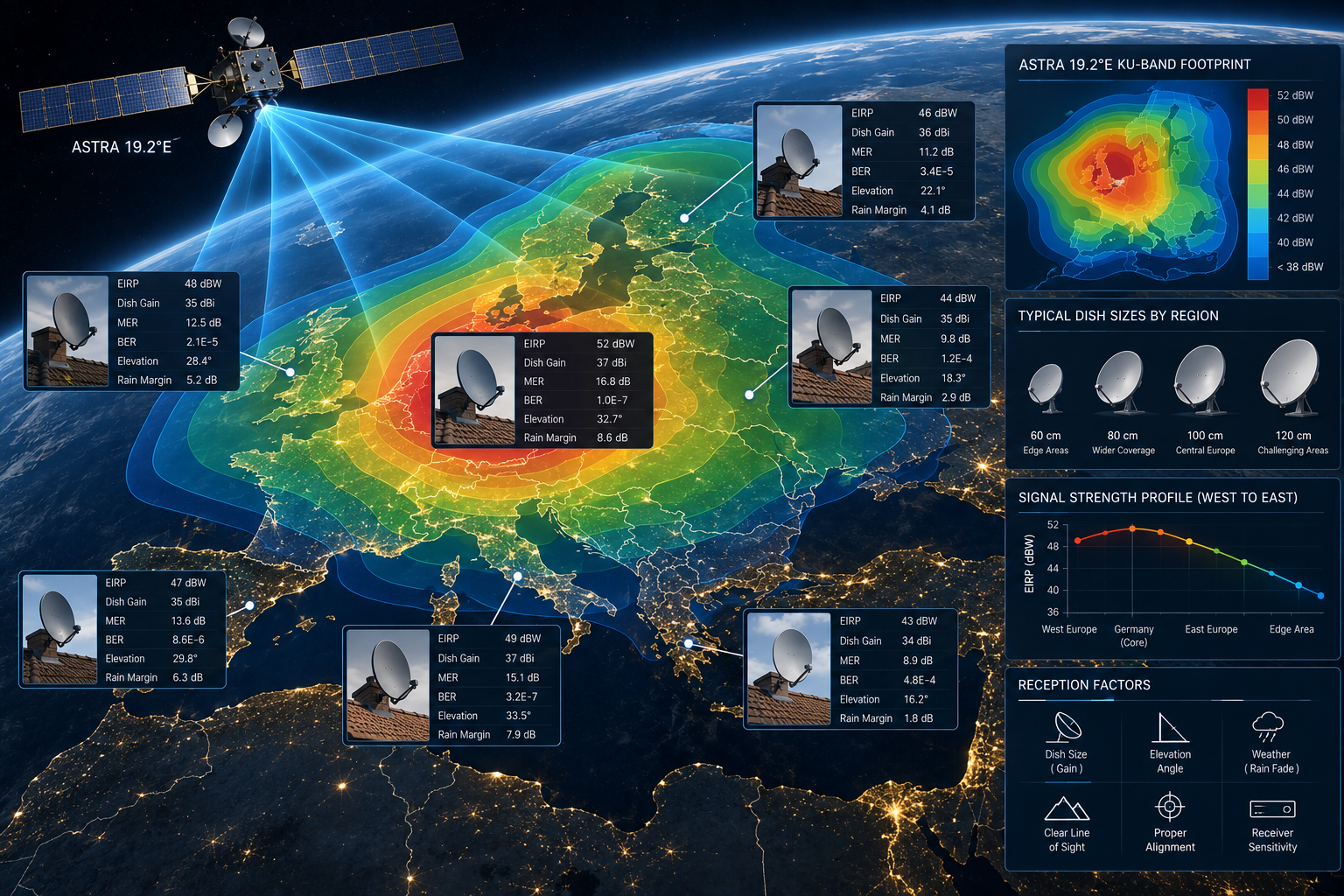
Astra 19.2E can deliver excellent satellite reception in Germany while the same transponder may require a larger dish much farther from the centre of its European coverage area. This does not mean the satellite is randomly changing its power. Satellite antennas deliberately distribute RF energy across geographic footprints, and the amount of usable signal reaching a receiving dish varies according to location, beam design, dish gain, atmospheric conditions, and the complete link budget.
Astra states that its 19.2E television signals cover a broad European area. Within the central coverage zone, Astra says a dish around 60 cm can be sufficient, while reception toward outer footprint areas can require dishes up to around 120 cm. Astra 1P, which entered commercial service at 19.2E in December 2024, is a Ku-band wide-beam satellite designed to strengthen pan-European television coverage from this orbital neighbourhood. :contentReference[oaicite:0]{index=0}
A satellite footprint is not a simple on/off boundary. Inside it are different levels of effective radiated power. Near a strong coverage region, a modest dish can provide substantial signal margin. Closer to the edge, received power can decrease and a larger antenna may be required to recover enough carrier-to-noise performance for reliable DVB-S2 reception.
- What an Astra Satellite Footprint Really Means
- Why Signal Power Is Not Equal Everywhere
- What EIRP Means
- Why the Centre of the Footprint Is Easier to Receive
- Why Dish Size Changes Across Europe
- How Dish Gain Compensates for Weaker Coverage
- Why Astra 19.2E Can Reach Such a Large Area
- How Elevation Angle Changes Across Europe
- Why Weather Matters More Near the Footprint Edge
- Why Signal Margin Is More Important Than Signal Strength
- How MER and BER Reveal the Real Reception Quality
- Why Different Astra Transponders Can Behave Differently
- Why Frequency Matters
- How LNB and Cable Loss Affect Regional Reception
- Why a Larger Dish Does Not Fix Every Problem
- How to Improve Astra Reception in a Marginal Area
- Reality Check
- Final Verdict
- FAQ
What an Astra Satellite Footprint Really Means
A satellite footprint is the geographic area illuminated by a satellite antenna beam.
The spacecraft does not radiate useful television power equally toward every point on Earth. Its antenna system shapes RF energy toward the markets the satellite is designed to serve.
Coverage maps therefore contain contours rather than one perfectly uniform reception zone.
Each contour represents a different level of received satellite power or related coverage performance.
This is why the phrase “inside the Astra footprint” does not guarantee that two households thousands of kilometres apart will receive exactly the same signal level.
Why Signal Power Is Not Equal Everywhere
A satellite has limited RF power.
Its antennas concentrate that energy toward a selected geographic region instead of distributing it uniformly across the entire visible surface of Earth.
The antenna pattern determines where more or less power is delivered.
A location near a strong part of the beam can therefore receive considerably more usable carrier power than a location near an outer coverage contour.
This difference becomes part of the complete satellite link budget and influences how much receiving antenna gain is required.
What EIRP Means
EIRP stands for Effective Isotropic Radiated Power.
In satellite coverage engineering, it is a useful way to describe the effective transmitted power in a particular direction after transmitter power and satellite antenna gain are considered.
Coverage maps often express EIRP in dBW.
Higher EIRP generally means the receiving station can achieve the required link quality with less antenna gain, assuming the other parts of the system remain comparable.
Lower EIRP requires the receiving installation to recover that missing link margin elsewhere, often through a larger dish and careful RF design.
| Reception Factor | Strong Coverage Area | Footprint Edge |
|---|---|---|
| Satellite EIRP | Generally higher | Generally lower |
| Required dish gain | Lower gain may be sufficient | Higher gain may be necessary |
| Dish diameter | Smaller dishes may work reliably | Larger dishes are often beneficial |
| Clear-sky margin | Usually greater | Often smaller |
| Weather tolerance | Usually better | Can become more critical |
| Alignment tolerance | More forgiving when margin is high | Precise alignment becomes increasingly important |
| MER | Can remain comfortably above threshold | May operate closer to the decoding threshold |
| BER during poor conditions | FEC may retain substantial reserve | Errors can increase sooner as margin disappears |
Why the Centre of the Footprint Is Easier to Receive
The central or high-power region of a satellite footprint is normally where reception is most forgiving.
The receiving dish starts with more available carrier power, so the system can tolerate some additional losses without immediately approaching the decoder threshold.
A slightly imperfect cable, moderate rain attenuation, or a small alignment error may therefore remain invisible to the viewer.
The same imperfections can cause much more trouble in a region where the clear-sky link already has limited reserve.
Astra’s own reception guidance illustrates this difference by identifying a central European coverage area where a 60 cm dish can be sufficient and outer areas where substantially larger antennas may be needed. :contentReference[oaicite:1]{index=1}
Why Dish Size Changes Across Europe
A larger parabolic reflector provides greater antenna gain at the same frequency when its efficiency and construction are comparable.
That gain allows the dish to collect more of the incoming microwave energy and concentrate it toward the LNB feed.
In a strong coverage region, that additional gain may not be necessary.
Near the edge of the footprint, however, increasing dish diameter can restore valuable link margin.
Astra specifically notes that approximately 60 cm can be sufficient within its core reception area, while dishes up to around 120 cm may be required in outer footprint regions. :contentReference[oaicite:2]{index=2}
Those figures should be treated as coverage guidance rather than a guarantee for every installation. Local obstruction, installation accuracy, weather, equipment quality, and the exact transponder still matter.
How Dish Gain Compensates for Weaker Coverage
The purpose of increasing dish diameter is not to make the satellite transmit more power.
The satellite remains unchanged.
Instead, the receiving antenna provides more gain.
More antenna gain improves the wanted carrier level relative to the receiving system’s noise contribution, helping the receiver achieve the carrier-to-noise performance needed by the selected modulation and coding configuration.
This is why moving to a larger dish can transform unstable reception into reliable reception in a weak coverage area.
Why Astra 19.2E Can Reach Such a Large Area
Astra 19.2E is designed as a major European television neighbourhood rather than a narrowly targeted local service.
Astra 1P is particularly relevant. SES describes it as the most powerful wide-beam satellite to operate at 19.2E and says it was designed to serve major European television markets from the orbital position. It became fully operational in December 2024 after in-orbit testing. :contentReference[oaicite:3]{index=3}
A wide beam allows the same satellite infrastructure to serve a very large geographic audience.
That does not mean every location receives identical EIRP. Wide coverage still has an engineered antenna pattern with stronger and weaker regions.
How Elevation Angle Changes Across Europe
Astra 19.2E remains at the same geostationary orbital longitude, but viewers across Europe observe it from different geographic coordinates.
The required dish azimuth and elevation therefore change with location.
In some regions the satellite appears relatively high in the sky. In others it is lower above the horizon.
Lower elevation can make local obstacles more problematic because buildings, trees, terrain, or nearby structures are more likely to enter the line of sight.
The atmospheric path geometry also changes, although in normal Ku-band DTH reception the complete link margin and local weather conditions remain more useful practical indicators than elevation alone.
Why Weather Matters More Near the Footprint Edge
Rain attenuates Ku-band satellite signals.
The important question is not simply whether rain creates attenuation. It is how much signal margin existed before the rain began.
Imagine one installation operating several decibels above the required decoding threshold and another operating only slightly above it.
The same additional weather loss can leave the first receiver working normally while pushing the second below its threshold.
This is why viewers near weaker coverage areas can experience rain-related failures more frequently even when the same Astra services remain stable elsewhere in Europe.
Why Signal Margin Is More Important Than Signal Strength
Receiver signal-strength percentages are not standardized engineering measurements.
A display reading of 80 percent on one receiver cannot safely be compared with 80 percent on another model.
What matters is how far the received carrier operates above the minimum quality required by its modulation and coding configuration.
That reserve is the signal margin.
A system with substantial margin can absorb rain fade, small pointing errors, cable ageing, LNB drift, and other impairments before pictures are affected.
A marginal system may look perfect in clear weather but fail suddenly when conditions deteriorate slightly.
How MER and BER Reveal the Real Reception Quality
MER measures how accurately the receiver sees the transmitted modulation constellation.
Noise, interference, phase errors, poor polarization isolation, and other RF impairments move received constellation points away from their ideal positions.
BER measures errors in the recovered digital data.
Forward Error Correction can repair many errors while adequate margin remains.
When MER deteriorates enough, the raw error rate increases until the FEC system can no longer recover the transport stream reliably.
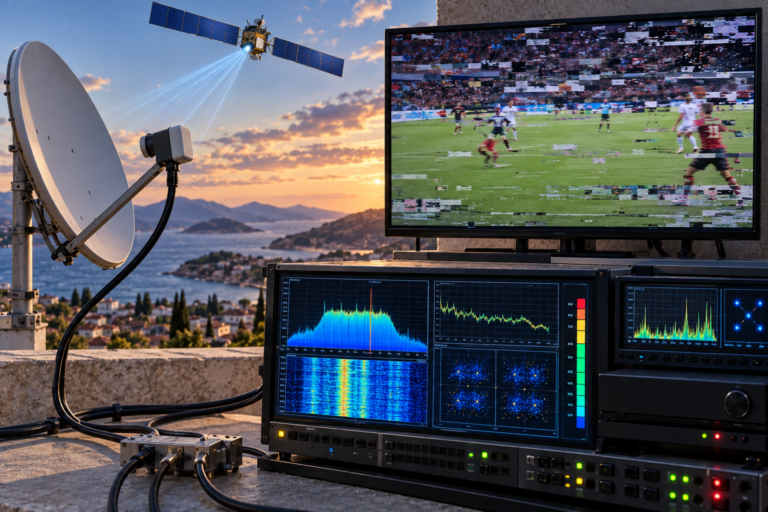
The familiar digital cliff then appears: pixelation, audio breakup, freezing, and finally loss of service.
Why Different Astra Transponders Can Behave Differently
Geographic location is only one part of Astra reception.
Not every transponder uses identical technical parameters.
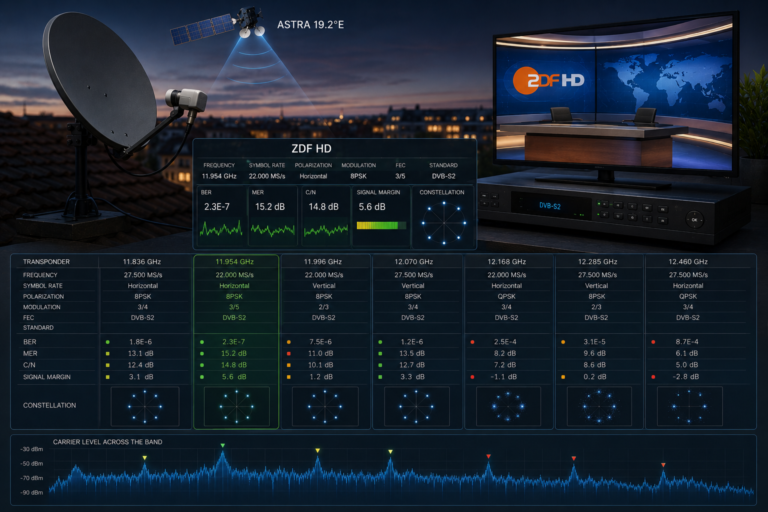
The current Astra 19.2E channel database shows services distributed across different frequencies, polarizations, symbol rates, satellites, and transmission configurations. Current listings include symbol rates such as 22000, 27500, and 29700 depending on the carrier. :contentReference[oaicite:4]{index=4}
Two transponders can therefore have different reception margins at the same house.
A weak installation may receive one group of channels perfectly while another group fails first.
Why Frequency Matters
The receiving installation does not have perfectly flat performance across the entire satellite band.
LNB gain and noise performance can vary with frequency.
Coaxial cable attenuation also generally increases as frequency rises within the intermediate-frequency distribution system.
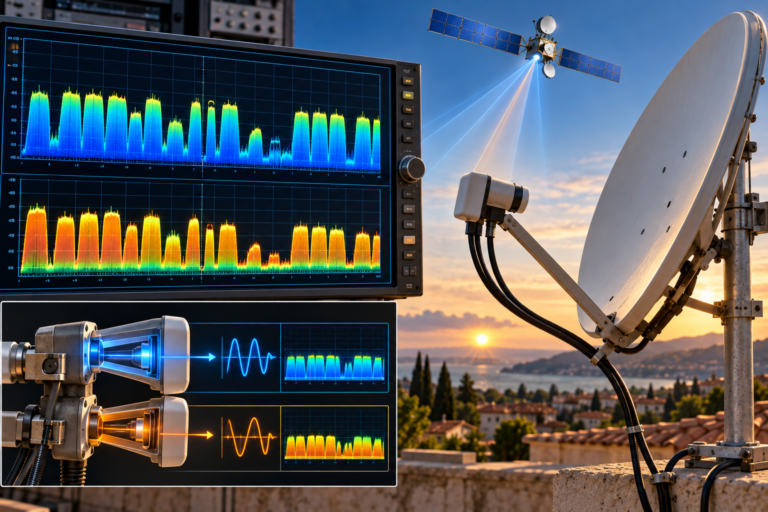
Switches, multiswitches, connectors, amplifiers, and filters can introduce additional frequency-dependent behaviour.
As a result, two Astra carriers with similar satellite coverage can still produce different quality readings at the receiver.
This should not automatically be blamed on the geographic footprint.
How LNB and Cable Loss Affect Regional Reception
A strong satellite footprint can hide weaknesses in a domestic installation.
An ageing LNB, long coaxial cable, corroded connector, poor multiswitch, or incorrect LNB skew may reduce reception quality without immediately causing complete failure.
Move the same equipment to a weaker coverage area and the missing margin becomes much more important.
This is why reception reports from different countries must be interpreted carefully.
Two users can live in similar coverage contours yet experience different results because one installation has a larger dish, lower cable loss, better polarization alignment, or a healthier LNB.
Why a Larger Dish Does Not Fix Every Problem
A larger reflector is extremely useful when insufficient antenna gain is the real limitation, but it cannot solve every satellite fault.
If a tree blocks the line of sight, simply increasing dish diameter does not remove the obstruction.
If the receiver cannot decode DVB-S2 or the required codec, more RF gain will not add that missing compatibility.
If the wrong satellite is being received, a larger dish can actually make alignment more demanding because its beamwidth is narrower.
Similarly, incorrect LNB polarization or defective distribution hardware still requires direct correction.
How to Improve Astra Reception in a Marginal Area
Begin with the coverage conditions for the intended location and use an appropriately sized dish rather than assuming that a small antenna suitable for central Europe will work equally well everywhere.
Confirm an unobstructed line of sight toward 19.2E.
Then optimize azimuth, elevation, and LNB skew using MER or another reliable digital quality measurement.
Inspect the coaxial path and remove unnecessary losses. Use good connectors, weatherproof outdoor connections, and check multiswitches or DiSEqC equipment where present.
Test multiple transponders across different frequencies and both polarizations. Optimizing only one strong carrier can hide problems elsewhere in the band.
Most importantly, design for clear-sky margin rather than merely achieving a picture. A receiver that works only just above threshold has very little protection against weather or normal system variation.
For the wider engineering context behind this orbital position, see why Astra 19.2E is Germany’s most important satellite, including how its European television neighbourhood, colocated spacecraft, transponders, and broadcast infrastructure work together.
Astra signal does not simply become weak because a viewer crosses a national border.
Satellite beams follow engineered antenna footprints, not political boundaries. Two cities in different countries can have similar reception conditions, while two locations within the same country can have different elevation, obstruction, weather, and installation conditions.
Astra’s own guidance illustrates the broader geographic effect: around 60 cm can be sufficient in its central coverage area, while outer footprint locations can require antennas up to approximately 120 cm. :contentReference[oaicite:5]{index=5}
The correct engineering question is therefore not “Which country am I in?” but “What link margin is available at this location for this transponder with this receiving system?”
Astra signal changes across Europe because a geostationary satellite distributes finite RF power through a shaped antenna footprint rather than illuminating the continent uniformly.
Locations inside stronger coverage contours can achieve reliable reception with relatively modest antenna gain. As received EIRP decreases toward outer coverage areas, larger dishes and more careful installation become increasingly important.
But geography is only part of the equation. Transponder frequency, modulation and coding, dish gain, LNB performance, polarization alignment, cable loss, interference, rain attenuation, MER, BER, and clear-sky margin all determine whether the receiver remains above its digital decoding threshold.
The most accurate way to understand Astra reception is therefore through the complete link budget. The satellite footprint determines how much signal arrives in the region, while the receiving installation determines how effectively that signal is converted into reliable television.
| Question | Answer |
|---|---|
| Why is Astra stronger in some parts of Europe? | The satellite antenna distributes RF energy through a shaped footprint with different EIRP levels across the coverage area. |
| Does Astra 19.2E cover Europe? | Yes. Astra describes 19.2E as providing broad European television coverage, with reception conditions varying between its central and outer footprint areas. :contentReference[oaicite:6]{index=6} |
| What dish size is needed for Astra 19.2E? | Astra says around 60 cm can be sufficient in its central coverage area, while dishes up to around 120 cm can be needed toward outer footprint regions. Actual requirements depend on the installation and location. :contentReference[oaicite:7]{index=7} |
| What is EIRP? | Effective Isotropic Radiated Power describes the effective transmitted power in a particular direction after transmitter power and antenna gain are considered. |
| Does a larger dish make the satellite signal stronger? | It does not change satellite transmit power. It provides greater receiving antenna gain, improving the available link margin. |
| Why does rain affect weak coverage areas more? | Those installations may have less clear-sky margin, so additional rain attenuation can push the carrier below the decoding threshold sooner. |
| Is signal strength percentage enough to judge reception? | No. Receiver percentages are not standardized. MER, BER, carrier quality, and available signal margin provide more useful information. |
| Why can one Astra transponder work while another fails? | Transponders can differ in frequency, polarization, modulation, coding, satellite payload, and resulting reception margin. |
| Does every location inside the footprint receive the same signal? | No. A footprint contains different coverage levels rather than one uniform signal value. |
| Does crossing a country border suddenly change Astra reception? | No. Satellite coverage follows beam contours, not national borders. |
| Is Astra 1P a spot-beam satellite for German TV? | Astra 1P is described by SES as a powerful Ku-band wide-beam satellite serving the 19.2E European television neighbourhood. :contentReference[oaicite:8]{index=8} |
| What is the best way to improve weak Astra reception? | Use adequate dish gain, precise alignment and LNB skew, minimize cable and distribution losses, verify clear line of sight, and maximize digital quality and clear-sky margin across multiple transponders. |