Why Satellite Phones Need Huge Antennas but Your Smartphone Doesn’t
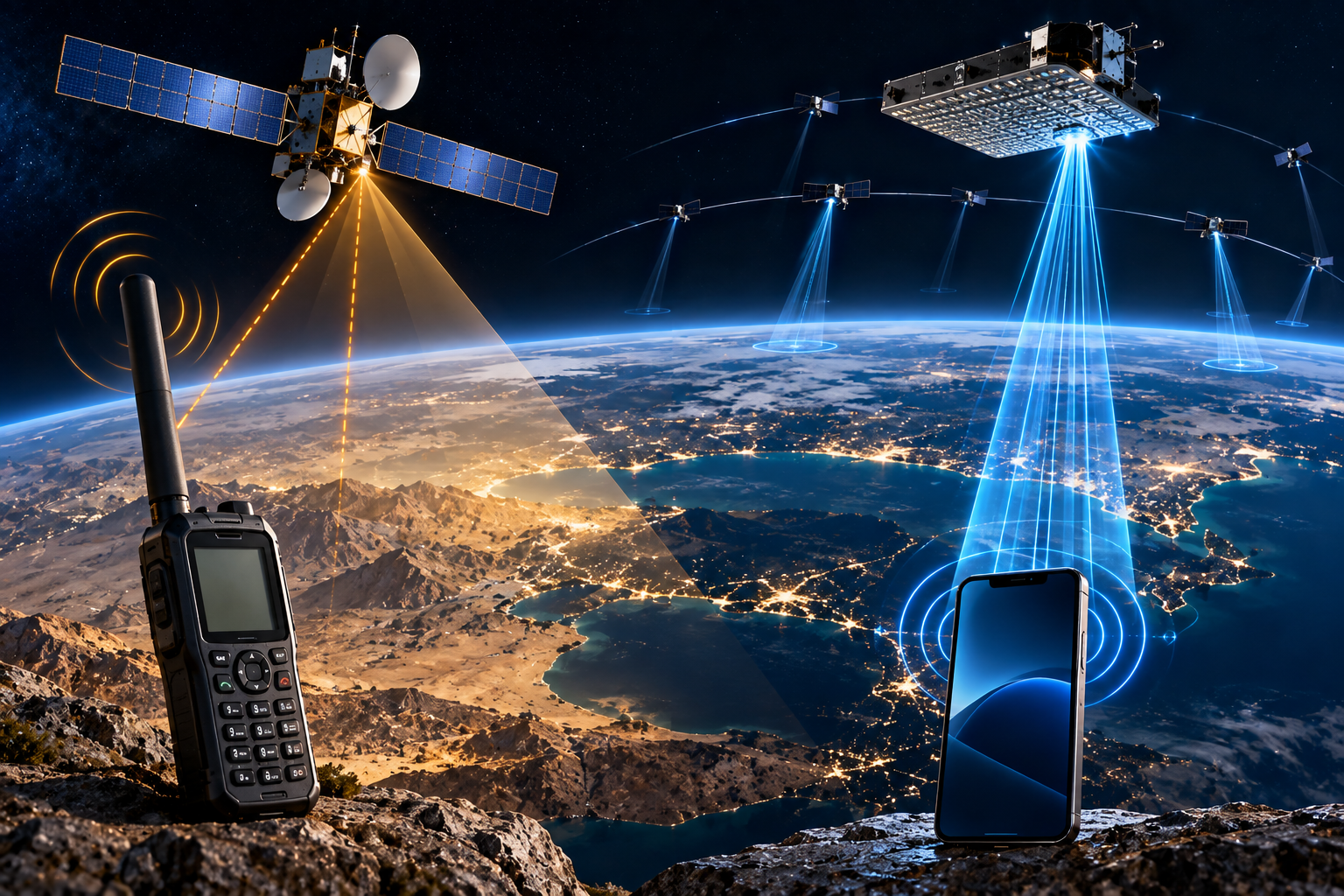
For decades, connecting directly to a satellite meant using specialized hardware. Satellite phones often had visible external antennas, dedicated radio systems and designs very different from ordinary mobile phones. Yet a new generation of satellite networks is being built to communicate directly with smartphones that were originally designed for terrestrial cellular networks.
That can sound like the antenna problem has somehow disappeared. It has not. The physics of transmitting a weak radio signal over hundreds of kilometers still applies. The major change is where engineers solve the problem. Instead of demanding a much larger antenna from the person holding the phone, modern direct-to-device systems can move much of the RF challenge into the satellite, its antenna array, its orbit and the surrounding network architecture.
An ordinary smartphone does not suddenly become a powerful satellite terminal. Its antenna remains small and its transmit power remains limited. Modern direct-to-device networks compensate through technologies such as low Earth orbit, high-gain satellite antennas, phased arrays, beamforming, signal processing and integration with mobile operator spectrum and infrastructure.
- Why Traditional Satellite Phones Look Different
- The Smartphone Has a Much Harder RF Limitation
- The Real Problem Is the Link Budget
- Why Low Earth Orbit Changes the Equation
- The Huge Antenna Moved Into Space
- Why Phased Arrays Matter
- The Smartphone Uplink Is the Difficult Part
- The Satellite Must Reach the Phone Too
- Why Mobile Spectrum Matters
- The Ground Network Has Not Disappeared
- Why Not Every Phone Can Connect Everywhere
- Will Smartphones Replace Satellite Phones?
- Reality Check
- Final Verdict
- FAQ
Why Traditional Satellite Phones Look Different
Traditional satellite phones were designed specifically for satellite communication rather than primarily for terrestrial cellular networks.
That design freedom matters.
A manufacturer can choose an antenna system, radio front end, enclosure and operating procedure around the requirements of the satellite network. Many familiar satellite handsets therefore use prominent antennas that extend away from the body of the phone.
Ordinary smartphones face a very different set of constraints.
Consumers expect a thin device containing multiple cellular antennas, Wi-Fi, Bluetooth, GNSS, cameras, batteries and other electronics. There is little room for a large dedicated satellite antenna extending from the handset.
Traditional satellite-phone architecture therefore solved more of the RF problem at the terminal.
Modern direct-to-device networks are trying to reverse that relationship.
The Smartphone Has a Much Harder RF Limitation
A modern smartphone is an impressive radio device, but it was fundamentally designed around terrestrial cellular infrastructure.
A nearby cellular base station can use substantial infrastructure: elevated antennas, sectorized coverage, carefully planned sites, high-performance receivers and a connection to the operator’s core network.
The phone itself can remain small and power efficient.
Put the base station hundreds of kilometers above Earth and the geometry changes dramatically.
The smartphone still has its compact antenna. It still has limited battery power. It still needs to remain safe, portable and compatible with cellular regulations.
You cannot simply increase handset transmit power by enormous amounts to overcome the extra distance.
Instead, the satellite system has to become exceptionally good at receiving a weak handset signal.
The Real Problem Is the Link Budget
The engineering question behind satellite-to-phone connectivity is not simply, “Can the satellite see the phone?”
The better question is:
Can enough usable signal survive the complete radio path for both ends to decode each other reliably?
This is a link-budget problem.
A simplified satellite link includes transmitter power, transmitting antenna gain, propagation loss, receiving antenna gain, receiver noise characteristics and the signal quality required by the selected waveform and coding scheme.
Distance creates substantial free-space path loss.
The smartphone cannot eliminate that loss, so other parts of the system must compensate.
| Traditional Approach | Modern Direct-to-Device Approach |
|---|---|
| Specialized satellite handset | Can target ordinary cellular smartphones |
| Dedicated handset antenna | Uses the phone’s existing compatible radio hardware |
| Terminal designed around satellite network | Satellite network adapts more heavily to handset limitations |
| Specialized satellite service architecture | Can integrate with mobile operator networks |
| Satellite-specific user equipment | Large RF infrastructure can move into orbit and gateways |
Why Low Earth Orbit Changes the Equation
Distance is one of the most important reasons modern direct-to-device systems often use low Earth orbit, or LEO.
A satellite in LEO is dramatically closer to the user than a geostationary satellite almost 36,000 kilometers above the equator.
Direct-to-device architectures vary, but some current systems operate at altitudes of only several hundred kilometers. Vodafone, for example, reported using an AST SpaceMobile LEO satellite at roughly 500 kilometers altitude during its direct-to-smartphone demonstration. :chatgpt-content-reference{index=”0″}
Reducing the path distance helps the radio link and latency, but LEO introduces its own engineering challenges.
The satellites move rapidly relative to users on Earth. Coverage changes continuously, Doppler shift must be managed, and the network must track users across moving beams and satellites.
So LEO does not make the problem easy.
It makes a previously difficult link more practical while introducing a different set of network problems.
The Huge Antenna Moved Into Space
This is the key idea behind one of the most striking direct-to-device architectures.
If you cannot put a huge antenna on the smartphone, put an enormous high-performance antenna on the satellite.
AST SpaceMobile provides a clear real-world example. The company says its BlueBird 1-5 satellites use phased arrays of 693 square feet, while its next-generation BlueBirds use arrays of approximately 2,400 square feet. The stated reason for these unusually large arrays is directly related to the low power and small antennas of standard mobile phones. :chatgpt-content-reference{index=”1″}
A larger effective antenna aperture can provide more antenna gain.
On receive, that helps the satellite extract the weak signal arriving from the handset.
On transmit, a high-gain array can concentrate RF energy toward a particular geographic coverage area rather than spreading it equally in every direction.
The smartphone did not defeat the antenna problem. In some direct-to-device architectures, engineers effectively moved a large part of that antenna problem from your pocket into orbit.
Why Phased Arrays Matter
A huge antenna alone is not enough.
Modern direct-to-device satellites can use phased-array technology to electronically shape and steer beams.
Instead of physically rotating a large dish toward every individual coverage area, many antenna elements operate together with controlled phase relationships.
This allows the system to create focused beams toward geographic cells on Earth.
Beamforming provides two major advantages.
First, it concentrates useful RF energy where it is needed.
Second, multiple beams can support frequency reuse and divide a very large satellite footprint into smaller service areas.
AST says its large arrays create focused beams while its onboard processing supports many coverage cells. :chatgpt-content-reference{index=”2″}
This begins to explain why describing a direct-to-device satellite simply as “a phone tower in space” is useful for visualization but incomplete from an engineering perspective.
The orbital radio system must compensate for a link that terrestrial mobile networks were never originally required to close over such distances.
The Smartphone Uplink Is the Difficult Part
It is easy to imagine a powerful satellite transmitting down toward Earth.
The reverse path is more surprising.
A battery-powered smartphone must transmit upward, and the satellite must recover that weak signal after substantial propagation loss.
AST explicitly describes its large phased arrays as necessary to capture the weak signal from standard mobile phones. :chatgpt-content-reference{index=”3″}
That makes the uplink one of the most interesting engineering problems in direct-to-device communication.
The satellite’s receiving system needs sufficient antenna gain and receiver performance, while the network must also deal with timing and frequency effects created by a rapidly moving spacecraft.
Doppler is particularly important.
As a LEO satellite rapidly approaches and then moves away from a user, the apparent received frequency shifts. Network architecture and signal processing must compensate for these effects sufficiently for the cellular link to remain usable.
This subject deserves its own deeper analysis because the weak smartphone uplink is where much of the apparent “magic” of satellite-to-phone communication disappears into RF engineering.
The Satellite Must Reach the Phone Too
Solving the uplink does not automatically solve the downlink.
The phone also needs to receive the satellite transmission using its compact antenna and normal radio hardware.
Again, beamforming and satellite antenna gain become valuable.
Instead of transmitting energy broadly across an enormous area with little concentration, a satellite can form targeted beams toward specific geographic cells.
The system still operates under a finite link budget.
Obstructions, device orientation, spectrum choice, interference and environmental conditions can influence the available margin.
This is one reason direct-to-device coverage should not be interpreted as a guarantee that an ordinary smartphone will behave identically outdoors, inside a concrete building, inside a vehicle and beneath heavy obstructions.
Why Mobile Spectrum Matters
The antenna is only one piece of the compatibility puzzle.
An ordinary smartphone contains radio hardware designed to operate in particular cellular frequency bands and according to supported network technologies.
A direct-to-device system therefore needs a spectrum strategy compatible with its devices, operators and regulatory environment.
Some architectures work with spectrum licensed to partner mobile network operators. Others can use spectrum associated with mobile-satellite services or standardized NTN approaches.
The industry is not based on one universal D2D radio architecture.
Ericsson, for example, distinguishes between approaches that extend connectivity to unmodified 4G devices and newer 3GPP NTN implementations designed around standardized non-terrestrial capabilities introduced from Release 17 onward. :chatgpt-content-reference{index=”4″}
This distinction is important because saying that “any smartphone can now connect to any satellite” would be incorrect.
Hardware capability, frequency support, network agreements, standards, software and regulatory authorization all matter.
The Ground Network Has Not Disappeared
Satellite-to-phone sounds like a direct connection between two devices: satellite and smartphone.
That describes the radio access link but not the entire communication path.
Traffic still needs to reach the wider telecommunications network.
In AST’s published architecture, the phone communicates with the satellite, which relays the connection through a ground gateway and into a partner mobile operator’s network. The company also describes gateway processing used to compensate for delay and Doppler effects. :chatgpt-content-reference{index=”5″}
The complete path can therefore involve:
Smartphone → Satellite → Ground Gateway → Mobile Operator Network → Destination
This is another reason the satellite should not be viewed as a completely independent replacement for terrestrial telecommunications infrastructure.
It becomes another access layer connected to the wider network.
Why Not Every Phone Can Connect Everywhere
The phrase “ordinary smartphone connects to satellite” needs an important qualification.
Direct-to-device availability depends on the specific service architecture.
A compatible device still needs access to the appropriate radio technology and frequencies. The satellite operator needs suitable coverage. The mobile operator may need a commercial and technical integration. Regulators must authorize spectrum use in the country concerned.
The service itself may also differ.
One system may initially support messaging, another may support voice, and another may target broadband data.
3GPP NTN-capable devices represent another path in which handsets gain features specifically designed for non-terrestrial networks. The European Space Agency notes that NTN standardization beginning with 3GPP Release 17 is an important part of integrating terrestrial and satellite connectivity. :chatgpt-content-reference{index=”6″}
So the disappearance of the giant handset antenna does not mean the disappearance of compatibility requirements.
Will Smartphones Replace Satellite Phones?
Direct-to-device technology will reduce the need for specialized terminals in some situations, but it does not automatically make dedicated satellite equipment obsolete.
Different systems are optimized for different missions.
Professional maritime, aviation, emergency, industrial and remote communications can require specialized antennas, higher reliability, particular network capabilities or equipment designed for extreme environments.
A consumer smartphone connected through D2D solves a different problem: extending familiar mobile connectivity into areas where terrestrial cellular coverage is missing or unavailable.
The most significant change is therefore not that every satellite phone is becoming unnecessary.
It is that satellite connectivity is becoming available to a category of device that historically depended almost entirely on terrestrial base stations.
Reality Check
Modern smartphones do not connect to satellites because their tiny internal antennas suddenly became equivalent to large satellite antennas.
The radio link is being redesigned around the limitations of the smartphone.
Low Earth orbit can reduce path distance. Large orbital phased arrays can provide substantial antenna gain. Beamforming can concentrate coverage. Advanced processing can compensate for satellite motion, and integration with mobile operators can allow compatible cellular radio technology to participate in the service.
There is also no single architecture that describes every satellite-to-phone system. Some services target unmodified cellular devices, while standardized NTN capabilities are increasingly being incorporated into newer devices and networks. :chatgpt-content-reference{index=”7″}
The correct question is therefore not “Why doesn’t the smartphone need an antenna?” It already has antennas. The question is how the rest of the network became capable enough to work with antennas that were never designed to look like traditional satellite-phone hardware.
Final Verdict
The giant satellite antenna did not disappear. In some modern direct-to-device systems, much of it effectively moved from the handset into space.
Traditional satellite phones could use specialized antennas and radios because the entire handset was designed around a satellite service. Ordinary smartphones are constrained by size, battery life, cellular standards and compact internal antennas.
Direct-to-device engineering attacks the problem from the opposite end of the link.
Put the satellite closer in LEO. Give it a high-gain phased array. Form focused beams. Build receivers capable of detecting weak handset transmissions. Compensate for Doppler and timing. Connect the satellite layer back into terrestrial mobile networks through gateways.
The result is one of the biggest changes in satellite communications: instead of asking consumers to carry specialized satellite hardware, the network is increasingly being engineered to reach devices they already carry.
Frequently Asked Questions
| Question | Answer |
|---|---|
| Why do satellite phones have large antennas? | Traditional satellite handsets are purpose-built for direct satellite communication, so their antenna and radio design can be optimized specifically for the satellite link rather than hidden inside a thin consumer smartphone. |
| Does a smartphone need an antenna to connect to a satellite? | Yes. Smartphones already contain multiple internal antennas. Direct-to-device systems use compatible handset radio hardware rather than eliminating the need for an antenna. |
| How can a satellite hear such a weak smartphone signal? | Some systems use large high-gain phased arrays, focused beams, sensitive receivers and advanced signal processing to compensate for the limited transmit power and small antenna of the handset. |
| Why does low Earth orbit help satellite-to-phone communication? | LEO satellites are much closer to Earth than geostationary satellites, reducing path distance and helping the link budget, although their rapid movement introduces Doppler, tracking and handover challenges. |
| What is a phased-array satellite antenna? | It is an antenna made from many coordinated elements that can electronically shape and steer radio beams without mechanically pointing a large reflector toward each coverage area. |
| Is the uplink from the phone harder than the downlink? | The uplink is particularly challenging because a battery-powered smartphone transmits with limited power and a small antenna. The satellite must recover that weak signal after substantial propagation loss. |
| Can any smartphone connect directly to any satellite? | No. Device radio support, frequency bands, network technology, operator integration, satellite coverage, service availability and regulatory authorization all matter. |
| Is direct-to-device the same as 5G NTN? | Not always. Direct-to-device is a broader concept. Current architectures include approaches designed for existing cellular devices as well as standardized 3GPP NTN technologies supported by newer devices. |
| Does satellite-to-phone eliminate ground stations? | No. Many architectures use ground gateways to connect the satellite radio layer with mobile operator networks and the wider telecommunications infrastructure. |
| Will ordinary smartphones replace dedicated satellite phones? | They can reduce the need for specialized handsets in some use cases, but professional satellite equipment can still offer capabilities and reliability requirements designed for specific maritime, aviation, emergency or industrial applications. |